

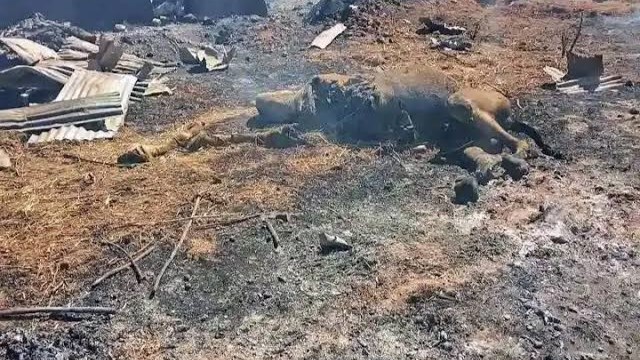
SEVERAL persons are feared killed, with many others injured, following a suspected accidental airstrike on Jilli Market near Fuchimiram village in Geidam Local Government Area of Yobe State, in an incident that has triggered outrage and renewed concerns over civilian safety in military operations.

News Point Nigeria reports that Jilli, a border community with Damasak in Borno State, lies more than 200 kilometres from Damaturu, the Yobe State capital, and serves as a bustling weekly market attracting traders and buyers from surrounding communities including Gubio, Chiweram, and Benisheikh in Borno, as well as Gurokayeya and Geidam in Yobe State.
The incident, which occurred on Saturday, was reported by residents and local sources, although initial details remained unconfirmed at the time.


According to a resident who spoke on condition of anonymity, the strike happened while traders were engaged in their normal business activities at the market, turning what should have been a routine trading day into a scene of chaos and devastation.
Eyewitnesses described panic as explosions rang out across the market. One source said the attack occurred at about 2:46 p.m., when multiple fighter jets were seen overhead.
“Four fighter jets carried out the attack, though the fourth jet was not clearly visible. We only heard the sound of explosions,” the eyewitness said.
The source added that he counted at least 56 bodies at the scene and helped rescue two injured persons who were taken to hospital, noting that the death toll could rise as more bodies were still being recovered.
Multiple local sources said the fighter jet had been tracking suspected Boko Haram insurgents believed to have moved into the market to collect levies from traders and obtain supplies, but the strike reportedly missed its intended target.
Another eyewitness who visited the Geidam Specialist Hospital and shared images said the facility’s Accident and Emergency unit had become overstretched, as injured victims continued to arrive for urgent medical attention.

Hospital sources indicated that no fewer than 14 people were receiving treatment, while other reports suggested that over 20 victims had been admitted, with some later referred to the Teaching Hospital in Damaturu.
The councillor of Fichimaram Ward, Malam Lawan Zanna, confirmed the incident, stating that the airstrike hit the weekly market in Jilli village under his ward.
“When the jets launched their attack, people panicked and began to run, but the strikes continued. As we speak, over 30 people have been killed,” he said.


He added that more than 20 people were hospitalised in Geidam, while two were referred to Damaturu, noting that some of those receiving treatment had died, pushing the casualty figures higher.
Meanwhile, the Special Adviser to the Yobe State Governor on Security Matters, Brigadier General Abdulsalam Dahiru (rtd), confirmed the incident but clarified that the location falls within Borno State’s Gubio Local Government Area.
“I have spoken with the chairman of Geidam Local Government, who informed me that Jilli village falls under Gubio LGA of Borno State. You may contact officials in Maiduguri for further details,” he said.
Amid the confusion, the Nigerian Air Force (NAF) confirmed that it carried out air operations in the Jilli axis, although it did not confirm civilian casualties.
In a statement signed by its Director of Public Relations and Information, Air Commodore Ehimen Ejodame, the NAF said it conducted precision follow-up mop-up airstrikes on identified terrorist locations within the Jilli axis of Borno State on April 11, 2026.
According to the statement, the mission formed part of a coordinated air-ground operation with the Nigerian Army under Operation HADIN KAI, targeting fleeing insurgents and regrouping cells in the area.
“Coming amid intensified efforts to track and neutralise terrorist elements responsible for recent attacks on security forces within the wider theatre, the follow-on strikes were aimed at fleeing remnants and regrouping cells seeking to exploit the difficult terrain,” the statement said.
The Air Force added that the operation was based on credible intelligence and was aimed at consolidating earlier gains, denying terrorists freedom of movement, and preventing attacks on both military positions and civilian communities.
It also stated that the strikes were part of ongoing efforts to secure lives, protect property, and stabilise vulnerable areas across Borno State and the wider North-East region.
However, the statement made no reference to casualties or to the incident reported by residents at the market.
As of the time of filing this report, there had been no official confirmation from the Nigerian Air Force regarding the civilian casualties linked to the strike.
The development has drawn strong reactions, including condemnation from former Vice-President Atiku Abubakar, who described the incident as a tragic failure.
Atiku said the airstrike, which targeted insurgents, once again resulted in innocent civilians being reduced to collateral damage, raising serious concerns about the safety of Nigerians amid ongoing counter-insurgency operations.
“The Jilli market airstrike that killed scores of innocent traders is not just tragic, but a devastating failure that must outrage every conscience,” he said.
He questioned the recurring pattern of civilian casualties, asking how long Nigerians would remain unsafe both from terrorists and from the very operations meant to protect them.
Drawing comparisons with international military conduct, he cited a recent United States operation in which over 150 aircraft were deployed and an estimated $300 million spent to rescue a single pilot, underscoring what he described as the high value placed on one citizen’s life.
“Here at home, we must ask: what is the value of Nigerian lives? This demands urgent review, accountability, and decisive action to prevent a recurrence,” he added.
He also extended condolences to bereaved families and affected communities, stressing that Nigeria must uphold its responsibility to protect its citizens, which he described as the ultimate essence of national security.
The incident marks yet another troubling episode in Nigeria’s counter-insurgency efforts, highlighting the delicate balance between targeting armed groups and safeguarding civilian lives, while raising fresh concerns over operational accuracy and accountability in military engagements.