

IN an era defined by interconnectedness, universities worldwide are reimagining the boundaries of knowledge, research, and innovation. Maryam Abacha American University of Nigeria (MAAUN) exemplifies this global vision through its robust international faculty network, strategic partnerships, and commitment to cross-border education that fosters leadership, research excellence, and societal impact.
Global Academic Footprint
MAAUN has established a remarkable global presence across six continents and more than fifty countries, leveraging the expertise of over 100 international scholars. This diverse academic environment encompasses a spectrum of disciplines including Computing & Artificial Intelligence, Engineering, Health Sciences, Social & Management Sciences, Education, Mathematics, Physics, Law, and Public Policy.


The university’s honorary adjunct faculty hail from world-renowned institutions such as Indiana State University, Zhejiang University, University of Warwick, Universiti Sains Malaysia, ESPM University and Morgan State University.
This global engagement ensures that MAAUN students and faculty benefit from contemporary pedagogical practices, cutting-edge research insights, and mentorship from leaders in their respective fields.
MAAUN’s approach is not merely about geographic diversity; it is a strategic integration of global knowledge with local relevance. International faculty contribute to:
Curriculum development:
Embedding global best practices and standards in all programs.
Research collaboration: Conducting interdisciplinary projects that address pressing global and local challenges.
Student mentorship: Guiding postgraduate research, fostering critical thinking, and preparing students for international careers.
Capacity building: Providing faculty development and training to elevate local academic excellence.
Through these mechanisms, MAAUN bridges the gap between theoretical knowledge and practical societal applications, fostering graduates who are globally competent yet locally impactful.

Continental Representation And Impact
MAAUN’s faculty network reflects its commitment to global inclusion:
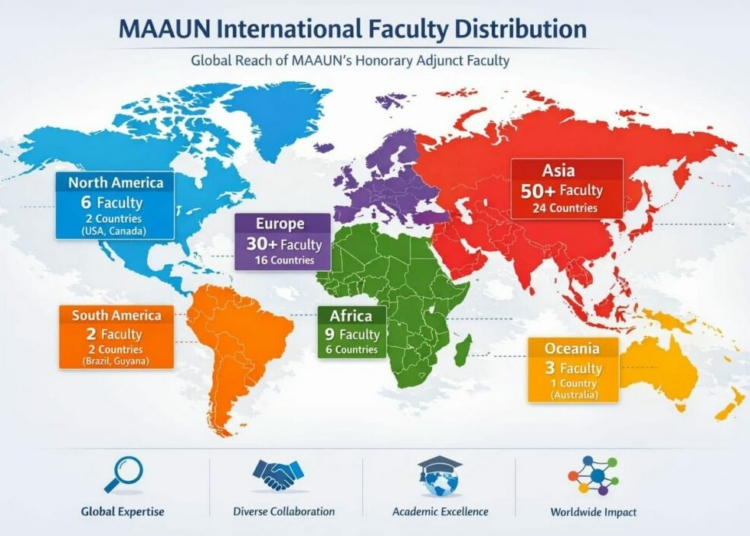
* Asia: 50+ faculty across 24 countries, driving innovation in technology, health, and education.
• Europe: 30+ faculty from 16 countries, contributing to social sciences, finance, and AI research.
• Africa: 9 faculty from 6 countries, advancing applied sciences and public health initiatives.
• North America: 6 faculty, enriching business, computing, and engineering programs.
• South America: 2 faculty, focusing on marketing, finance, and interdisciplinary research.
• Oceania: 3 faculty in technology and applied mathematics.
This continental diversity is central to MAAUN’s mission of fostering inclusive, globalized education that reflects multiple perspectives and cultures.
Global Research And Knowledge Exchange


MAAUN’s international faculty network has catalyzed numerous research initiatives addressing global challenges, including Artificial Intelligence and Emerging Technologies, Sustainable Health Solutions and Biomedical Research, Cross-Cultural Management and Leadership, Education Innovation and Curriculum Globalization andbApplied Mathematics, Physics, and Environmental Sciences
Such research is not confined to academic circles but actively informs policy, industry practices, and community development initiatives across Nigeria and beyond.
A Model For The 21st Century University
MAAUN demonstrates that excellence in higher education is inherently global and collaborative. Its strategic internationalization positions it as a beacon for universities aiming to:
* Elevate academic standards through global collaboration
• Build a diverse, interdisciplinary faculty and research network
• Produce graduates capable of thriving in a competitive, interconnected world
• Align local education with global innovation ecosystems
By fostering partnerships that transcend borders, MAAUN embodies the future of education: inclusive, research-driven, globally connected, and socially impactful.
Conclusion
Maryam Abacha American University of Nigeria is more than an academic institution; it is a platform for global learning, innovation, and societal transformation. Its international faculty network exemplifies how universities in Africa can achieve global relevance while serving local communities. As higher education continues to globalize, MAAUN stands as a model of how strategic collaboration, diversity, and excellence can reshape the future of knowledge and leadership.
- Sufi, wrote in from Abuja.