

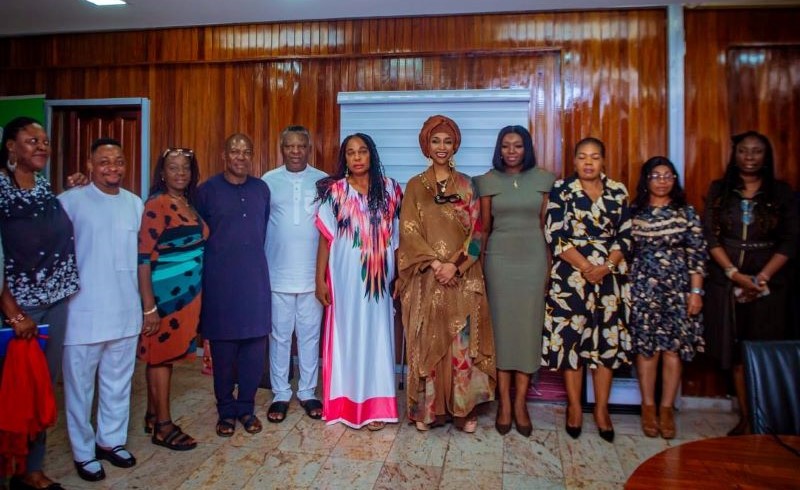
THE Minister of Art, Culture, Tourism and Creative Economy has inaugurated four drafting committees—Policy & Strategy; Programmes & Implementation; Stakeholder Engagement; and Monitoring & Evaluation—to design policy and financing frameworks for Nigeria’s arts, culture, tourism and creative economy.
According to a statement sent to News Point Nigeria on Monday by her Special Adviser on Media and Publicity, Dr. Nneka Ikem Anibeze, at Tuesday’s inauguration in Abuja, Musawa said the creative sector commands global attention yet accounts for only about 2.3% of national output, constrained by fragmented governance, weakly enforced intellectual-property rules, and scarce financing. Under President Tinubu’s Renewed Hope agenda, the ministry has set two headline goals: a ₦100 billion contribution to GDP and two million jobs for young Nigerians by 2030.
“You are charged with reviewing our existing institutional architecture and proposing a coherent governance framework that eliminates fragmentation, clarifies responsibilities, and positions the creative economy as a pillar of national development. The creatives, entrepreneurs, and young Nigerians who depend on this sector deserve no less than your very best”, she said, urging members to treat the work as nation-building, not rhetoric.


Each committee will submit terms of reference and a 90-day work plan by 21 April 2026, with quarterly public briefings to follow. She thanked partners including NESG, UNESCO and UNDP for technical backing.
In his remarks, Dr Ikenna Nwosu, the CEO of the Nigerian Economic Summit Group, welcomed the move, stating that the creative economy is not just a cultural asset.
“The Creative Economy is a powerful economic frontier. Across the world, nations are leveraging their creative industries to drive innovation, create jobs, expand exports, and strengthen their global influence. Nigeria, with its immense talent, rich heritage, and global cultural footprint, is uniquely positioned to lead this transformation on the African continent.
“These committees are not just advisory bodies; they are engines of reform and innovation. They are tasked with developing practical, evidence-based work plans that will shape policy, unlock investments, and drive implementation,” Dr Nwosu said.
He noted that finance gaps, weak IP protection, infrastructure shortfalls and fragmented policies have long constrained the sector, and charged the committees to produce practical, evidence-based plans covering priorities, timelines, financing mechanisms and responsibilities.
The four committees will work in parallel: an inter-ministerial technical team to redesign governance so ministries operate from one playbook; a policy team to draft Nigeria’s first comprehensive creative-economy policy; a financing group to close funding gaps through fiscal and non-fiscal measures, stronger IP protection, PPPs and a Creative Economy Development Fund; and a planning group to convene an international summit that showcases Nigeria as a serious creative-economy partner.

The ministry reaffirmed its commitment to co-create policies that unlock investment, spur innovation and anchor diversification in the creative sectors.
