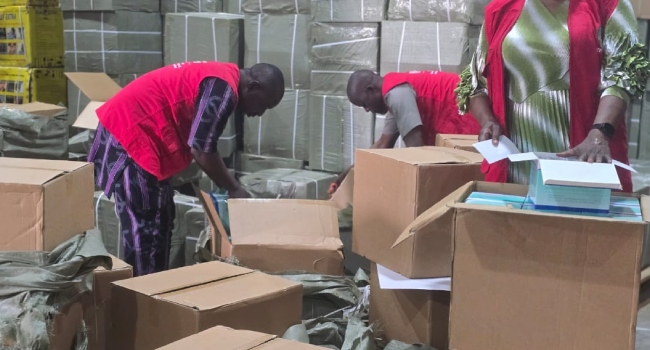

THE National Agency for Food and Drug Administration and Control (NAFDAC) has commenced investigations into concerns over the safety of disposable sanitary pads in Nigeria, including claims about potentially harmful chemicals in some products.
The agency said it had also initiated a vigilance activity to assess the presence of volatile organic compounds (VOCs) in selected sanitary pads with NAFDAC marketing authorisation.

Read also: EFCC Arrests Abuja Businessman Over Alleged $120m Fraud Involving Ukrainian Investor
News Point Nigeria reports that the move comes amid growing concerns on social media over the safety of menstrual products and calls for greater transparency on their chemical composition and regulatory requirements.

“A complaint received on a named sanitary pad is currently being investigated as the product has been sampled for laboratory evaluation for safety including microbial limit and skin irritation tests,” it said.
The move follows growing concerns on social media over the safety of sanitary products, sparked by claims about chemical substances allegedly detected in sanitary pads following studies conducted in 2024 by scientists from the Nigerian Defence Academy and the Air Force Institute of Technology.


A doctor, Aniekwe Donald, had questioned what regulatory authorities had done about the reported findings and called for greater transparency on the chemical composition and safety requirements for sanitary pads sold in Nigeria.
Some women on social media have also reported itching, burning sensations, infections and perceived changes in menstrual flow after using particular brands, although others said they had used the same products for years without experiencing adverse reactions.
Responding to the concerns, NAFDAC said sanitary pads are classified as Class I medical devices and are subject to regulatory requirements covering their registration, laboratory evaluation, manufacturing processes and post-market surveillance.

The agency said it uses the applicable Nigerian Industrial Standard, NIS 291, developed by the Standards Organisation of Nigeria, in the laboratory evaluation of disposable sanitary pads.
It also said manufacturers are required to meet applicable quality-management requirements, while product labelling is reviewed to ensure that information provided to consumers supports safe use.
According to NAFDAC, its oversight does not end when a product is registered, as complaints and reports of adverse reactions remain subject to investigation and possible regulatory action.


The agency said it was currently investigating a complaint involving a named sanitary pad after sampling the product for laboratory evaluation, including microbial limit and skin irritation tests.
NAFDAC also disputed claims that it does not test disposable sanitary pads.
“The agency conducts laboratory evaluation of Disposable Sanitary Pad products submitted for regulatory approval and those sampled from post-market surveillance activities,” it said.
On the concerns over VOCs, NAFDAC said it had begun assessing selected registered sanitary-pad products and was examining the regulatory experience of other countries, including South Korea, on monitoring and reducing VOCs in menstrual products.
The agency said the assessment could inform additional regulatory measures, including VOC testing and monitoring, restrictions on substances of regulatory concern, disclosure of fragrances and other relevant constituents, and stronger post-market surveillance.
It stressed, however, that any additional regulatory requirements would be based on scientific evidence, risk assessment and consultation with relevant stakeholders.
The development comes amid calls for authorities to clarify the findings being circulated online and distinguish established health risks from claims that have yet to be scientifically verified.
Pharmacist Ezekiel Daniel cautioned against concluding that a sanitary product was unsafe solely because some consumers reported adverse reactions, noting that individuals could have different sensitivities or allergies to products.
He said the studies being discussed on social media did not, by themselves, establish that the products were harmful and urged NAFDAC to publicly clarify what the scientific findings showed.
NAFDAC said its Greenbook lists numerous locally manufactured and imported sanitary pads with valid registrations, adding that registered products remain subject to regulatory monitoring throughout their life cycle.
The agency said it was reviewing emerging scientific evidence on menstrual products and would continue to strengthen its regulatory framework where necessary.
NAFDAC said its primary objective was to protect public health and assured consumers that safety concerns involving menstrual health products would be assessed through scientific evidence, laboratory testing and regulatory investigation.
=
Military Personnel Receive Increased Salaries, Presidency Confirms
DADA Olusegun, Special Assistant to President Bola Tinubu on Social Media, says personnel of the Nigerian military have started receiving their increased salaries approved by President Bola Tinubu.
Onyechi Anele, Army spokesperson, and a source at the Defence Headquarters (DHQ) confirmed the development to News Point Nigeria late on Thursday. News Point Nigeria reports that the salary increase, which took effect on September 1, is expected to affect about 250,000 personnel across different ranks of the armed forces.
In a statement on X, Olusegun said the salary increase is expected to boost the morale of military personnel.
“I can categorically confirm that personnels of the Nigerian Military have now started receiving their newly increased salaries as approved by President @officialABAT in August,” the presidential aide wrote.
“Another critical factor that is expected to boost the morale of our frontline forces as we continue to win the war against insecurity.”
In August, Tinubu approved a new salary package for armed forces personnel.
Bayo Onanuga, Special Adviser to the President on Information and Strategy, said the salary increase ranges from 30 to 80 percent, depending on rank.
Onanuga said about 250,000 personnel would benefit from the package, which took effect on September 1.
He said officers above the rank of colonel, including brigadier generals, major generals, lieutenant generals and generals, would receive a 30 percent salary increase.
Read also: Police Rescue 11 Ghanaians Allegedly Held Hostage In Ogun Over Fake Canada, Spain Visa Promises
He added that personnel from colonel down to warrant officer would get a 50 percent increase, while those from private to staff sergeant would receive an 80 percent increase.
The presidential aide said the new package would raise the annual salary bill for armed forces personnel from N660 billion to N924 billion.