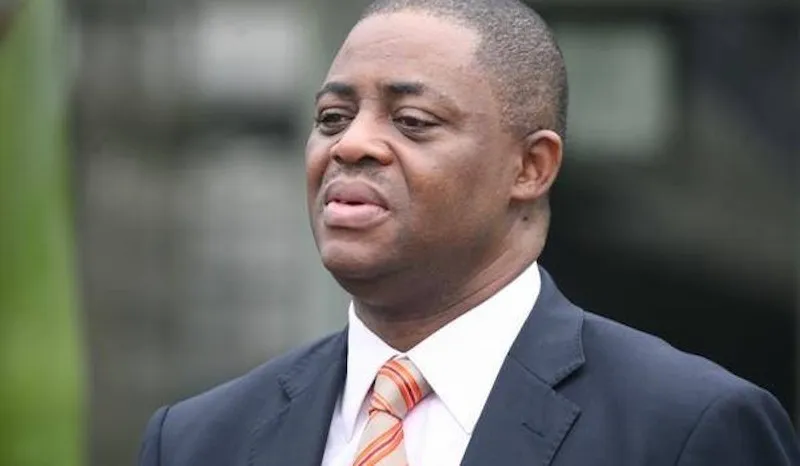
NIGERIA’s Ambassador to South Africa, Femi Fani-Kayode, has defended former President Olusegun Obasanjo and former Vice-President Atiku Abubakar over the collapse and eventual liquidation of the defunct Nigeria Airways, amid renewed debate over the airline’s troubled history and the responsibility of successive administrations.
News Point Nigeria reports that Fani-Kayode weighed in on the controversy following an exchange involving the Minister of Aviation and Aerospace Development, Festus Keyamo, and Atiku over the economic challenges inherited by successive governments and the liquidation of Nigeria Airways in September 2004.

Read also: Aviation Minister Accuses Atiku Of ‘Hypocrisy’ Over Nigeria Airways Collapse 22 Years Ago

Fani-Kayode, who served as Minister of Aviation under the Obasanjo administration, addressed questions surrounding the airline’s collapse, offering his account of the circumstances that led to its liquidation and defending Obasanjo against criticism over the decision.


His intervention comes after Keyamo accused Atiku of hypocrisy, arguing that the former Vice-President was part of the administration under which Nigeria Airways was liquidated, leaving thousands of workers without jobs and many former employees struggling to receive their outstanding pensions and gratuities.
At the centre of the controversy is the role played by the Obasanjo administration, in which Atiku served as Vice-President and Fani-Kayode held ministerial office, in the airline’s eventual closure and the subsequent handling of former workers’ entitlements.
In a post published on Wednesday, Keyamo accused the administration in which Atiku served as vice-president of liquidating Nigeria Airways in September 2004, leaving thousands of workers without jobs and their pensions and gratuities unpaid.
The minister said the outstanding entitlements had remained unresolved for years, claiming that some former workers died while waiting for their benefits.
He added that President Bola Tinubu had approved and released N36 billion to settle the outstanding obligations, with beneficiaries already receiving payment alerts.
Keyamo also accused Atiku of taking credit for the achievements of the Obasanjo administration when convenient while distancing himself from controversial decisions.
Responding to the debate, Fani-Kayode said it was unfair to blame Obasanjo for the airline’s collapse, arguing that its decline had begun long before his return to office.
“In fairness to President Obasanjo the Nigeria Airways ‘mess’, as you have described it, was established before he came back to power in 1999.

“And it was indeed a mess but it was not of Obasanjo’s making!
“He met it there after he was sworn in and what he found broke his heart,” Fani-Kayode wrote.
He recalled that when Obasanjo left office as military Head of State in 1979, Nigeria Airways had 32 functional aircraft, experienced pilots and crew members, a first-class management team and an accountable board of directors.
Read also: US Threatens To Restrict Military Support To Nigeria Over Child Soldier Recruitment
He described the airline at the time as “the pride of the nation”.
However, Fani-Kayode said the situation had deteriorated considerably by 1999, when Obasanjo returned as a civilian president.
“By the time Obasanjo came back to power in 1999, 20 years later, there was only one plane left and it was not functional.
“The rest had vanished together with virtually all of the company’s assets,” he said.
According to him, successive management teams and boards contributed to the airline’s decline through corruption and mismanagement between 1979 and 1999.
He said the company’s liquidation followed chronic insolvency, operational collapse and unsuccessful attempts to revive its operations, including privatisation advice from the International Finance Corporation, which later withdrew.
Fani-Kayode maintained that the Obasanjo/Atiku administration was justified in refusing to continue providing public funds to the struggling airline.
“This is why Obasanjo/Atiku govt liquidated it in 2004 and I believe that they had no choice,” he said.
“There was nothing left to save even though it was a painful decision given the fact that he was one of those that had done so much for that company when he was Military Head of State.”
The former minister said the payment of outstanding pensions became a major issue following the liquidation.
He recalled that a committee chaired by the then Head of Service of the Federation, Yayale Ahmed, recommended that funds be released to pay the pensioners.
Fani-Kayode said he subsequently presented a memo to the Federal Executive Council in 2006, advocating the payment of the outstanding entitlements.
However, he said the proposal was rejected because some cabinet members believed former management teams and board members were responsible for the airline’s destruction and did not deserve pensions.
“I did not share that view but sadly I and those that supported me were in a minority and we lost the debate,” he said.
Fani-Kayode, popularly known as FFK, is Nigeria’s Ambassador to South Africa.