

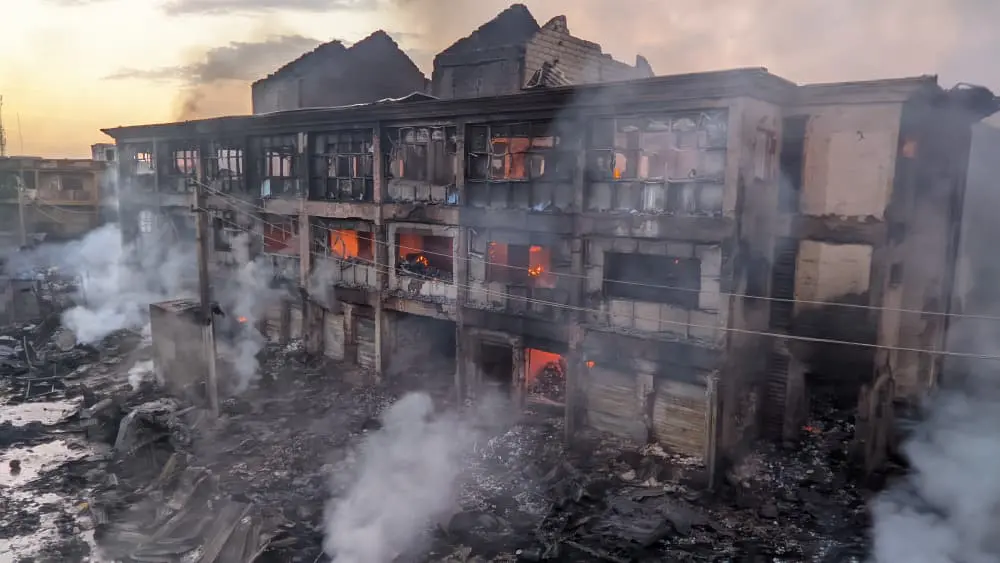
A MASSIVE fire outbreak has swept through the popular Singer Market in Kano metropolis, destroying properties estimated at over N8 billion, crippling more than 1,000 businesses, and leaving seven persons missing. Traders have described the inferno as one of the darkest moments in the market’s history.

The Chairman of Singer Market, Junaid Zakari, disclosed the extent of the destruction on Sunday while speaking with News Point Nigeria, describing the incident as a catastrophe that has left hundreds of families devastated.
Zakari revealed that the inferno razed four residential buildings within the market area, many of which housed small-scale businesses and served as both shops and living quarters for traders.


According to him, goods, equipment, and other valuables were completely burnt, wiping out years of investment and plunging business owners into uncertainty.
“This is one of the worst tragedies we have experienced in the history of Singer Market,” Zakari said. “Over 1,000 businesses have been affected, and properties worth more than N8 billion have been destroyed as at 1pm Sunday.”
Adding to the tragedy, Zakari confirmed that seven persons had been declared missing as of the time of filing this report.
He said investigations were ongoing to determine their whereabouts and to confirm whether they were alive or dead. Emergency responders and security agencies are working tirelessly to account for everyone who may have been trapped during the blaze.
The uncertainty surrounding the missing individuals has heightened anxiety among traders and residents, many of whom spent the weekend searching through debris and making frantic phone calls in hopes of locating loved ones.
Amid the charred remains of shops and buildings, traders struggled to salvage whatever was left of their properties.

Isa Abubakar, a shop owner, said he lost goods worth over N200 million in the fire.
“From God we come, and to Him we shall return. It is heartbreaking to see goods worth billions of naira destroyed by fire,” he lamented, his voice heavy with emotion.
Another trader, Musa Ibrahim, said he suffered losses exceeding N340 million.


“The fire consumed everything we had,” he said. “Years of hard work gone in just a few hours.”
Many affected traders described the inferno as a devastating blow, especially at a time when economic conditions are already challenging.
Authorities have yet to officially determine the cause of the fire. Zakari noted that emergency responders and relevant security agencies are still investigating the incident.
The blaze reportedly spread rapidly, overwhelming local firefighting efforts and leaving traders scrambling to remove goods before the flames engulfed entire sections of the market.
Singer Market, one of Kano’s key commercial hubs, is known for its bustling trade activities and serves as a source of livelihood for thousands of families.
In the wake of the disaster, Kano State Governor, Abba Kabir Yusuf, visited the scene while the fire was still raging.
Zakari commended the governor’s swift response, saying it demonstrated solidarity and concern for the affected traders.
“The governor came while the fire was still burning. That shows he cares about the people,” he said.
Earlier, this newspaper reported that Governor Yusuf had called on the Federal Government to urgently provide modern firefighting equipment, including air support, following what he described as a second fire outbreak at the Singer Market.
The governor made the appeal during his visit to the Gidan Gilas section of the market, where flames were still destroying shops and properties.
Governor Yusuf’s appeal underscores growing concerns about the capacity of local firefighting services to handle large-scale infernos in densely populated commercial centres.
He stressed the need for advanced firefighting tools and rapid-response mechanisms to prevent similar tragedies in the future.
The latest incident has reignited discussions about fire safety standards, market infrastructure, and emergency preparedness across Kano and beyond.
As smoke continued to rise from the ruins, traders gathered in small groups, some in tears, others silent in shock. For many, the market was not just a place of business but a lifeline for entire families.
Zakari emphasised the urgent need for government and private sector support to help victims rebuild.
“This tragedy will not be forgotten in the history of Singer Market,” he said. “We need assistance to help our people stand on their feet again.”
For now, the focus remains on locating the missing persons, determining the cause of the inferno, and charting a path toward recovery for one of Kano’s most important commercial centres.