

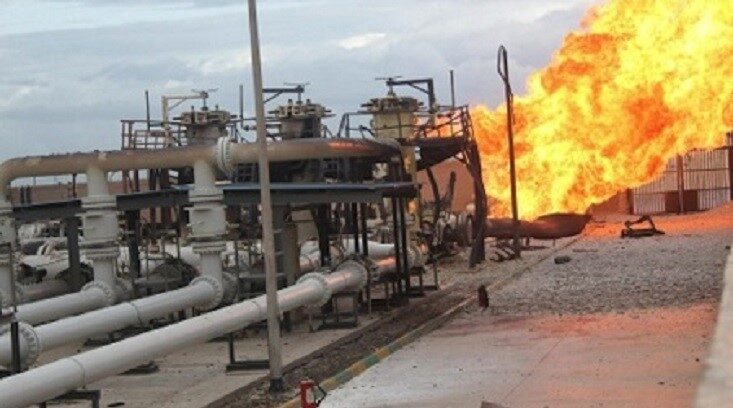
NIGERIA’s energy infrastructure suffered a major setback on Thursday following an explosion along the Escravos–Lagos Gas Pipeline (ELGP), one of the country’s most critical gas transmission routes.

The Nigerian National Petroleum Company Limited (NNPC Ltd) confirmed the incident in a statement sent to News Point Nigeria late Friday, noting that the blast disrupted gas supply and triggered a large-scale emergency response.
According to NNPC, the explosion occurred near the Tebijor, Okpele, and Ikpopo communities in Warri South-West Local Government Area of Delta State.


Engineers monitoring the system detected a sudden pressure drop on the pipeline, consistent with a breach or loss of containment, prompting immediate shutdown procedures.
Although the company has yet to provide full details on the extent of the damage or whether any lives were lost, the incident has already raised significant concerns about potential impacts on power generation and industrial gas supply across the southwest regions heavily reliant on the ELGP for electricity and manufacturing operations.
The Escravos–Lagos pipeline, with the capacity to transport 2.2 billion standard cubic feet of gas per day, is a backbone of Nigeria’s domestic gas infrastructure. It feeds major power plants including Egbin, Omotosha, and Geregu, as well as several industrial facilities.
Frequent disruptions on the line have historically triggered power deficits in the national grid, exacerbating Nigeria’s chronic electricity shortages.
NNPC said investigations had been launched to determine the cause of the explosion. The company’s emergency response teams, along with security agencies and community leaders, have been deployed to contain the situation, secure the site, and prevent further escalation.
“We are working closely with relevant authorities and the impacted communities to mitigate the effects of the incident,” NNPC stated, adding that restoration efforts would intensify once safety assessments are concluded.

Authorities have yet to confirm whether sabotage, equipment failure, or accidental ignition caused Thursday’s’s blast.
