

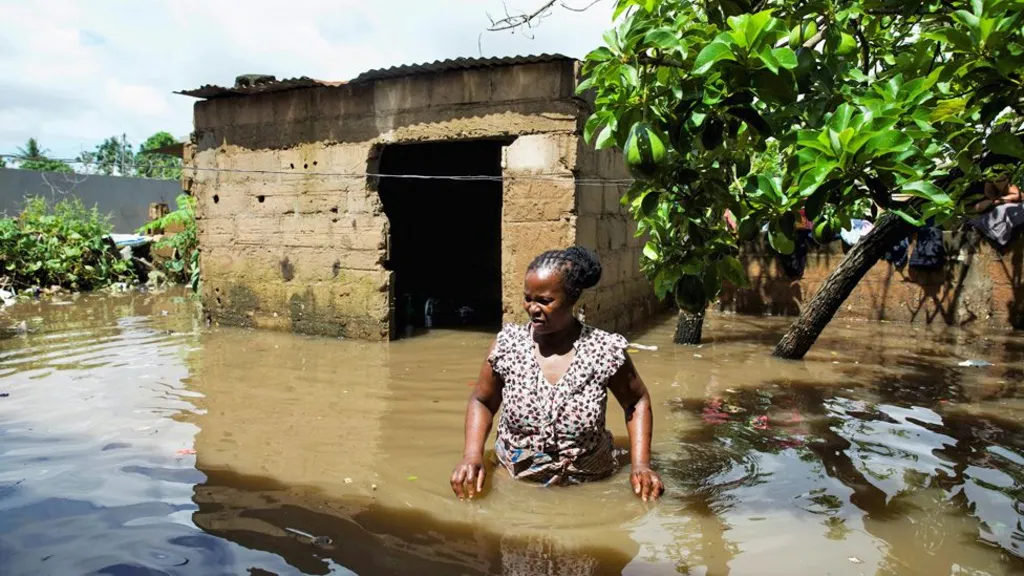
MLAU and his family, who live near Marracuene – a town 30km (19 miles) north of the capital, Maputo – woke up to find their house inundated after the Inkomati River burst its banks.

“When a rescue boat came a few hours afterwards, we did not hesitate to board it and come to safety in Marracuene town,” he said, adding they had to abandon all their belongings and only managed to bring a change of clothes.
Mlau, his wife and two children have found refuge at one of six centres – schools and churches – that are so far sheltering about 4,000 people.


Many of those gathered at Gwazamutini Secondary School are farmers from the low-lying areas with livestock and rice fields.
“We lost everything in the floodwaters, including houses, TV sets, fridges, clothing and livestock – cattle, goats and pigs. Our farms are under water. I am a farmer. I grow quality rice,” 67-year-old Francisco Fernando Chivindzi told me.
His home is in Hobjana, one of several flooded neighbourhoods between the left bank of the Incomati River and the coastal tourism resort of Macaneta. Marracuene town is on the river’s right bank.
“The floodwaters reached heights we weren’t expecting. We have never experienced this level of flooding in my lifetime,” Chivindzi said.
“We are happy to be here on higher ground. However, we are very worried that all our belongings were left behind.”
The farmer expressed his gratitude to the boat owners who came to assist him and his neighbours free of charge – and he urged others to save themselves.

“We hear that there are still some people resisting – clinging to treetops and on roofs. I wish they would heed the rescuers and join us here in this temporary shelter. We should value life more than the goods,” the father of nine said.
This was a view echoed by Shafee Sidat, the mayor of the Marracuene municipality, as he visited Gwazamutini Secondary School on Saturday.
“We still have people to rescue, some of whom refuse to abandon the risk areas. That’s a challenge. We reckon that more than 10,000 people are affected in Marracuene as a whole,” he told me.


At least 642,122 people have been affected since 7 January by flooding – particularly in southern and central regions, with 12 deaths recorded so far, according to provisional data from the National Institute for Disaster Risk Management and Reduction.
In total 125 people have died in Mozambique since the rainy season began in October.
Mayor Sidat fears the situation is likely to get worse because of heavy rain in neighbouring South Africa, the source of the Inkomati River.
“We are worried about discharges of a South African dam on the Inkomati River. Our town is the last one downstream,” the mayor said.
“Before the waters flow into the Indian Ocean, they flood the ‘machambas’ (farmlands), homes and grazing areas here in the low-lying zones.”