

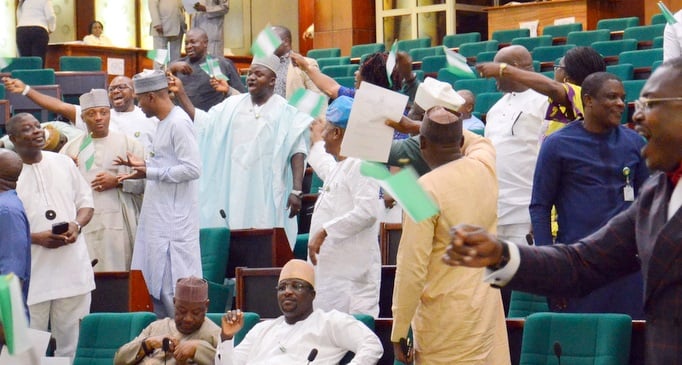
THE Public Accounts Committee of the House of Representatives has directed the Office of the Accountant-General of the Federation and the Office of the Auditor-General for the Federation to prepare and submit the consolidated financial statements and audited accounts of the Federal Government for the years 2023, 2024 and 2025 before October 2026.
News Point Nigeria reports that the directive was issued on Monday during an investigative hearing at the National Assembly, where lawmakers examined persistent delays in the submission of audited government accounts and scrutinised the effectiveness of Nigeria’s public financial management systems.
Chairman of the Committee, Bamidele Salam, expressed strong dissatisfaction over what he described as a recurring pattern of non-compliance with statutory reporting obligations by the Accountant-General’s office.


He reminded officials that the Fiscal Responsibility Act mandates the Federal Government to publish audited and consolidated financial statements not later than six months after the end of each financial year.
According to Salam, the continued delay in meeting this obligation undermines fiscal discipline, weakens institutional credibility and damages investor confidence.
He further noted that the slow pace of financial reporting in Nigeria’s public sector reduces the country’s ability to attract foreign direct investment and secure support from international development partners who depend on credible and up-to-date financial data.
The committee also raised concerns over the payment of N9.8 billion to vendors of the Government Integrated Financial Management Information System (GIFMIS) in 2024.
Lawmakers questioned the value derived from the expenditure, observing that the platform has yet to fulfil its core mandate of ensuring accurate, transparent and timely reconciliation of government accounts.
Members argued that despite renewed contracts aimed at improving system efficiency and financial consolidation, the expected improvements in reconciliation processes and reporting timelines have not materialised.

Representing the Accountant-General of the Federation, Shamseldeen Ogunjimi, the Acting Director of Consolidated Accounts, Shuaibu Sikiru, attributed the delays to operational and institutional constraints.
He cited the failure of the Central Bank of Nigeria to provide complete bank statements for Ministries, Departments and Agencies (MDAs) as a major obstacle to timely reconciliation.
Sikiru also pointed to technical and operational limitations of the GIFMIS platform, disclosing that the last comprehensive reconciliation of government accounts was conducted in 2022.


On the Treasury Single Account (TSA), he explained that the engagement of Remita as a payment gateway was carried out without sufficient coordination with the Office of the Accountant-General, resulting in operational complications and fragmented financial data management across MDAs.
Auditor-General Highlights Constitutional Gaps
In his presentation, the Auditor-General for the Federation, Shaakaa Chira, drew attention to structural weaknesses within the legal framework governing financial reporting timelines.
He explained that while the Fiscal Responsibility Act prescribes timelines for publishing audited accounts, the 1999 Constitution (as amended) does not specify a clear deadline for the Accountant-General to submit financial statements, thereby complicating the auditing process.
Chira disclosed that audit reports addressing compliance issues and internal weaknesses for the years 2022 to 2025 are currently being finalised for submission to the National Assembly.
He assured lawmakers that efforts were ongoing to clear the backlog and restore compliance with statutory requirements.
Delays in the submission of audited financial statements to the legislature have been a recurring issue across successive administrations.
Under existing procedures, the Accountant-General prepares the Federation’s financial statements, which are subsequently audited by the Auditor-General before being transmitted to the National Assembly for consideration by the Public Accounts Committees of both chambers.
However, the gap between the close of each financial year and the submission of audited accounts has often exceeded the six-month window stipulated in the Fiscal Responsibility Act.
Lawmakers emphasised that the absence of up-to-date audited accounts constrains the National Assembly’s oversight capacity and may result in budget deliberations proceeding without a comprehensive understanding of the government’s financial position.
They warned that continued delays could further erode public confidence in government finances and weaken Nigeria’s standing among investors and development partners.
Ruling after the hearing, the Salam-led committee directed both the Accountant-General and the Auditor-General to ensure that all outstanding financial statements and audit reports are submitted before October 2026.
Lawmakers warned that failure to comply with the directive would attract legislative sanctions.
The committee reaffirmed its commitment to strengthening transparency, accountability and prudent management of public funds, stressing that timely financial reporting is essential to restoring trust in Nigeria’s public finance system.