
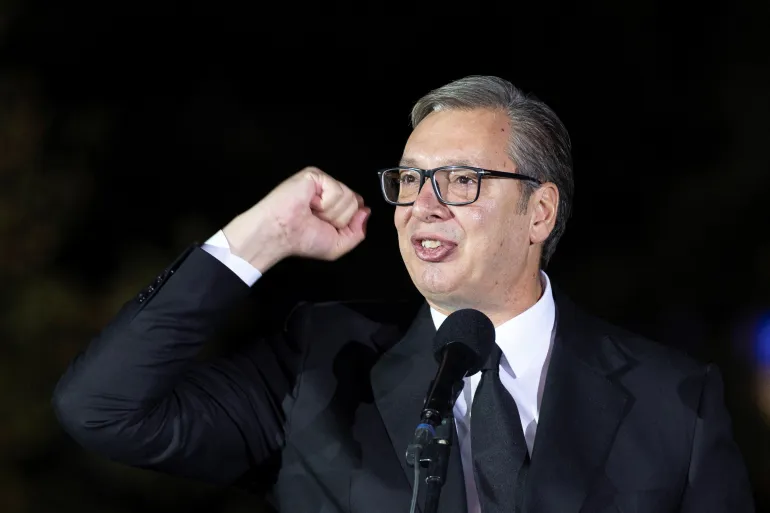
SERBIAN President Aleksandar Vucic has resigned to seek the prime minister’s post in a snap parliamentary election on October 25, as a student-led movement mounts the most serious challenge to his rule in more than a decade.

Vucic, on the Serbian Progressive Party (SNS) ballot, has dominated Serbian politics as president or prime minister since 2014. Barred from seeking a third presidential term, he is now seeking to extend his hold on power through the parliamentary vote.

Read also: Funeral Held For 75 Palestinians After Remains Recovered From Gaza Ruins
Parliament Speaker Ana Brnabic, a close ally, will serve as acting president pending a presidential election. Vucic said one of his final acts in office was to pardon 49 people, including 23 convicted in connection with the protests.

The election follows nearly two years of demonstrations prompted by the killing of 16 people when a concrete canopy collapsed at a railway station in the northern city of Novi Sad on November 1, 2024.
Students have since organised some of Serbia’s largest demonstrations in decades, drawing hundreds of thousands of people onto the streets.


Protesters have accused the government of corruption, a lack of transparency and political interference in state institutions.
Vucic and his allies reject the allegations that they are responsible for the problems highlighted by the protesters.
The student movement is contesting the parliamentary election under the banner “Students Win”, with the backing of several opposition parties, including the Democratic Party, which was once led by former Serbian President Boris Tadic.

Read also: Christiane Amanpour To Leave CNN In June 2027 After 43 Years
Its list of 250 candidates includes mostly university professors and professionals from a range of fields. Its platform calls for investigations into allegedly ill-gotten property, measures against corruption and political interference in public institutions and greater transparency in the use of public funds.
Some polls suggest that the student-backed movement could pose a serious threat to Vucic’s Serbian Progressive Party, although the authenticity and methodology of some of the polls are difficult to independently verify.


Belgrade-based editor and columnist Dejan Ilic told Al Jazeera that Vucic should not be credited with choosing to hold an early election.
“Vucic is not the only actor in this country. People have said that Serbia is in a bad state, they demanded elections and they forced elections,” Ilic said.
Aida Corovic, a former Serbian parliamentarian and human rights activist, said the anger extended beyond the student movement.
“Serbia has been undergoing internal change in recent months,” Corovic told Al Jazeera.
Read also: Iran Says Two Tankers Catch Fire After Hitting Mines In Strait Of Hormuz
“I fear that the crisis in Serbia could only begin after the October 25 elections,” she said. “This government has taken over the institutions, it is deeply intertwined with organised crime and it will try every possible way to remain in power.”
A few hours before his resignation, Vucic told CNN that if the opposition won, he would acknowledge the results and congratulate his opponents that same evening.


