

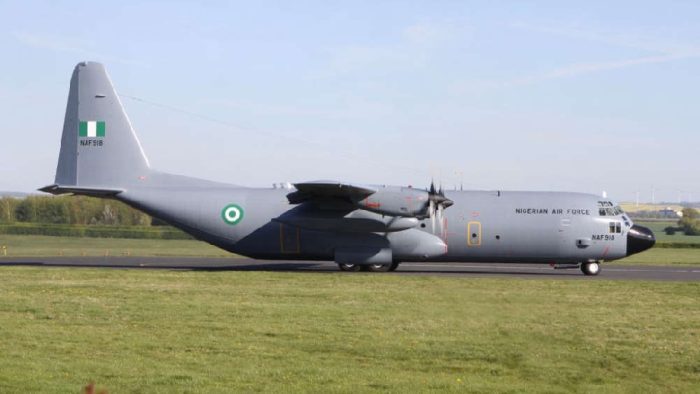
SIX days after a Nigerian Air Force C-130 aircraft made a precautionary landing in Burkina Faso, the fate of the 11 Nigerian military personnel on board remains uncertain, as diplomatic efforts intensify behind the scenes to secure their release and defuse a growing regional tension.

What began as a routine ferry mission has since escalated into a delicate diplomatic standoff between Nigeria and its Sahelian neighbour, with the Burkinabe military government detaining both the aircraft and its crew over alleged violations of national airspace.
News Point Nigeria reports that according to Burkinabe authorities, the Nigerian military aircraft was forced to land in Bobo-Dioulasso after it reportedly entered Burkina Faso’s airspace without prior authorisation.


The development was announced on Tuesday by the Agence d’Information du Burkina, the country’s state-run news agency, which cited a statement from the Confederation of Sahel States (AES).
The AES said investigations by Burkinabe authorities had revealed that the aircraft lacked clearance to fly over Burkina Faso, describing the incident as a breach of sovereignty.
The bloc condemned what it termed an unauthorised military incursion, stressing that it viewed the matter as a serious violation of the territorial integrity of its member states.
“The Confederation condemns with the utmost firmness this violation of its airspace and the sovereignty of its member States,” the statement said.
Nigeria, however, has maintained that the aircraft’s landing was driven purely by safety considerations. The Nigerian Air Force explained that the C-130 aircraft was on a non-combat ferry mission to Portugal when the crew detected a technical concern shortly after departing Lagos on December 8, 2025.
In line with international aviation protocols and standard safety procedures, the crew diverted to the nearest suitable airfield, which happened to be in Bobo-Dioulasso. The Air Force insisted that there was no hostile intent or operational mission involved.

In a statement sent to News Point Nigeria by the Director of Public Relations and Information of the Nigerian Air Force, Air Commodore Ehimen Ejodame, the service confirmed that the personnel on board were safe and receiving what it described as cordial treatment from Burkinabe authorities.
Despite these assurances, the continued detention of the soldiers has raised concern in Nigeria, particularly as the days stretch on without a resolution. The Federal Government has since activated diplomatic channels to address the situation, tasking Nigeria’s embassy in Ouagadougou with engaging the Burkinabe authorities.
Speaking on Wednesday, the spokesperson for the Ministry of Foreign Affairs, Kimiebi Ebienfa, confirmed that discussions were ongoing.


He said Nigeria was working quietly through diplomatic means to secure the release of both the personnel and the aircraft.
As the diplomatic process unfolds, the incident has begun to stir debate at home, with some voices calling for a firmer response.
A former federal lawmaker from Ekiti State and chieftain of the All Progressives Congress, Ayodele Arise, has urged President Bola Tinubu to consider military action if diplomatic efforts fail.
Speaking on Saturday during a televised interview, Arise argued that Nigeria must demonstrate resolve in defending its military personnel, even while acknowledging the country’s existing security challenges at home.
“I think we should move and do something,” he said. “Once they are aware that we want to do that, I am sure that the man who is President there will have a rethink because they are our neighbours.”
While stressing the importance of good neighbourly relations, Arise warned that friendliness should not be mistaken for weakness, adding that Nigeria must make it clear that its sovereignty and armed forces cannot be toyed with.
Drawing on historical precedent, he referenced Israel’s daring 1976 Entebbe Raid in Uganda, suggesting that decisive action has, in some cases, forced reluctant governments to reconsider their positions.
The former senator, who represented Ekiti North, also defended recent regional military interventions, including Nigeria’s role in supporting efforts to suppress a coup attempt in the Republic of Benin.
He dismissed claims that President Tinubu acted hastily or outside constitutional bounds, insisting that national security considerations sometimes demand swift action.
For now, however, the Federal Government appears committed to a diplomatic solution, wary of escalating tensions in a region already grappling with instability, military rule, and strained relations among neighbouring states.