

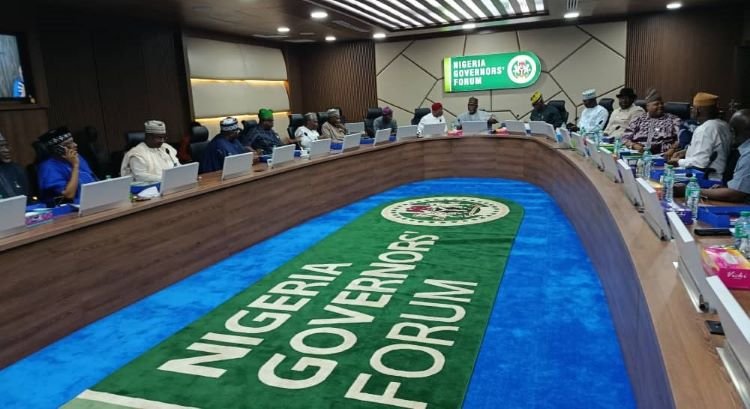
THE push for the establishment of state police in Nigeria has gathered fresh momentum as the Nigeria Governors Forum formally submitted its contribution to the proposed framework, setting the stage for legislative consideration by the National Assembly.

News Point Nigeria reports that the Chairman of the Forum and Kwara State Governor, AbdulRahman AbdulRazaq, disclosed this on Sunday during a high-level meeting with President Bola Ahmed Tinubu at his residence in Ikoyi, Lagos.
AbdulRazaq explained that the governors’ proposal had already been forwarded to the Office of the National Security Adviser, led by Nuhu Ribadu, as part of ongoing consultations on the future of policing in the country.


According to him, the document is expected to be transmitted to the National Assembly for the development of a legal framework that would enable the creation of state police.
“On the issue of state police, discussions are ongoing amongst various security organisations, led by the National Security Adviser, and the NGF has made its contribution,” AbdulRazaq said.
“That document will be taken to the National Assembly to see how we can have a legislative framework for state police.”
The NGF chairman reiterated the commitment of state governors to strengthening collaboration with security agencies in tackling terrorism and other forms of criminality across the country.
“As governors, we commit to renew our collaboration with security forces to defeat terrorism steadily, expand infrastructure opportunities and improve the lives of our people,” he said.
He emphasized that collective action remains critical to addressing the persistent security challenges confronting Nigeria, urging all stakeholders to work together toward restoring peace and stability.

AbdulRazaq also used the occasion to commend President Tinubu for his recent state visit to the United Kingdom, describing it as a landmark engagement that signals a new phase in Nigeria’s international relations.
“We congratulate you on the successful state visit to the United Kingdom and the many successes and investment proposals achieved during the trip,” he said.
“While our nation has always enjoyed a good relationship with the United Kingdom, the state visit, the first in 37 years, is bold and significant. It speaks to new leadership in Nigeria.”


He expressed optimism that the bilateral agreements reached during the visit would strengthen ties between both countries and deliver economic benefits to Nigerians.
The governor further lauded the administration’s Renewed Hope Agenda, noting that it has inspired a sense of national participation in governance and development.
“Every Nigerian now has a stake in nation-building. We believe that this will translate to improved security in every part of our country,” he stated.
He stressed the importance of unity and shared responsibility in overcoming the nation’s challenges, calling on leaders and citizens alike to embrace values such as selflessness, compassion, and mutual understanding.
The meeting at the President’s Lagos residence drew a large number of governors from across the federation, with AbdulRazaq noting that about 25 governors attended on short notice.
“As you can see here today, we have about 25 governors who attended at short notice; it’s a respect we have for you and the leadership you’re providing for the nation,” he said.
Also present at the meeting were Vice President Kashim Shettima, Chief of Staff to the President Femi Gbajabiamila, and other senior government officials.
The proposal for state police has long been a subject of national debate.
Proponents argue that decentralising policing would enhance security by bringing law enforcement closer to local communities, improving intelligence gathering and response times.
However, critics have raised concerns about the potential for abuse, particularly the risk of state governors using such forces for political purposes.
Amid the ongoing debate, the Inspector-General of Police, Tunji Disu, had in February established a committee to develop modalities for the possible implementation of state police.
The committee’s work is expected to complement the efforts of the NGF and other stakeholders as the country moves closer to a decision on the issue.
With the governors’ proposal now ready for transmission, attention is expected to shift to the National Assembly, where lawmakers will deliberate on the framework and determine its feasibility.