

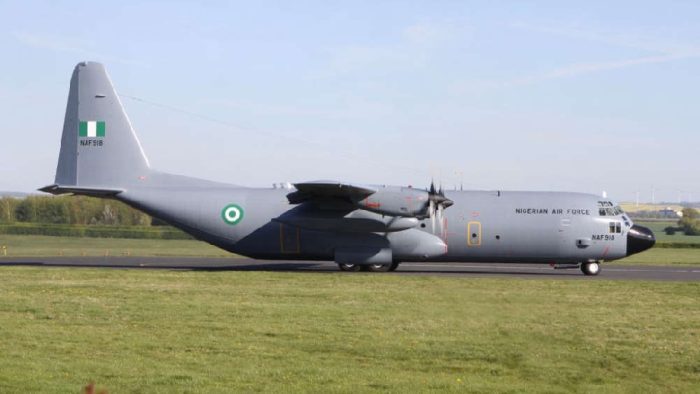
REGIONAL tensions escalated on Monday after the Alliance of Sahel States (AES) comprising Mali, Niger, and Burkina Faso condemned the emergency landing of a Nigerian Air Force (NAF) C-130 aircraft in Burkina Faso, describing the incident as an “unfriendly act” and a violation of its airspace.

News Point Nigeria reports that the aircraft, which was ferrying 11 Nigerian military personnel on a mission to Portugal, made an unplanned landing in Bobo-Dioulasso following what Nigerian authorities have confirmed was a genuine technical concern mid-flight.
In a statement broadcast on state media across the three military-led nations, the Sahel Alliance claimed the aircraft had entered Burkina Faso’s airspace without authorisation.


“An aircraft belonging to the Air Force of the Federal Republic of Nigeria, type C-130, was forced to land today in Bobo-Dioulasso, Burkina Faso, following an in-flight emergency situation while it was operating in Burkinabe airspace,” the statement read.
Despite acknowledging the aircraft’s technical issue, the alliance faulted Nigeria for what it labelled an intrusion, saying such incidents constituted “unfriendly acts.”
The AES further directed its respective air forces to remain on maximum alert, with orders to “neutralise any aircraft” violating the confederation’s airspace in the future.
The statement did not indicate the condition or location of the 11 Nigerian personnel after the landing, contributing to uncertainty until Nigeria issued its clarification.
In response, the Nigerian Air Force issued a formal clarification on Tuesday, confirming that the emergency landing was strictly a safety-driven decision taken in line with international aviation standards.
According to Air Commodore Ehimen Ejodame, Director of Public Relations and Information for the NAF, the C-130 aircraft had departed Lagos on 8 December 2025, bound for Portugal, when the crew detected a technical concern.

“Following takeoff from Lagos, the crew observed a technical concern which necessitated a precautionary landing in Bobo-Dioulasso, Burkina Faso, the nearest airfield in accordance with standard safety procedures and international aviation protocols,” Ejodame said.
He stressed that the personnel on board were safe and had received “cordial treatment from the host authorities,” pushing back against suggestions of hostility between the two states.
NAF confirmed that plans were underway to resume the mission once technical checks and clearance procedures were completed. The Air Force further expressed appreciation to Burkinabe officials for their cooperation.


Ejodame reiterated NAF’s unwavering commitment to operational safety: “The Nigerian Air Force remains professionally committed to strict compliance with operational procedures and safety standards, ensuring the protection of its personnel while fulfilling its constitutional mandate.”
The airspace dispute emerges against the backdrop of increasingly strained relations between Nigeria and the three Sahelian juntas, which have distanced themselves from traditional West African blocs and partners.
In January, Mali, Niger, and Burkina Faso withdrew from ECOWAS, forming the AES amid growing diplomatic rifts. The alliance has also realigned geopolitically, cooling relations with Western nations — especially France — while strengthening ties with Russia.
A security source told News Point Nigeria that that the swift escalation of Monday’s incident reflects the tense and highly sensitive environment surrounding sovereignty and airspace control in the politically fragile Sahel.
He warns that misinterpreting routine aviation emergencies as hostile incursions could heighten tensions in an already volatile region. He further urged both sides to de-escalate, with calls for communication channels to remain open to avoid worsening regional insecurity.