

I WAS returning from a quiet evening stroll a few days ago when I noticed a group of boys sitting under a tree by the estate gate. About seven of them. They couldn’t have been more than seven to eleven years old. They were laughing, resting, talking nothing out of the ordinary at first glance.

I was about to walk past when something in their conversation stopped me in my tracks. I slowed down. I listened. And what I heard sent a chill through my body.
These were not the words of children who had been protected. They were not conversations shaped by innocence, guidance, or care.


They were casually discussing acts and experiences no child should even have the language for things they should never have been exposed to, let alone normalised. There was no shame in their tone, no hesitation in their voices. When they noticed me, they did not lower their voices. They did not stop.
To them, nothing was wrong.
I walked away shaking. Guilty. Disturbed. Ashamed not of them, but of us.
When my conscience refused to let me rest, I went back outside. They were gone. Just like that. Almost as if their presence had been meant to confront me, to accuse me, and then disappear.
Since that evening, one question has refused to leave my mind: How did we come to this?
These children were not born this way. They were not created with darkness in their words or corruption in their thoughts. They did not arrive in the world armed with adult knowledge, moral confusion, or emotional scars.

They were shaped.
They were conditioned.
They were abandoned.
First, by parents who handed them over to the streets in the name of survival.
Then by a system that disguises neglect as “culture” and exploitation as “tradition.”


And finally by leaders who see these children not as lives to be protected, but as numbers future tools for violence, elections, or crime.
We like to pretend the Almajiri crisis is about religion or poverty alone. It is not. It is about responsibility. It is about adults who chose convenience over care, ideology over safety, and silence over action.
When a child is left to roam the streets hungry, unsupervised, uneducated, and unprotected, the streets will raise him. And the streets do not teach values. They teach survival—often in the most brutal and damaging ways.
So no, these children are not the problem.
The problem is the adults who failed them.
The problem is a country that keeps producing neglected children and then acts shocked when insecurity grows teeth.
You cannot abandon innocence and expect peace.
You cannot raise children on neglect and pray for a safe society.
If we do not rescue children early, we will keep burying victims later.
And when next we hear of violence, abuse, or crimes that leave us asking, “How could someone do this?” we should remember those boys under the tree.
These children are not just hungry and uncared for; many of them are angry, angry from childhood.
A few months ago, one of them came to ask if he could help take out my trash. I agreed. I began giving him food, slowly involving him in small chores around the gate and errands. I have a card I use strictly for errands; I usually transfer only the exact amount needed.
Then came what I now call my utmost mistake.
After the usual sweeping, I gave him food and handed him the card to quickly get me something. He took it, emptied it, and disappeared. The next morning, the card was thrown back into my compound.
I asked myself what I did wrong. But the truth was harsher: what do we expect from a child raised on neglect and survival alone?
You cannot starve a child of care, guidance, and structure, then demand honesty and restraint. When survival is the only lesson a child has ever been taught, morality becomes optional.
They were once innocent too.
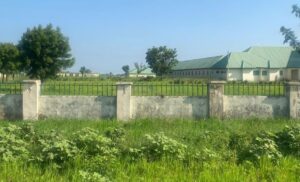
Some months later, while in Kanwa village in Madobi Local Government Area, I came across a massive abandoned structure. From a distance, it looked like unused farmland—overgrown, bushy, forgotten. But it wasn’t farmland.
It was a school.
A school.
Classes were ongoing elsewhere, so I asked questions. I even took pictures, because it was hard to believe what I was seeing. I was told it was one of the Tsangaya Model Schools, a federal initiative launched during the Goodluck Jonathan administration.
Not just one.
Several of them exist across the country.
Fully built.
Fully abandoned.
And I asked myself: Why?
Why does a country that complains daily about street children allow schools built specifically to protect them to rot away? Why do we keep arguing endlessly about what to do with Almajiri children when the solution is literally standing there unused, overgrown, silent?
If those boys I encountered under the tree were sheltered, fed, supervised, and educated, I would not have overheard a conversation that still haunts me. They would have been in classrooms, not on the streets learning life the hardest and most damaging way.
The irony is painful.
The structures already exist.
The children already exist.
Unemployment already exists.
Reviving these schools would mean education for children and jobs for teachers, caregivers, administrators, cooks, cleaners, and security personnel. This is not just social reform; it is economic sense.
If 10,000 Almajiri children are taken off the streets and properly raised, we will not be battling 1,000 lost souls later in society. Prevention has always been cheaper and more humane than punishment.
So again, the question remains: What is stopping the government?
Is it lack of funds or lack of will?
Is it complexity or simple indifference?
Because what we have now is a cycle of neglect. Boys grow up knowing nothing but survival. They grow up, marry early, marry multiple wives, and send their own children back to the streets not out of wickedness, but because neglect was normalised for them.
“I survived, so will you.”
But is survival the standard we want?
Is endurance without dignity success?
A society that keeps abandoning its children cannot pretend to be shocked by insecurity, violence, and moral decay. You cannot keep sowing neglect and expect to reap peace.
The Almajiri child is not Nigeria’s problem.
Nigeria’s refusal to act is.
And until we choose protection over politics, education over excuses, and responsibility over silence, we will keep asking “How did we get here?” even when the answer is staring at us through abandoned school gates.
This is where the Federal and State Governments must stop passing the buck. Child welfare is not a regional inconvenience; it is a national responsibility. Education is on the concurrent list no one gets to say “it’s not my job.”
Those abandoned Tsangaya Model Schools did not build themselves. Public funds were spent. Blueprints were drawn. Promises were made. Letting them decay is not just failure it is negligence.
Revive them.
Staff them.
Fund them transparently.
Monitor them strictly.
And this responsibility does not end with government.
Business tycoons, philanthropists, religious institutions, and corporate bodies this is your call too. A country where children roam the streets unprotected is not safe for investment, profit, or legacy. You cannot build empires in a society collapsing quietly from the bottom.
Adopt a school.
Sponsor a programme.
Pay teachers.
Provide meals.
Demand accountability.
This is not charity.
It is nation-building.
Because when we all look away, the streets step in. And the streets are ruthless teachers.
We must stop raising children on survival stories and start raising them with structure, care, and opportunity. “I survived, so will you” is not a philosophy it is a failure we keep recycling.
The Almajiri child is not asking for pity.
He is asking for protection.
For education.
For a future that does not begin and end on the streets.
This is on the government.
This is on the elite.
This is on communities.
This is on all of us.
And history will not ask who built the abandoned schools, it will ask who chose to revive them… and who didn’t.
Voice just cleared its throat.
- Kabara is a writer and public commentator. Her syndicated column, Voice, appears in News Point Nigeria newspaper on Monday. She can be reached at hafceekay01@gmail.com.