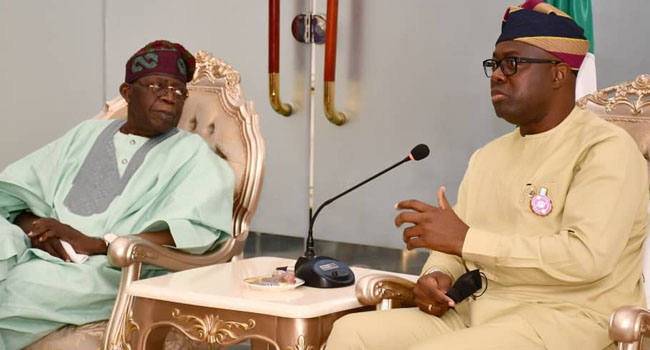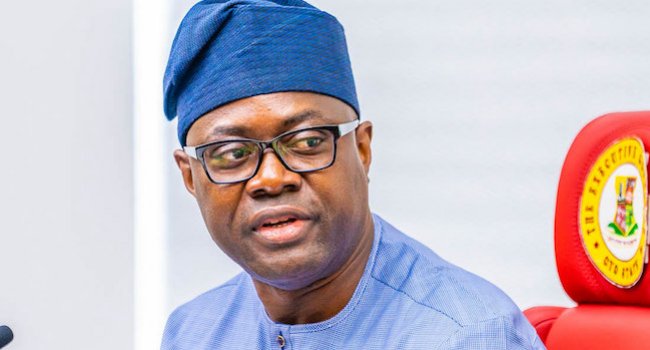
LAST Saturday in Yola, the Adamawa State capital, Governor Seyi Makinde, presidential candidate of the Allied Peoples Movement (APM), stood before a town hall crowd and made a promise. If Nigerians elect him in 2027, he will serve one term and leave.
“Our government will not last beyond four years. And it will be an all-inclusive government,” he said. He called it a transitional government of national unity, one that would “reset” the country and deal with insecurity, poverty and the electricity problem that has followed every Nigerian government since independence.

Read also: Will A Nobel Solve The World’s Trump Problem? The President Thinks So – By Azu Ishiekwene
He did not stop there. “We will not play politics. We will not undermine your rights. We will ensure that we tell you the exact truth. We will listen to you. Solutions can come from anywhere.”

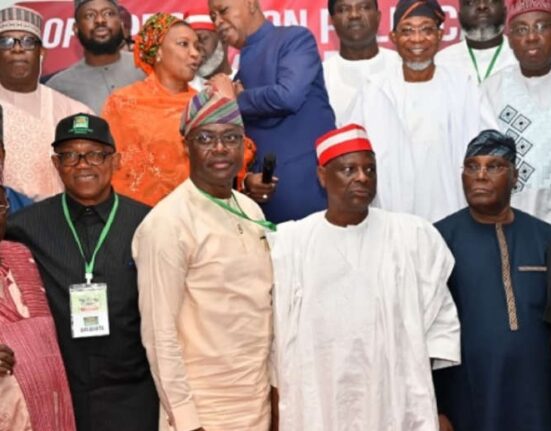
Fine words. Mind you, Makinde is not the only one selling four years. Peter Obi, presidential candidate of the Nigeria Democratic Congress (NDC), has been on the same one-term message for months.
In July, his running mate, Senator Rabiu Kwankwaso, went on Channels Television and said Obi had signed two documents, one with the party and another between the two of them, committing to a single term. “After our four-year term, from 2027 to 2031, power returns to the North,” Kwankwaso said.


So we now have two major candidates from the South promising to keep the seat warm for four years and hand it back. Welcome to the one-term gambit.
Let me call it what it is. This pledge is about zoning.
After four years of a Southern president under Bola Tinubu, a Southern challenger walking into the North to ask for votes needs to answer one question before any other: when does the North get its turn? The one-term promise is that answer. It is a reassurance letter written to Northern power brokers, and the address on the envelope is 2031.
Now, I will be fair to the idea, because it has a respectable side. A president who knows he will not run again is, in theory, free. He does not need to spend his third year appeasing governors, buying delegates or sharing appointments to secure a second ticket.
He can take hard decisions and absorb the anger. Mexico elects its president for a single six-year term with no re-election, for this exact reason. There is something to that argument and I won’t pretend otherwise.
But this is Nigeria, and we have watched this film before.
In 2011, after the death of President Umaru Musa Yar’Adua, Goodluck Jonathan sought the PDP ticket. Some Northern governors and party leaders later insisted that he had agreed to serve one term and step aside in 2015. Jonathan’s camp denied that any such deal was ever signed. Whatever the truth, he contested in 2015, the agreement nobody could produce became a campaign weapon, and the North voted accordingly.
The lesson? In our politics, a one-term promise is worth exactly what the man in Aso Rock decides it is worth once he has tasted the office. Nobody can sue a sitting president for changing his mind. God forbid we pretend otherwise.
Like I have said previously on this page, the bigger question is not whether these men will keep their word. It is whether four years is enough to do what they are promising. I have my doubts, and the numbers are not on their side.
Let me start with power, since every candidate puts it at the top of his list.
Nigeria has an installed generation capacity of about 13,625 megawatts. In February this year, according to NERC data average available capacity was 4,384 megawatts, roughly 32 per cent of what is installed. Our best day on record sits somewhere around 5,700 megawatts. Various estimates say a country of our size needs at least 40,000 to 50,000 megawatts for anything close to round-the-clock supply.
Read also: Nigerians’ Mental Health Is Under Siege – By Boma West
Building that gap costs money we do not like to talk about. A 300-megawatt coal plant costs around $400 million, which at today’s exchange rate of about N1,350 to the dollar is roughly N540 billion. A solar plant of the same size goes for about $500 million, close to N675 billion.
A 300-megawatt hydro plant can run from $1.65 billion to $2.5 billion, somewhere between N2.2 trillion and N3.4 trillion, and big projects with dams, turbines and transmission lines can pass $5.8 billion.
Do the arithmetic with me. To add even 45,000 megawatts using the cheapest option on that list, we would need 150 coal plants of 300 megawatts each. That is about $60 billion, more than N80 trillion, before anyone strings a single transmission line, fixes a single distribution company or settles a single debt in the power sector.
And power plants are not built in a campaign season. From financing to commissioning, a serious plant can take four to seven years on its own. Mambilla has been “about to start” since I was in primary school .
So when a candidate tells me he will fix electricity in four years, I want to see the drawings, the financing and the timelines. Ask Makinde, because he made this exact point in Yola. He reminded the crowd that President Tinubu once told Nigerians not to vote for him again if he failed to fix electricity in four years, and said electricity has not been fixed.
Fair hit. But the sword cuts both ways. If a sitting president with the full machinery of government behind him could not do it in four years, what will Makinde or Obi do differently in the same four years? Next scene please.
Power is only one part of a much bigger hole. According to estimates from the Infrastructure Concession Regulatory Commission and the Revised National Integrated Infrastructure Master Plan, Nigeria needs between $2.3 trillion and $3 trillion over the next 20 to 30 years to close its infrastructure deficit.
That works out to about $100 billion a year. Our infrastructure stock sits at roughly 30 to 35 per cent of GDP, against the World Bank benchmark of 70 per cent for emerging economies. No president, one term or two, is closing that gap. The best any of them can do in four years is to start it properly and make it hard for the next person to stop.
Then there is the elephant in the room. Insecurity.In March, the Institute for Economics and Peace ranked Nigeria fourth on the Global Terrorism Index and recorded a 46 per cent increase in terrorism deaths in 2025. Amnesty International counted at least 323 people killed in rural communities across Benue, Kwara, Kebbi, Katsina, Niger and Zamfara in 21 days in February alone.
Kidnapping has become an industry. A recent BusinessDay investigation counted 7,825 victims and N7.78 billion paid in ransom. Schoolchildren are still being taken from their classrooms. In my own Niger State, communities in Shiroro and Rafi now treat going to the farm as a gamble with their lives.
Defeating that requires more than a new president. It requires state police, a reorganised security architecture, intelligence that works, soldiers who are paid and equipped, and judges who convict. Much of that needs constitutional amendments, which means the National Assembly and two-thirds of the state Houses of Assembly. You cannot do that by executive order in your first hundred days.
To be fair to Makinde, he has a decent idea or two. In Yola he asked the Federal Government to publish its petroleum pricing template so Nigerians can see how pump prices are set. That is the kind of transparency I like to see, and I hope whoever wins keeps it.
But his running mate, Lawal Daura, told the crowd the party’s detailed policies will be unveiled at the start of the national campaign. My question is, which start? INEC opened the presidential campaign on August 19. We are almost two months in. When exactly does the substance arrive?
The same goes for Obi. His campaign has promised to restore fuel subsidy, and he has promised one term. Put those two side by side and tell me how a four-year government pays for the subsidy, builds the power plants and funds the security overhaul at the same time. These are numbers, not slogans.
Read also: 2027: Opposition Parties Begin Talks With Atiku, Obi, Makinde, Others On G100 Resolutions
This is campaign season, and everybody is catching cruise with sweet promises to woo voters. Four years sounds humble. It sounds patriotic. It travels well in Kano and Yola. But a promise to leave early is not a plan to do the work. A president who spends his first year settling into office and his last year handing over has about two working years in between.
What can you build in two years? Which power plant will be ready? Which forest will be cleared of bandits? Which law will be passed? And who guarantees that the man who takes over in 2031 will not abandon all of it, the way we abandon everything in this country?
The one-term pledge answers the question of who rules next. Nigerians are asking a different question: who fixes the country, and how?
- Nda-Isaiah is a political analyst based in Abuja and can be reached on jonesdryx@gmail.com. His syndicated column appears on News Point Nigeria newspaper on Saturday.