

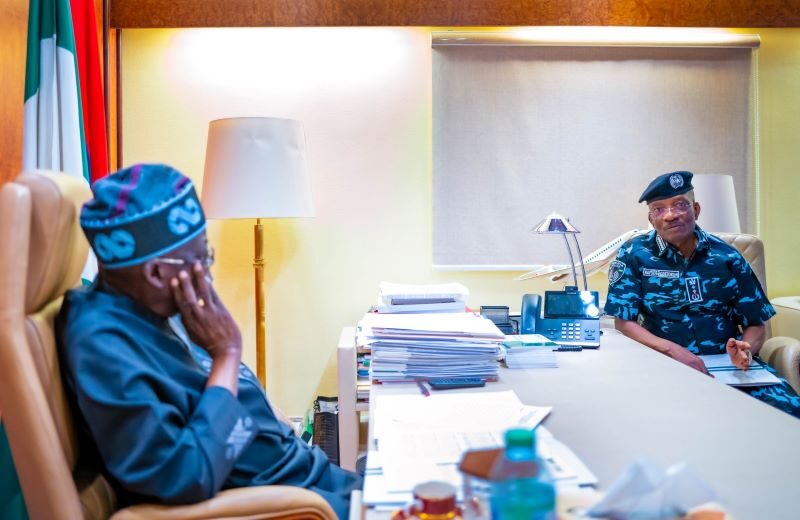
PRESIDENT Bola Tinubu has appointed Tunji Disu as the Acting Inspector-General of Police (IGP), following his acceptance of the resignation of Kayode Egbetokun, in what appears to be a significant shift in the country’s security leadership.

News Point Nigeria reports that the announcement was made after Egbetokun tendered his resignation in a letter dated Monday, citing pressing family considerations.
However, a credible source within the Presidential Villa told News Point Nigeria that deeper policy disagreements and mounting security concerns may have influenced the sudden leadership change.


In a statement issued by Bayo Onanuga, Special Adviser to the President on Information and Strategy, the Presidency confirmed that President Tinubu had accepted Egbetokun’s resignation.
According to Onanuga, the President expressed profound appreciation for Egbetokun’s decades of distinguished service to the Nigeria Police Force and the nation.
“The President acknowledged his dedication, professionalism, and steadfast commitment to strengthening internal security architecture during his tenure,” the statement read.
While the official communication framed the development as voluntary, insiders indicate that tensions had been building behind closed doors over the direction and pace of security reforms.
At the heart of the reported disagreement is President Tinubu’s renewed push for the establishment of State Police, a proposal he has repeatedly described as a necessary structural reform to address Nigeria’s complex and localised security challenges.
The President has reportedly invested significant political capital in mobilising support for decentralised policing. Recent meetings of the National Economic Council were convened to fast-track legal and operational frameworks for State Police implementation.

However, sources suggest that Egbetokun was perceived within certain corridors of power as “unenthusiastic” or insufficiently proactive in aligning the Force’s strategic direction with the President’s reform agenda.
The Presidency source hinted that the Force leadership’s cautious posture toward decentralisation may have created friction at a time when the administration was seeking urgency and visible momentum.
According to the Villa insider, Egbetokun attended a high-level breakfast meeting on Monday night where discussions reportedly turned tense.


The source further disclosed that the former IGP may have “ruffled powerful feathers,” although details of the exchange remain undisclosed.
By Tuesday morning, the resolve for a leadership change had crystallised, culminating in the acceptance of his resignation and the appointment of Disu as acting IGP.
Beyond policy disagreements, the deteriorating security situation in some northern states is believed to have intensified the pressure for change.
In February 2026 alone, at least 800 lives were reportedly lost to bandit attacks in farming communities the north. The violence triggered national concern and prompted urgent consultations at the State House.
Taraba was also a flashpoint, as at least 25 lives were reportedly lost to bandit attacks in Takum and Donga Local Government Areas daily.
Governor Agbu Kefas was said to have met President Tinubu last Wednesday to brief him on the escalating carnage in the affected communities.
A different Presidential sure told News Point Nigeria that Egbetokun joined the meeting approximately 15 minutes after it commenced.
Though official details of the discussions were not released, sources believe the Taraba crisis may have underscored broader concerns about the effectiveness of current security strategies.
The spate of killings across the north drew sharp reactions from regional leaders and civil society groups and President Tinubu reiterated on Monday night his determination to establish State Police as part of broader measures to fortify security nationwide.
The source added that the appointment of Disu may signal a more aggressive implementation phase for the administration’s decentralisation agenda.
Disu is widely regarded within policing circles as operationally driven and reform-minded, qualities that could align with the President’s renewed urgency.