

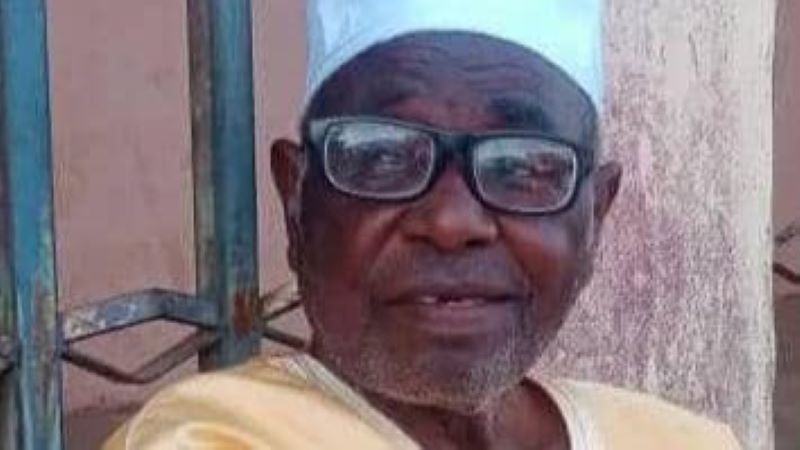
PRINCE Engr. Ahmad Yusuf, popularly known as Babandiga, was named after our grandfather and, out of deep respect, members of the family called him by our grandfather’s nickname, Babangida. As a curious child, I once asked our late grandmother why she was called Yandiga while our brother was called Babandiga. She explained that he had been named after her husband. Still curious, I asked what the name Babandiga meant.
She told me that her husband served as a supervisor at a railway construction site during the colonial era. In those days, “Diga” referred to the rail, and because of that role he earned the name Babandiga. Later, he was recalled home to succeed his father, Maje Bariki, and to serve as the Prime Minister of our Kingdom, holding the revered title Madaki Amadu.
Our late brother never missed an opportunity to share the history of our family with me, a history he carried with immense pride. He often explained that his namesake, the Prime Minister, was a great warrior who commanded respect and maintained an official residence befitting his position where he told me our fathers were born and the place is now the present Suleja Townhall.


To many he was Yaya, to others Babanmu, but to all of us he was humility and simplicity personified. Contentment defined his character. The only time one could see pride sparkle in his eyes was whenever he spoke about our heritage.
Yaya lived in the house he built as a young man when he first moved to Lafiya to seek a livelihood. Despite owning several properties in Lafiya, he chose to live among the neighbours he grew up with. For him, wealth was never meant to be displayed; rather, it was something to be managed quietly while remaining connected to one’s roots.
There was a time when an assignment took me and some colleagues to Lafiya. I invited them to accompany me to visit him. We were warmly received by him and the family members. After the visit, one of my colleagues took me aside and suggested that I should renovate my brother’s house to modern standards. I simply smiled and thanked him.
What my colleague did not know was that even the bungalow directly opposite the house belonged to my brother, yet he chose not to move there. When we visited, he had a well-furnished apartments that served as a guest house. Beyond that, he also had the option of living in one of the mansions behind the Government House where two of his sons lived with their families. Yet simplicity remained his deliberate choice.
Since I grew up to know him, Yaya never missed the opportunity to return home for Sallah. Remarkably, despite owning properties in Suleja, he always spent his holidays in our ancient family home — the house that accommodates all our relatives. Even when our grandparents were alive, and later our parents, he never felt the need to stay away from that sometimes noisy and crowded family home that he cherished deeply.
He once told me that our Zaure carried a unique history that no other in Suleja possessed. According to him, it was the second to be built after Zauren Zazzau when the migration that led to the establishment of Abuja now Suleja took place.

Yaya was also remarkably generous. He gave freely and quietly, even sponsoring some of our relatives to Saudi Arabia to perform the Hajj.
One of my most cherished memories with him dates back to my primary school days when my grandmother prepared me to spend my holidays in Lafiya. The experience was unforgettable. When it was time for me to return home, he showered me with gifts. Apart from my father, no one had ever given me that many gifts.
Today, our family has lost a great wall, a wall we all leaned on. Yet we remain grateful to Almighty Allah for making him one of us and for granting him a life that was rich not only in material blessings but also in humility, generosity and honour.


One moment that will forever remain etched in my memory also was when Alhaji once told his wife to tell me to do something that I swore, I wouldn’t. She went back and informed him.
From his room he called out loudly, “Mairo!”
I immediately sensed something was wrong because he rarely called me by my name. He always addressed me as Hajiya, even though he was old enough to be my father.
I went before him and knelt down on both knees. He looked at me carefully and asked:
“Wanene ni a wurinki?”
(Who am I to you?)
Through tears, I replied:
“Kai Baba na ne.”
(You are my father.)
And truly, that was how I had always seen him since the death of our father.
He then said:
“Alhamdulillah tunda kin san haka. Yanzu tashi ki wuce gida.”
(Alhamdulillah, since you know that. Now stand up and leave for home now.)
I cried for more than three hours that day, but I obeyed his instruction and left. As I walked away, I could hear him praying for me repeatedly, saying:
“Allah Ya yi maki albarka.”
Whenever he came home, he made it a point to visit me, just as our father used to do when he was alive.
Yaya was also a living archive of our family history. He would patiently explain everything to me, the story of forefathers’ migration to Suleja, the roles our grandparents played as Prime Ministers in Abuja, and how our fathers were born and raised in their official quarters, the building that today stands as the Suleja Town Hall. He even provided documents and charts to help me understand the branches of our family tree.
Now he is gone.
May Allah have mercy on his beautiful soul and bless the family members he left behind. May his kindness, humility and devotion to family continue to speak for him.
Inna Lillahi Wa Inna Ilaihi Raji’un.
Rest on, dear big brother.
- Mairo Mudi writes from Suleja, Niger State and she can be reached via mairommuhammad@gmail.com.