

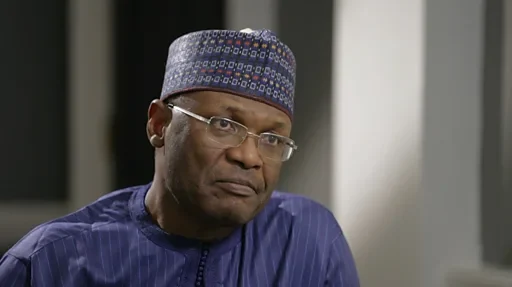
THE Office of the Auditor-General of the Federation has flagged a total sum of ₦288.18 billion in expenditures by the Independent National Electoral Commission (INEC), citing widespread procurement breaches, financial irregularities and internal control weaknesses under the leadership of Professor Mahmood Yakubu.

The revelations are contained in the Auditor-General’s Annual Report on Non-Compliance and Internal Control Weaknesses in Ministries, Departments and Agencies (MDAs) for the 2022 financial year, obtained by News Point Nigeria.
According to the report, the queried expenditures relate largely to activities carried out between 2018 and 2019, covering procurement processes, payments to contractors, non-retirement of advances, and failure to remit statutory deductions.


One of the most significant audit observations involved the payment of ₦5.31 billion for the supply of Smart Card Readers (SCRs) used during the 2019 general elections.
The Auditor-General reported that the contract was awarded through a restricted procurement method without prior approval from the Bureau of Public Procurement (BPP), despite exceeding the approval threshold of INEC’s Tender Board.
Rather than securing approval from the Federal Executive Council (FEC), the commission relied on presidential approval under Section 15(2) of the Public Procurement Act, a provision the audit noted did not apply to the procurement of smart card readers.
The report further revealed that mobilisation fees and additional payments were made without sufficient documentation or clear evidence that supplies were delivered as claimed.
In its response, INEC management insisted that due process was followed, stating that presidential approval was obtained through official correspondence and that urgency ahead of the 2019 elections justified the procurement approach.
INEC said mobilisation payments were made to ensure timely delivery of the card readers and that all required documents, including Advance Payment Guarantees, were available on file.

However, the Auditor-General described the commission’s explanation as unsatisfactory, stressing that presidential approval could not substitute statutory procurement approvals required under existing laws.
The audit also queried ₦4.51 billion paid as 35 per cent contract sums to six contractors without documentary evidence of supplies. It further faulted the use of conditional Advance Payment Guarantees, which contravenes procurement regulations.
Required procurement records, including contractors’ eligibility documents, were reportedly not provided for audit verification.


Another troubling finding involved ₦331.23 million paid to contractors under what the audit described as doubtful circumstances, with inconsistencies in supporting documents suggesting that some payments and supplies may have occurred before contract awards.
The report revealed that INEC made payments totalling ₦235.8 billion to contractors without deducting the mandatory one per cent stamp duty, amounting to ₦2.19 billion in unremitted revenue.
The commission was said to have offered no justifiable explanation for the failure to deduct and remit the statutory charge to the treasury.
The audit further identified ₦630.63 million granted as non-personal advances to INEC officials that remained unretired as of the audit period.
In several instances, officers were reportedly granted multiple advances without accounting for previous ones, a practice the Auditor-General said violated financial regulations.
Also flagged were contracts worth ₦41.31 billion awarded for the printing of ballot papers and result sheets, with the audit noting the absence of evidence that contractors met eligibility requirements or possessed relevant experience.
The contracts were reportedly awarded without FEC approval or a “No Objection” certificate from the BPP.
Additionally, the supply of four Toyota Land Cruiser vehicles to INEC at a cost of ₦297.78 million was queried, with auditors noting that the contract price exceeded prevailing market rates at the time of purchase.
While INEC maintained that due process was followed in its procurements and payments citing urgency and presidential approvals, the Auditor-General said many of the responses failed to address the core issues raised.
The report stated that the audit queries would remain valid until corrective actions were taken and recommended that the INEC Chairman account for the queried sums before the Public Accounts Committees of the National Assembly.
It also advised the recovery of irregular payments and their remittance to the treasury.
“Otherwise, sanctions relating to irregular payment and failure to manage public funds effectively, as prescribed under paragraphs 3106 and 3115 of the Financial Regulations (2009), should apply,” the report warned.