

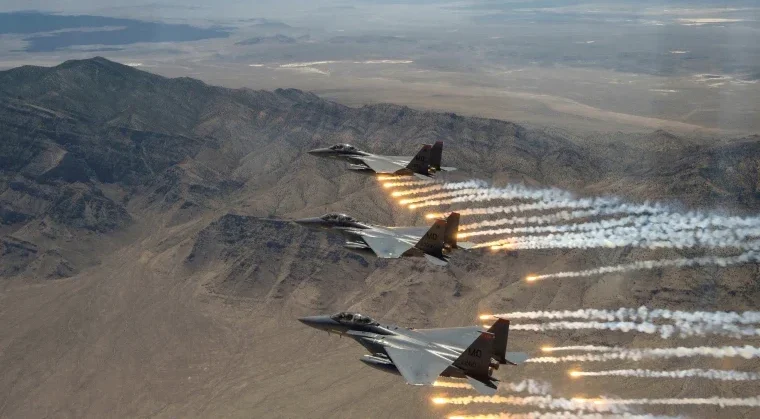
THE United States has carried out airstrikes against Islamic State (ISIS) terrorist targets in northwestern Nigeria following authorisation by President Donald Trump, in an operation that Nigerian authorities say was conducted through established security cooperation frameworks between both countries.

News Point Nigeria reports that President Trump announced the military action on Thursday, describing the strikes as “powerful and deadly” and warning ISIS militants to halt attacks on Christian communities in Nigeria.
According to Trump, the operation was carried out on Christmas Day and resulted in the killing of “multiple ISIS terrorists.”


“I have previously warned these Terrorists that if they did not stop the slaughtering of Christians, there would be hell to pay, and tonight, there was,” Trump said in a post on his Truth Social platform.
“May God Bless our Military. MERRY CHRISTMAS to all, including the dead Terrorists, of which there will be many more if their slaughter of Christians continues,” the US President added.
The US Department of Defense later confirmed that American forces had conducted the strike at the request of Nigerian authorities but declined to provide operational details. The US Africa Command (AFRICOM) said the attack took place in Sokoto State and resulted in the deaths of several ISIS militants.
“US forces conducted a strike at the request of Nigerian authorities in Sokoto State, killing multiple ISIS terrorists,” AFRICOM said in a post on X.
US Defense Secretary Pete Hegseth also praised the operation, thanking Nigerian authorities for their cooperation and describing the mission as evidence of Washington’s readiness to confront terrorism in West Africa.
The strikes mark the first known US military action inside Nigeria under Trump’s current administration and come amid heightened rhetoric from Washington over alleged persecution of Christians in the country.

Trump had, in recent months, publicly accused Nigeria of failing to protect Christian communities and re-designated the country as one of “particular concern” over religious freedom. The US also imposed visa restrictions on Nigerian officials earlier this year, citing similar concerns.
However, Nigeria’s Federal Government has consistently rejected claims that violence in the country is driven by religious persecution, maintaining that insecurity affects citizens across religious and ethnic lines.
In a statement released early Friday, Nigeria’s Ministry of Foreign Affairs confirmed the airstrikes, describing them as “precision hits on terrorist targets” conducted within the framework of bilateral cooperation and international law.


“Nigerian authorities remain engaged in structured security cooperation with international partners, including the United States of America, in addressing the persistent threat of terrorism and violent extremism,” the ministry said.
“This has led to precision hits on terrorist targets in Nigeria by air strikes in the North West.”
The ministry stressed that the cooperation includes intelligence sharing and strategic coordination while respecting Nigeria’s sovereignty and international legal obligations.
It also reaffirmed the government’s position that terrorism in Nigeria is not targeted at any single religious group.
“Terrorist violence in any form — whether directed at Christians, Muslims, or other communities remains an affront to Nigeria’s values and to international peace and security,” the statement added.
The airstrikes came as Israeli Prime Minister Benjamin Netanyahu also weighed in on the situation, calling for an immediate end to attacks on Christians in Nigeria and elsewhere.
In a Christmas message posted on X, Netanyahu condemned global persecution of Christians and specifically referenced militant attacks in Nigeria.
“The persecution of Christians or members of any religion cannot and must not be tolerated, and Muslim militant displacement and attacks against Christians in Nigeria that too must end, and it must end now,” he said.
Netanyahu contrasted Israel’s treatment of Christians with alleged persecution in parts of the Middle East and Africa, saying Israel would always stand with Christian communities worldwide.
His comments echoed Trump’s rhetoric and further placed Nigeria at the centre of a growing international debate over the nature of the country’s security crisis.
However, several international organisations, including the European Union and the Economic Community of West African States (ECOWAS), have framed Nigeria’s violence as a complex security challenge driven by terrorism, banditry, and criminality, rather than religious persecution.
Security analysts have warned that framing Nigeria’s crisis solely along religious lines risks oversimplifying the problem and inflaming tensions in a country with a long history of religious coexistence.
Nigeria’s government reiterated that its counter-terrorism strategy prioritises the protection of civilians, national unity, and the rights of all citizens, while continuing to collaborate with international partners to dismantle terrorist networks and prevent cross-border threats.
As investigations into the impact of the US airstrikes continue, authorities say further updates will be communicated through official channels.