

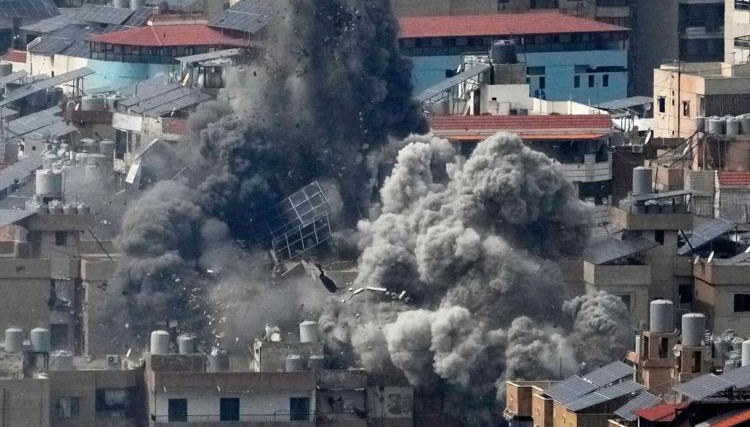
DONALD Trump has renewed his threat to “blow up” a range of civilian infrastructure in Iran, including all of the country’s desalination plants, in a move that would threaten the water source for millions of people and that experts say would be illegal.

The United States president has been regularly warning Iran about possible US strikes against energy and electricity facilities, but on Monday, he added water stations to the list of targets.
“The United States of America is in serious discussions with A NEW, AND MORE REASONABLE, REGIME to end our Military Operations in Iran,” Trump wrote in a social media post.


He added that “great progress” has been made in the talks.
“But, if for any reason a deal is not shortly reached, which it probably will be, and if the Hormuz Strait is not immediately ‘Open for Business,’ we will conclude our lovely ‘stay’ in Iran by blowing up and completely obliterating all of their Electric Generating Plants, Oil Wells and Kharg Island (and possibly all desalinization plants!), which we have purposefully not yet ‘touched’,” the US president said.
International law explicitly bans making civilian sites the “object of attack or of reprisals”.
Yusra Suedi, assistant professor in international law at the University of Manchester, said Trump’s threat “reinforces the climate of impunity around collective punishment in warfare”.
“This is clearly an act of collective punishment, which is prohibited under international humanitarian law. You can’t deliberately harm an entire civilian population to pressure its government,” Suedi told Al Jazeera.
The Fourth Geneva Convention says: “Collective penalties and likewise all measures of intimidation or of terrorism are prohibited.”

Raed Jarrar, advocacy director at the rights group DAWN, said Trump’s threats represent “clear, public evidence of criminal intent”.
“Threatening to obliterate a nation’s power grid, oil infrastructure and water supply to coerce its government is not a negotiating tactic; it is textbook collective punishment and a war crime,” Jarrar told Al Jazeera.
The White House said later on Monday that Trump has made it clear to Iranians that the US has “capabilities beyond their wildest imagination”.


Asked about the illegality of targeting civilian sites, White House spokeswoman Karoline Leavitt told reporters: “This administration and the United States Armed Forces will always act within the confines of the law.”
Annie Shiel, US Director at Center for Civilians in Conflict (CIVIC), described Trump’s threats as “appalling”.
“President Trump is threatening to destroy infrastructure — like electrical and water facilities — that is essential for civilian survival,” Shiel told Al Jazeera.
“The impacts of such attacks would be devastating and widespread: think hospitals without power for life-saving care, illnesses from a lack of clean water, and people completely cut off from communications, unable to reach loved ones or access emergency information.”
Trump first issued a threat to target Iran’s electrical grid and energy infrastructure on March 21 while also giving Tehran a 48-hour deadline to reopen the Strait of Hormuz.
The US president later pushed the deadline back by five days before extending it again until April 6.