

IN its Sunday deep-dive, News Point Nigeria reports that the nation’s political climate is undergoing a quiet but profound transformation triggered by President Bola Ahmed Tinubu’s resignation directive to aspiring officeholders. Far from a mere procedural step, the move has set off a ripple effect that is steadily reshaping alliances, ambitions, and the broader roadmap to 2027.

The directive, conveyed through the Office of the Secretary to the Government of the Federation under George Akume, aligns with Section 88(1) of the Electoral Act and the timetable released by the Independent National Electoral Commission.
It mandates that ministers, advisers, and other political appointees seeking elective office must vacate their positions to ensure fairness, transparency, and a level playing field.


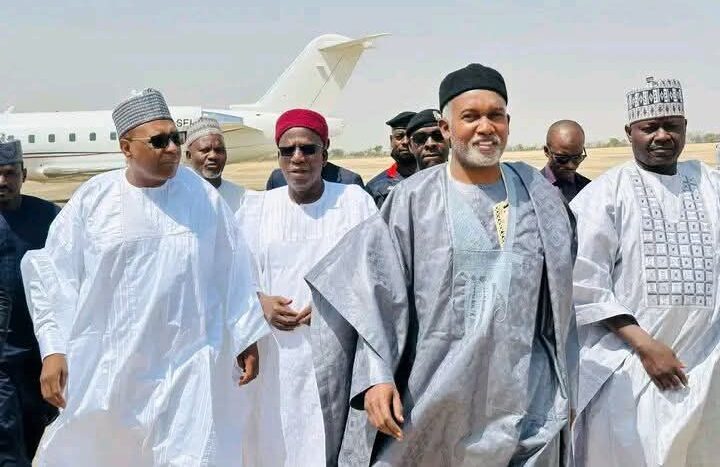
But beyond the legal and procedural implications lies a deeper political story, one playing out in Bauchi State, where two prominent figures in Tinubu’s cabinet, Muhammad Ali Pate and Yusuf Maitama Tuggar, are positioning themselves for a high-stakes contest for the governorship.
Their journeys, ambitions, and contrasting political styles form a compelling narrative of power, perception, and possibility.
Tinubu’s directive is not just administrative, it is strategic. By insisting that appointees resign before participating in party primaries scheduled between April 23 and May 30, the president has effectively forced aspirants to choose between incumbency and ambition.
The ripple effect is vast. Ministers, ministers of state, special advisers, senior aides, and heads of government agencies are all affected. The message is clear: governance and political ambition must not overlap.
For Bauchi, however, the directive has done more than enforce compliance, it has accelerated a silent rivalry that has long been brewing beneath the surface.
At the heart of this unfolding drama are two men with distinct trajectories.

On one hand is Pate, a technocrat with global recognition, a public health expert whose career spans international institutions and national service. On the other is Tuggar, a seasoned politician and diplomat, whose journey has been deeply rooted in Nigeria’s political trenches.
Both men are no strangers to ambition. Both have contested before. And both now see 2027 as their defining moment.
For Pate, the governorship ambition is not new. His attempts date back to 2015 under the PDP, followed by bids in 2019 and 2023 under different platforms. Though unsuccessful, each attempt has added to his political learning curve.


What distinguishes Pate today is evolution.
Once perceived as distant and reluctant to engage in grassroots politics, he is now seen as adapting. His tenure as Coordinating Minister of Health has not only elevated his national profile but also reshaped his political image.
Support for him appears to be organic and growing. Youth groups, no fewer than 101 have publicly called on him to run. Their argument is simple: competence, integrity, and vision.
Behind this momentum is a narrative carefully built around impact. From job creation claims to healthcare reforms, Pate’s supporters argue that his work has translated into tangible benefits, particularly for Bauchi indigenes.
He is also believed to enjoy significant backing from Abuja, with perceived goodwill from Tinubu’s inner circle. His international connections, including associations with figures like Bill Gates and Aliko Dangote, add another layer of influence, one that transcends local politics.
Yet, his path is not without obstacles.
The most significant is structural: Bauchi Central, his zone, has never produced a governor. Since 1999, power has rotated between the North and South, with the South dominating due to its population advantage.
For Pate, this is both a challenge and an opportunity. Breaking that pattern would require not just ambition, but coalition-building across entrenched political divides.
If Pate represents technocratic evolution, Tuggar embodies political experience.
A former member of the House of Representatives and a long-time political actor, Tuggar’s journey dates back to the Congress for Progressive Change (CPC). He has contested governorship elections before and even came second in 2011 against Isa Yuguda.
His credentials are solid. His exposure, both legislative and diplomatic is extensive.
Yet, in politics, perception often rivals reality.
Some sources told News Point Nigeria Sunday that Tuggar’s biggest weakness lies not in his experience, but in his connection or lack thereof with the grassroots. He is frequently described as distant, inaccessible, and disengaged from local political structures.
The sources point to his limited presence in Bauchi outside election cycles and his perceived inability to build enduring alliances.
Even within his party, the APC, he faces stiff competition not just from Pate, but also from figures like Senator Shehu Buba.
More critically, his relationship with the incumbent governor, Bala Mohammed, has deteriorated sharply. No analysis of Bauchi politics is complete without Bala Mohammed.
As governor under the PDP, Bala controls the state’s political machinery, commands loyalty, and influences the security architecture. His role in determining the outcome of 2027 directly or indirectly cannot be overstated.
Once allies under Yuguda’s mentorship, Bala and Tuggar are now estranged. Their fallout, fueled by political disagreements and public confrontations, has added a personal dimension to the contest.
A widely reported altercation at a high-profile wedding underscored the depth of the rift, with tensions spilling into the open.
For Tuggar, this presents a formidable challenge. Competing in a PDP-controlled state without the governor’s goodwill is a steep uphill task.
For Pate, however, the dynamics may be different. Speculation that Bala could reconcile with the Tinubu administration or even defect to the APC introduces a wildcard. If such a shift occurs and Bala backs Pate, the balance could tilt significantly.
The Tuggar–Pate strive ultimately boils down to two contrasting strengths.
Tuggar has the advantage of political experience, a history of contestation, and a legacy rooted in traditional politics. But his perceived rigidity and limited grassroots engagement raise questions about his electability.
Pate, on the other hand, is building momentum through adaptability, strategic alliances, and a growing connection with key demographics particularly the youth. His challenge lies in overcoming structural barriers and proving that technocratic success can translate into political victory.
In Nigeria, elections are rarely decided by credentials alone. They are shaped by money, relationships, and timing.
An Emir in Bauchi, who spoke to News Point Nigeria Sunday on condition of anonymity, noted that while Pate may have access to substantial resources and influential networks, his success will ultimately depend on how effectively they are deployed. Wealth without strategy, he warned, can be squandered, just as influence without strong local grounding may prove ineffective.
For Tuggar, the challenge is different. He must rebuild trust, expand his network, and demonstrate tangible impact both politically and developmentally.
Beyond strategy and structure lies a more intangible factor: character. Politics is as much about perception as it is about policy. Leaders who are seen as approachable, responsive, and empathetic often gain an edge. Here, Pate appears to be gaining ground, while Tuggar faces the task of reshaping his public image.
As the March 31 resignation deadline approaches, the contours of the 2027 race are becoming clearer.
For Pate and Tuggar, the decision to step down from the federal cabinet will mark the beginning of a new phase, one that will test not just their ambition, but their resilience, strategy, and connection to the people.
Bauchi stands at a crossroads. Will it embrace a technocrat seeking to redefine its political history, or return to a seasoned politician aiming to complete a long journey? The answer will not come easily. It will emerge from a complex interplay of power, perception, and political maneuvering.
But one thing is certain: the Tuggar–Pate Bauchi contest is more than a race, it is a reflection of the evolving nature of Nigerian politics itself.