

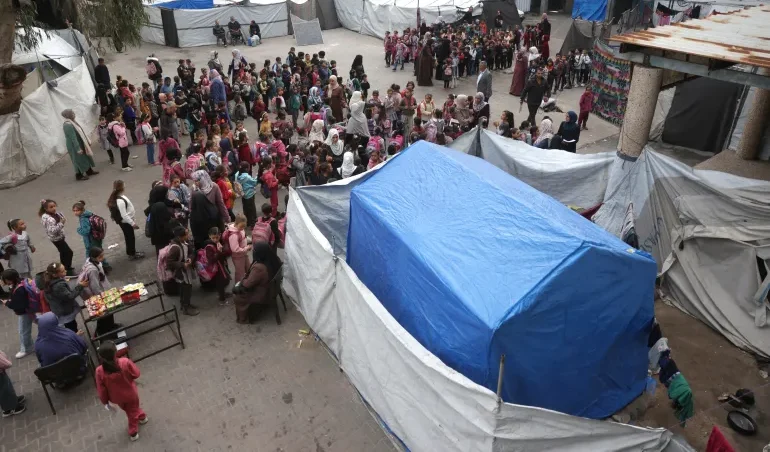
IN a small tent overshadowed by the sound of nearby gunfire, seven-year-old Tulin prepares for her first day of school in two years.

For most children, this would be a moment of excitement. For Tulin and her mother, it is a chapter of terror.
The relentless Israeli war has destroyed the vast majority of Gaza’s educational infrastructure, forcing families to create makeshift “tent schools” in dangerous proximity to Israeli forces — an area demarcated by Israel as the “yellow zone” west of the separation line, often just a few metres away from danger.


“Until my daughter gets to school, I honestly walk with my heart in my hand,” Tulin’s mother told Al Jazeera correspondent Shady Shamieh.
“Many times, I find myself involuntarily following her until she reaches the school. I feel there is something [dangerous], but I want her to learn,” she added. “If not for this situation, she would be in second grade now. But we are determined.”
The journey to the classroom is perilous. Walking through the rubble of Beit Lahiya, Tulin admits she is terrified of the open spaces.
“When I go to school, I am afraid of the shooting,” Tulin said. “I can’t find a wall to hide behind so the shelling or stray bullets don’t hit us.”
Inside the tents, protection is nonexistent. The canvas walls cannot stop bullets, yet the students sit on the ground, determined to learn.
Their teacher describes a harrowing daily routine where education is frequently interrupted by the crack of sniper fire.

“The location is difficult, close to the occupation [forces],” the teacher explained. “When the shooting starts, we tell the children: ‘Take the sleeping position.’ I get goosebumps, praying to God that no injuries occur. We make them lie on the ground until the shooting stops.”
“We have been exposed to gunfire more than once,” she added. “Despite this, we remain. The occupation’s policy is ignorance, and our policy is knowledge.”
Among the students is Ahmed, who lost his father in the war. “We come with difficulty and leave with difficulty because of the shooting,” he told Al Jazeera. “But I want to fulfil the dream of my martyred father, who wanted to see me become a doctor.”


The desperate scenes in Beit Lahiya reflect a wider collapse of the education system in the enclave.
Speaking to Al Jazeera Arabic on Monday, Kazem Abu Khalaf, the spokesperson for UNICEF in Palestine, described the situation as “one of the biggest catastrophes”.
“Our figures indicate that 98 percent of all schools in the Gaza Strip have suffered varying degrees of damage, ranging up to total destruction,” Abu Khalaf said.
He noted that 88 percent of these schools require either comprehensive rehabilitation or complete reconstruction.
The human toll is staggering: approximately 638,000 school-aged children and 70,000 kindergarten-aged children have lost two full academic years and are entering a third year of deprivation.