

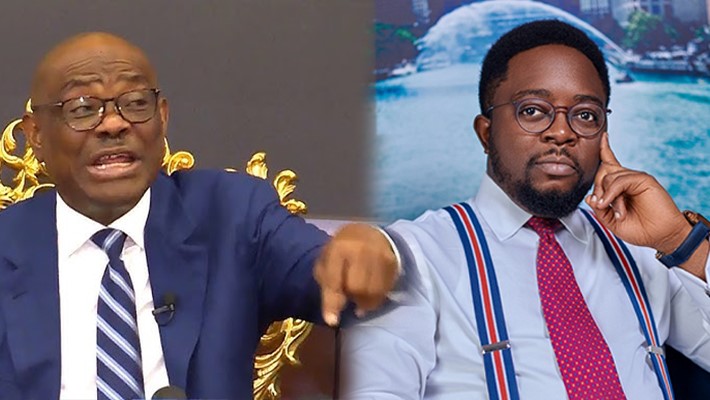
MINISTER of the Federal Capital Territory, Nyesom Wike, is facing mounting backlash after a controversial statement in which he said he would have “shot” a television presenter during a live broadcast sparked outrage across the country.
News Point Nigeria reports that the remark, directed at Seun Okinbaloye, anchor of Politics Today on Channels Television, has drawn condemnation from media organisations, civil society groups, and international human rights bodies, including Amnesty International.
The controversy traces back to a recent edition of Politics Today, where Okinbaloye raised concerns about Nigeria’s evolving political landscape ahead of the 2027 general elections.


During the programme, the journalist warned about the dangers of a shrinking opposition space, particularly in light of the crisis surrounding the African Democratic Congress (ADC) and its leadership dispute with the Independent National Electoral Commission (INEC).
Okinbaloye argued that a healthy democracy depends on robust political competition, cautioning against the emergence of a one-party dominant system.
“What makes the race very interesting is when it’s competitive and not when only one party stands… If this hope is dashed, we are doomed democratically speaking,” he said.
He further lamented the internal challenges facing opposition parties, describing the ADC as one of the key hopes for political balance ahead of the next election cycle.
Responding during a live media chat, Wike criticised the journalist for what he described as a lack of neutrality and an attempt to impose personal views during an interview.
“I was thoroughly surprised yesterday when I was watching Seun’s Politics Today. If there was any way to break the screen, I would have shot him,” Wike said.

He added: “You are now telling them your own view, as an interviewer, that you can’t allow a one-party state… I am not saying I will kill him. I am just angered that he made that kind of statement on national television.”
Although the minister later clarified that he had no intention of physically harming the journalist, the remark has continued to generate intense criticism.
In a statement sent to News Point Nigeria, Amnesty International described Wike’s comment as “reckless and violent,” warning that such rhetoric could incite harm against journalists.


“What Wike said carries the danger of normalising violence and encouraging the targeting of journalists for just doing their job,” the organisation stated, calling for an immediate retraction and apology.
The group also argued that the comment may violate Nigeria’s broadcasting standards overseen by the Nigerian Broadcasting Commission.
Similarly, a coalition of 14 civil society and media organisations including the International Press Institute, Media Rights Agenda, and YIAGA Africa condemned the minister’s remarks and demanded a public apology.
The coalition stressed that even hypothetical expressions of violence by public officials can have serious implications.
“Such rhetoric can be perceived as intimidation… Conditional threats or violent statements against journalists contribute to a climate of fear,” the groups said.
They further warned that such language undermines democratic accountability and erodes public trust in governance.
According to global press freedom rankings, the country currently sits at 122 out of 180, reflecting persistent issues such as harassment, surveillance, and arbitrary arrests of media professionals particularly during election periods.
The controversy has also dominated social media discussions, with Nigerians expressing a mix of outrage, criticism, and satire.
Many users described the comment as inappropriate and unbecoming of a public official, while others debated the broader issue of journalistic objectivity versus freedom of expression.
As the backlash continues, pressure is mounting on Wike to formally apologise, with critics arguing that the episode highlights the fragile relationship between political power and media independence in Nigeria.