

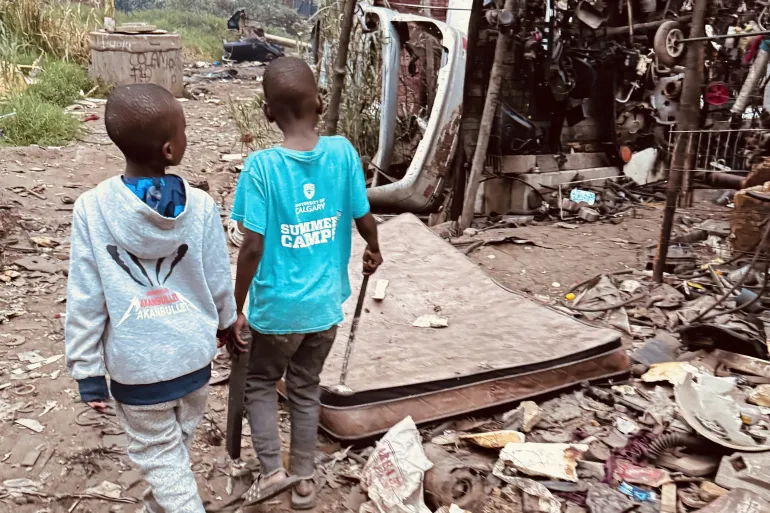
ON a drizzly Sunday evening in the Zimbabwean capital, three boys aged between six and nine scout for scrap metal just as the informal welders in Siyaso Market are about to close for the day.
Early the next day, the boys return to the informal steel fabrication market, which is now partly turned into collection points for discarded metal components, to pick up the scrap for reselling.
“We are only afraid of the dogs that can chase you, but usually we are safe, and no one suspects us [of stealing],” says eight-year-old Takudzwa Rapi. “Sometimes they allow us to pick the scrap whenever they have something they no longer want.”


Takudzwa stops by the roadside to buy doughnuts with the previous day’s earnings. He keeps some for his older sister back at home in Matapi flats, dilapidated council-run apartments that were plagued by a bedbug outbreak last year.
Siyaso is located near Mbare, a low-income neighbourhood just south of the city centre of Harare. Mbare is a bustle of activity with scrap metal-pickers – mostly unemployed people or those from poor backgrounds in search of any discarded metal.
Waste-pickers carry sackfuls of scrap metal while those with bulky supplies use hand-pushed carts that can carry up to 1 tonne.
While adult waste-pickers are mostly involved in plastic and bottle recycling in Zimbabwe, children like Takudzwa have also jostled their way into the scrap trade – rummaging for anything from motor vehicle engine components, metal cut-offs from fabrication, or copper- and brass-coated plates.
This is despite the country’s child labour laws that prohibit employment for children below the age of 16.
Takudzwa and his friends usually go to Siyaso before and after school, strolling around the welding and fabrication yards or rubbish heaps for scrap metal, which they carefully pile up in a sack in a nearby corner.

Traders and dealers in Mbare then buy scrap metal from the boys for anything between 10 and 20 US cents per kg, depending on the quality. Three traders here admitted to Al Jazeera that they underpay young scrap metal-pickers because they “are not looking for big money” compared with the adult pickers, they said.
Another of the boys, Quinton Gandiwa, also eight years old, says he gets paid more for brass- and copper-coated scrap. For that, the boys can earn up to $1 per small piece.
“Brass and copper pieces pay more but are hard to come by,” Quinton says. “We have to forage in less popular areas such as rubbish heaps, and, on a good day, you get lucky and get 1 dollar or more for just a small piece, which is a lot, and we can buy whatever we want for home and for school.”


The boys hope to make a few dollars or cents to help their parents pay for household necessities, they say. But the hazardous occupation comes with risks.
At a waste site in Siyaso, Wayne Mpala, now 33, says he started picking for scrap as a child.
Although he knows it is a way for young children to earn much-needed money, he says the boys foraging for scrap metal risk health and safety hazards.
He recalls an incident 25 years ago when, aged seven, a sharp nail pierced through the soft heel of the plastic sandal he was wearing. The injury stopped him working for two weeks, but he was lucky not to contract tetanus, he says.
The young boys’ scrap collection activities in Mbare are indeed risky, said Adolphus Chinomwe, a senior programme officer for the International Labour Organisation’s (ILO) Zimbabwe office.
“Hazardous child labour is work in dangerous or unhealthy conditions that could result in a child being killed or injured or made ill as a consequence of poor safety and health standards and working arrangements,” Chinomwe says.
He would like the government of Zimbabwe to intervene.
Though child labour is illegal under the constitution, the United States Department of Labor found in 2022 that the Southern African country is still witnessing some of the “worst forms” of it, with 14 percent of children aged 5 to 14 part of the workforce.
The ILO estimates that some 4.2 million children in Zimbabwe are involved in child labour.
Al Jazeera reached out to Zimbabwe’s Ministry of Public Service, Labour and Social Welfare with questions about what action the government is taking to protect children exposed to illegal employment, but it did not respond.
Analysts say the global scrap metal recycling market was worth about $64bn in 2025 and is projected to rise to $94bn by 2032 because of demand from the global construction sector. Furthermore, rising demand for scrap metals such as iron, copper and aluminium is being fuelled by rapid industrialisation and urbanisation in developing regions.
The African Development Bank acknowledges the intensifying steel recycling wave in Zimbabwe. It said in a 2021 report that “African countries without domestic iron ore production such as Zimbabwe also produce crude steel, potentially relying on imports or recycle scrap to produce iron and steel” products.
Observers say this means that more young boys from poor backgrounds are increasingly venturing into dangerous work at the bottom of the supply chain to access that steel and iron.
According to a 2025 report from the United Nations Children’s Fund (UNICEF), nearly 138 million children were already engaged in child labour globally, including about 54 million in “hazardous work” likely to jeopardise their health, safety or development. Sub-Saharan Africa continues to carry the heaviest burden, accounting for nearly two-thirds of all children in child labour worldwide.