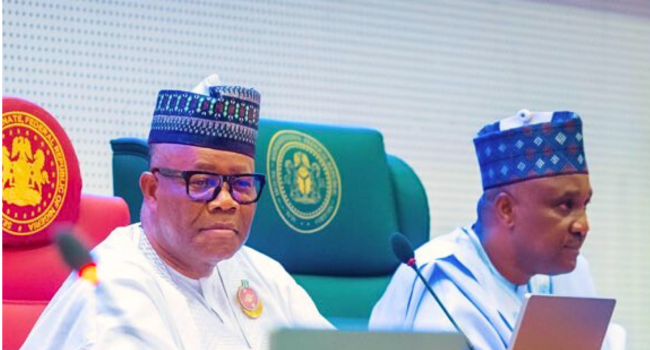

LAST week, the 10th National Assembly held its Open Week in Abuja, three days of events, presentations and self-congratulation themed around the slogan ‘Advancing Transparency, Inclusion and Reform.’ Senate President Godswill Akpabio declared the chamber had passed well over 100 bills, more than any previous Senate at this stage of Nigeria’s democratic journey. Speaker Tajudeen Abbas unveiled figures showing the House of Representatives had introduced 2,747 bills since June 2023, passing 363 of them. It was, by all accounts, an impressive display of institutional confidence. There was only one problem: another set of numbers told a very different story.
The civic-tech organisation AdvoKC Foundation, through its Promise Tracker NG platform, had weeks earlier released an independent assessment of the 10th National Assembly’s three-year record. The verdict was sobering. Of 92 legislative commitments tracked across both chambers, 68 had not been delivered. The House of Representatives fulfilled just 13 of its 56 tracked commitments a performance score of 26.8 per cent. The Senate did better, keeping 9 of its 34 promises with 12 partially fulfilled, giving it a score of 44.11 per cent. To put it plainly: three years in, the House has broken roughly twice as many promises as it has kept, and the Senate has not covered itself in glory either.
Read also: The Ondo Air Crash: Mourning Is Not Enough – By Jonathan Nda-Isaiah
Now before I go further, let me say what these figures do not mean. They do not mean the 10th Assembly has been useless. Credit where it is due , this Assembly passed the state police constitutional amendment, the Electoral Act 2026, the Student Loan Act through NELFUND, the Minimum Wage Act and several tax reform bills that were long overdue. These are real pieces of legislation that will have real consequences for Nigerians, and dismissing them would be intellectually dishonest. The Senate President is right that the legislative output in volume terms is significant. A legislature that spent three years doing absolutely nothing would not have produced the state police bill or the tax reform package.
But here is the question that the Open Week festivities did not answer: why is the quantity of bills passed so disconnected from the quality of life outside those chambers? The House passed 363 bills. Presidential assent was secured for 72. The rest are sitting somewhere in the gap between legislation and implementation in the executive’s inbox, in underfunded agencies, in state governments that received the law but not the resources to execute it. AdvoKC’s Project Director, Habib Sheidu, put it correctly when he said legislative agendas are not aspirational wish-lists , they are public covenants with citizens. By that measure, the 10th Assembly still has significant debt to settle.
Take the issue of budget implementation, which is perhaps the most revealing single indicator of whether a legislature is doing its actual job. According to reports, budget implementation under the 10th Assembly has been judged among the worst in recent times. Think about that for a moment. The National Assembly approves the budget. The National Assembly is supposed to oversee its implementation. Oversight committees exist in both chambers for every ministry, department and agency in the federal government. Those committees have powers of summons, of inquiry, of sanction.
If the budget is being poorly implemented year after year, what exactly are those committees doing? You cannot claim credit for passing an appropriation act and simultaneously wash your hands of what happens to that money between Abuja and the local government where it was supposed to build a health centre or rehabilitate a road. The money either got there or it didn’t. If it didn’t, someone should be explaining themselves to a committee and that explanation should be public.
The rubber stamp accusation is the one that clearly stings the most, judging by how forcefully Akpabio denied it at the Open Week. He said constructive partnership with the executive should not be mistaken for constitutional surrender, and that parliament does not prove its independence by manufacturing conflict. That is a fair point in principle. Nobody wants a National Assembly that opposes the executive purely for sport or creates artificial crises to demonstrate muscle.
But there is a wide and meaningful space between manufactured conflict and genuine independence, and the question ordinary Nigerians keep asking is whether the 10th Assembly has been living in that space or whether it has drifted too close to the executive’s orbit. The public perception of rubber-stamping does not emerge from thin air. It comes from watching the legislature wave through executive requests with minimal scrutiny. It comes from a culture in which oversight hearings look like negotiating sessions. It comes from constituency project allocations that make a lawmaker’s relationship with the executive feel more like financial dependence than constitutional partnership. These are not unfair observations , they are the lived experience of watching this institution operate over three years.

Read also: Rule Of Law, Nigeria’s Only Hope Of Survival (1) – By Dr Hassan Gimba
Mind you, I am not blind to the constraints. Our National Assembly operates in a system where the executive controls resources, where party loyalty is enforced from the top down, and where a lawmaker who challenges the presidency too aggressively can find their constituency projects quietly disappearing from the budget. These are real structural pressures. But structural pressures are precisely what strong institutions are supposed to resist. The 9th Assembly under Ahmad Lawan was widely criticised as the most compliant legislature in recent memory. The 10th Assembly came in with promises of a different character. Three years in, the promise tracker says otherwise.
What should the 10th Assembly do with its remaining year because that is what matters now. The retrospective accounting is useful but it cannot change the past. What can change is the record between now and June 2027. Habib Sheidu’s message at AdvoKC was diplomatic but the underlying point was hard: fast-track the trapped constitutional reforms, push through the outstanding commitments, and use the oversight machinery with genuine intent rather than theatre. There are specific items crying out for urgent attention.

The Federal Audit Service Bill has passed both chambers and has been sitting on President Tinubu’s desk for over seven months without presidential assent. According to AdvoKC, this represents the fifth legislative attempt in nearly two decades to give Nigeria a modern federal audit law , five attempts across multiple assemblies and presidencies, and the bill is still not law.
The National Assembly is the institution best placed to press the executive on this. If our legislators truly believe in fiscal accountability and transparent governance, as they said repeatedly at the Open Week, then they should be applying serious pressure to get that assent. Not a press release. Not a courtesy visit. Pressure. The kind that has a deadline attached to it.
There is also the question of what the state police law means on the ground. Passing the constitutional amendment is historic. But the fiscal, judicial and constitutional support structures that governors have said are needed to make it work ,those are still pending. The law exists on paper. The machinery to implement it responsibly is still being assembled. The 10th Assembly has one year to help complete that machinery or risk being remembered as the Assembly that passed the headline and left the detail for someone else.
Let me also say this plainly: the Open Week format is genuinely a good idea and it deserves to be more than a ceremonial exercise. A legislature that voluntarily opens itself to public assessment is doing something most of its predecessors never bothered to do, and that should be acknowledged. Speaker Abbas is right that Nigerians should be more engaged with what happens in those chambers ,the truth is that too many citizens have absolutely no idea what their senator or house member has done or failed to do in three years, and that ignorance is partly what allows underperformance to go unpunished at election time.
Read also: Igbokoda: Is Our Sky Unsafe For Nigerian Air Force Planes? – By Kazeem Akintunde
But the engagement has to go both ways. The National Assembly cannot invite scrutiny, host three days of events, pass out scorecards and call it accountability. The AdvoKC report with its 26.8 per cent fulfilment score for the House must be part of that conversation, not a document quietly filed away while the commendation plaques are being distributed.
One year remains. The 10th National Assembly has the legislation, the mandate and the constitutional tools to leave a meaningful legacy. The question is whether the will is there to use them.
- Nda-Isaiah is a political analyst based in Abuja and can be reached on jonesdryx@gmail.com. His syndicated column appears on News Point Nigeria newspaper on Saturday.