

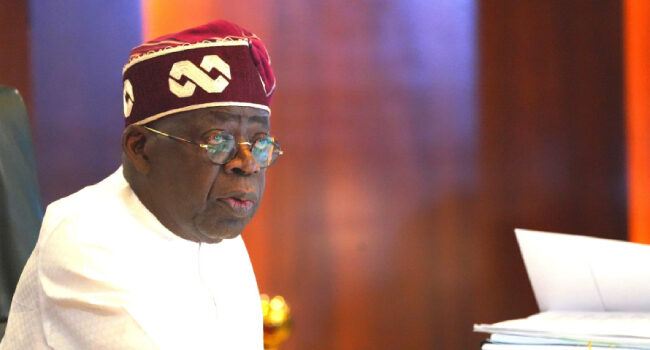
PRESIDENT Bola Ahmed Tinubu on Wednesday summoned the Chief Executive Officer of the Nigerian Midstream and Downstream Petroleum Regulatory Authority (NMDPRA), Engr. Farouk Ahmed, to the Presidential Villa, Abuja, amid escalating allegations of economic sabotage and corruption levelled against him by billionaire industrialist Aliko Dangote.
News Point Nigeria reports that Ahmed was sighted at the Presidential Villa at about 5:30pm, where he proceeded directly to the President’s office.

He reportedly left the Villa less than 25 minutes later, fuelling speculation over the purpose and outcome of the visit.

Although neither the Presidency nor the NMDPRA issued an official statement on the meeting as of press time, a senior source within the Presidential Villa confirmed to News Point Nigeria that the President personally summoned the NMDPRA boss.


“Of course, the President summoned him. You don’t just show up to see the President without his approval,” the source said.
However, the source declined to confirm whether Ahmed actually met President Tinubu during the brief visit, adding that the NMDPRA chief was expected to return to the Villa with documents and further briefings.
“He will be coming back to give the President some briefs and with some documents,” the source added.
Ahmed’s summons comes amid an intensifying public confrontation between the NMDPRA leadership and Aliko Dangote, Africa’s richest man and President of Dangote Industries Limited, over Nigeria’s downstream petroleum regulation and the future of domestic refining.
At a press briefing held on Sunday at the Dangote Petroleum Refinery in Lekki, Lagos, Dangote accused the NMDPRA, under Ahmed’s leadership, of economic sabotage, alleging that regulatory decisions were deliberately undermining local refining efforts.

Dangote claimed that the continued issuance of petroleum import licences by the regulator was discouraging domestic refining, sustaining Nigeria’s dependence on imported fuel, and benefiting foreign traders at the expense of local operators.
He further alleged that the NMDPRA was colluding with international oil traders and fuel importers, a claim the regulator has not publicly addressed.
Beyond regulatory issues, Dangote escalated the dispute by making personal allegations against the NMDPRA chief, accusing him of living far beyond his legitimate means as a public servant.


Dangote alleged that four of Ahmed’s children attend secondary schools in Switzerland, with education and upkeep costs running into several millions of dollars. According to him, such spending raised serious questions about conflicts of interest and the integrity of regulatory oversight in Nigeria’s downstream petroleum sector.
On Monday, Dangote provided further details, claiming that about $5 million was spent on secondary education and upkeep over six years, alongside an additional $2 million on tertiary education. He also alleged that one of Ahmed’s children was enrolled in a 2025 Harvard MBA programme costing approximately $210,000.
The controversy deepened on Tuesday when Dangote, through his lawyer, Ogwu Onoja (SAN), submitted a formal petition to the Independent Corrupt Practices and Other Related Offences Commission (ICPC).
In the petition addressed to the ICPC Chairman, Musa Aliyu (SAN), Dangote called for Ahmed’s arrest, investigation and prosecution over alleged abuse of office, corrupt enrichment and misappropriation of public funds.
The petition reportedly alleged that Ahmed spent over $7 million on the education of his four children in Switzerland without evidence of lawful income, and included the names of the children, the schools attended and specific financial figures for independent verification.
The ICPC has since confirmed receipt of the petition and announced that investigations have commenced.
Despite the gravity of the allegations and growing public scrutiny, neither the Presidency nor the NMDPRA has issued an official response as of the time of filing this report.
Ahmed had described the allegations against him as “wild and spurious,” stating that he would rather respond before a formal investigative body than engage in public exchanges.