

NIGERIA and the United Arab Emirates have scrapped tariffs on more than 13,000 goods under a landmark trade agreement designed to boost bilateral commerce, expand market access for Nigerian products, and accelerate Nigeria’s non-oil export and economic diversification drive.

News Point Nigeria reports that the Federal Government announced on Tuesday that Nigeria has eliminated tariffs on 6,243 products imported from the UAE, while the UAE has removed tariffs on 7,315 products imported from Nigeria, under the Nigeria–UAE Comprehensive Economic Partnership Agreement (CEPA).
The details were disclosed by the Federal Ministry of Industry, Trade and Investment in an official document on the agreement, which was signed in January 2026.


According to the ministry, the CEPA will “expand market access opportunities for Nigerian products, businesses, and professionals into the UAE while facilitating investment flows,” describing the pact as a major step toward deepening economic ties between both countries.
Under the agreement, Nigeria committed to eliminating tariffs on 6,243 UAE products, with 3,949 products (63.3 per cent) enjoying immediate tariff removal. Tariffs on 2,294 products will be phased out over a five-year period, while 123 products were excluded from liberalisation.
On its part, the UAE agreed to eliminate tariffs on 7,315 Nigerian products, removing duties immediately on 2,805 products (38.3 per cent). Tariffs on 1,468 products will be phased out within three years, while 3,042 products will be liberalised over five years. The UAE excluded or prohibited 593 products.
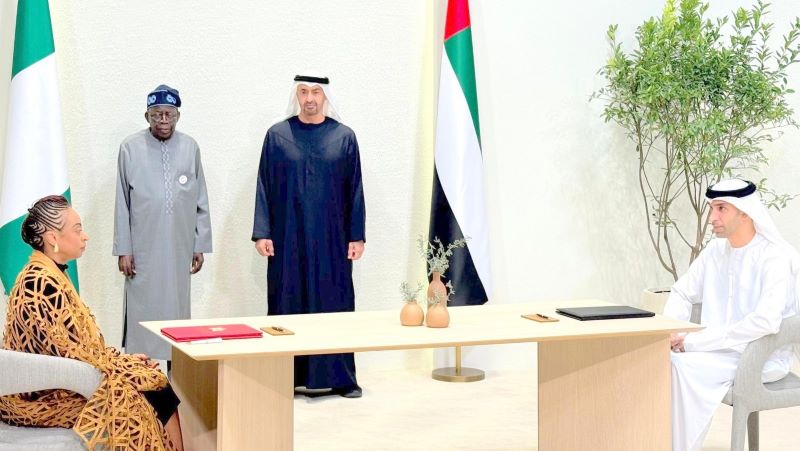
The agreement was signed on January 13, 2026, following negotiations led by Nigeria’s Minister of Industry, Trade and Investment, Dr Jumoke Oduwole, with technical support from the Federal Ministry of Justice and the Nigeria Customs Service.
Dr Oduwole and the UAE Minister of Foreign Trade, Dr Thani bin Ahmed Al Zeyoudi, signed the pact in the presence of President Bola Ahmed Tinubu and UAE President Sheikh Mohamed bin Zayed Al Nahyan.
The Federal Government said the tariff elimination would significantly open the UAE market to a wide range of Nigerian agricultural, primary, industrial, and manufactured goods.

Under agricultural and primary products, the UAE will immediately remove tariffs on fish and seafood, cereals and milling products, oil seeds, live animals and meat products, fruits and nuts, raw hides and skins, cotton and vegetable textile fibres, and other animal products.
Tariffs on cocoa and cocoa preparations, coffee, tea and spices, mineral fuels, wood and wood articles, precious stones and metals, and animal and vegetable fats and oils will be eliminated over a three- to five-year period.
For industrial and manufactured goods, the UAE will immediately scrap tariffs on pharmaceutical products, organic and inorganic chemicals, paper and paperboard, printed books, and newspapers. Tariffs on machinery, vehicles, electrical equipment, apparel, furniture, footwear, ceramics, and glass will be phased out over three to five years.


However, the UAE will maintain import prohibitions on 35 products, including pork and pork products, narcotic substances, used tyres, and asbestos-containing products.
On the Nigerian side, the agreement provides expanded access for UAE industrial and consumer goods. Nigeria will immediately remove tariffs on mineral fuels, machinery, vehicles, electrical equipment, iron and steel, plastics and related articles, while tariffs on fish, fruits, vegetables, and apparel will be phased out over five years.
Nigeria excluded 123 sensitive products from tariff elimination, including meat and dairy products, certain vegetables, vegetable oils, cocoa preparations, cereal and flour products, tomato paste, alcoholic beverages, soaps and detergents, and some cotton yarns and fabrics.
The ministry stressed that Nigeria’s Import Prohibition List remains in force as a separate policy measure.
Beyond trade in goods, the CEPA also covers services and investment. Nigeria made commitments covering 99 specific services across 10 sectors, while the UAE committed to 108 services across 11 sectors.
Under the agreement, Nigerian business visitors will be allowed to enter the UAE to explore trade and investment opportunities, while Nigerian entrepreneurs will be able to establish corporate entities and operate in the UAE under clear regulatory protections.
The Federal Government said the agreement would allow Nigerian businesses “to move with confidence, seize opportunities in the UAE, and benefit from robust protections,” while supporting the Renewed Hope Agenda of the Tinubu administration.
The government noted that the pact would also help remove obstacles to foreign direct investment from the UAE into Nigeria, reinforcing Nigeria’s position as a preferred investment destination and a gateway to the ECOWAS sub-region and the African Continental Free Trade Area (AfCFTA).
It added that the CEPA aligns with Nigeria’s obligations under the World Trade Organisation, AfCFTA, and ECOWAS, without undermining existing regional and continental commitments.
Following the signing, the Federal Government said it would work closely with relevant agencies, including the Nigeria Customs Service, Nigerian Export Promotion Council, and Nigerian Investment Promotion Commission, to ensure smooth implementation of the agreement.
Exporters and investors were advised to seek further information on product coverage, services commitments, rules of origin, and export procedures from the Ministry of Industry, Trade and Investment and other relevant agencies.
The government expressed optimism that the agreement would translate into increased exports, job creation, stronger investment flows, and deeper economic cooperation between Nigeria and the UAE.