

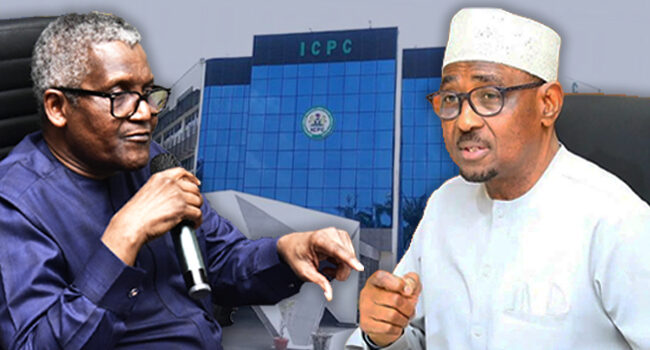
THE Economic and Financial Crimes Commission (EFCC) has commenced an investigation into a petition filed by the President of Dangote Industries Limited, Aliko Dangote, against the former Managing Director of the Nigerian Midstream and Downstream Petroleum Regulatory Authority (NMDPRA), Farouk Ahmed, over alleged abuse of office and unlawful expenditure of public funds.
Findings by News Point Nigeria indicate that the anti-graft agency has begun preliminary investigative steps, including writing to relevant local and international institutions named in the petition, notably a Swiss secondary school where Ahmed’s children are reportedly enrolled.
Dangote had initially submitted a petition in December 2025 to the Independent Corrupt Practices and Other Related Offences Commission (ICPC), alleging that Ahmed spent approximately $7 million on the education of his children in Switzerland while serving as head of the petroleum regulatory agency.


In the petition, Dangote accused the former NMDPRA boss of violating the Code of Conduct for Public Officers by allegedly diverting public funds to finance the overseas education of his children, an action he described as unlawful and unethical.
However, the petition was formally withdrawn from the ICPC on January 5, 2026, through a letter issued by Dangote’s legal counsel. Despite the withdrawal, the ICPC announced that it would proceed with its investigation in line with Sections 3(14) and 27(3) of its enabling Act, which empowers the commission to act on allegations of corruption in the public interest, regardless of petition withdrawal.
Subsequently, on July 6, the Dangote Group media team confirmed that a fresh petition against Ahmed had been submitted to the EFCC through Dangote’s legal representatives, effectively transferring the matter to Nigeria’s leading financial crimes watchdog.
Speaking with News Point Nigeria on Saturday, a senior EFCC official familiar with the case confirmed that the commission had opened an investigation but clarified that Ahmed had not yet been invited for questioning.
According to the official, who requested anonymity due to the sensitivity of the investigation, the EFCC is following its standard investigative procedure by first verifying claims contained in the petition through correspondence with individuals, organisations and institutions referenced in the allegations.
“We have prepared the ground and have started working on it. We have not invited the accused,” the official said.

“We are writing to all the parties mentioned in the petition. Whoever is indicted is always the last to be invited. All the parties mentioned will be written to, to provide information that will be used to confront the person accused.”
The source explained that both local and international engagements must be completed before any invitation is extended to the former NMDPRA chief.
“When you have not carried out both local and international engagements, you cannot just invite the accused. What we are doing is the normal investigative procedure of writing to all the relevant entities and parties—companies, government bodies and international institutions—involved to obtain their responses. Inviting the accused will come last,” the official added.


Another EFCC official confirmed that the investigation could involve direct correspondence with the Swiss school mentioned in the petition in order to verify the claims relating to tuition payments.
“We will have to confirm some claims in the petition; and this may lead to writing to the Switzerland school mentioned in it,” the official said.
The EFCC has previously written to educational institutions, both within and outside Nigeria, as part of investigations into alleged misuse of public funds to pay school fees.
As of the time of filing this report, Farouk Ahmed has not publicly responded to the allegations or confirmed whether he has been contacted by any anti-graft agency.