

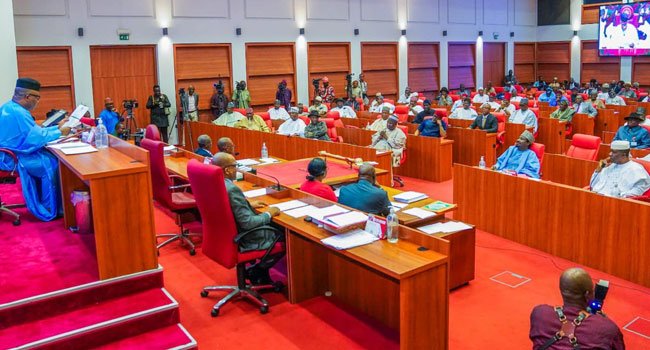
THE Senate on Thursday declared that Nigeria is not yet prepared for real-time electronic transmission of election results in the strict sense of e-voting, insisting that the Independent National Electoral Commission (INEC) currently lacks the technical capacity to conduct fully electronic elections.
News Point Nigeria reports that the Chairman of the Senate Ad-hoc Committee reviewing the 2026 Electoral Bill, Senator Adeniyi Adegbonmire, made the clarification during an interview on Arise News, amid sustained public debate over provisions relating to electronic transmission of results and the use of the INEC Result Viewing Portal (IReV).

According to the Senate, widespread public commentary has wrongly equated the uploading of polling unit results to IReV with the adoption of an electronic voting system.


Adegbonmire stressed that IReV is not an e-voting platform but merely a digital portal designed to publicise results that have already been manually counted and declared at polling units.
“IReV is not an e-voting platform as some people think,” he said. “It is software developed by INEC to publicise election results that have been manually counted and declared. It does not count votes, and it does not show how individuals voted.”
He explained that under the current system, voting remains manual. Ballots are thumbprinted, counted manually at polling units, and recorded in Form EC8A by the presiding officer. Only after the form is completed and signed by party agents are the results uploaded to the IReV portal.
The senator noted that changing the terminology in the Electoral Bill from “transmit” to “upload” would not alter the process.
“If we change ‘transmit’ to ‘upload,’ will it change anything? The answer is No. What is transmitted or uploaded is a manually completed form,” he stated.
Adegbonmire maintained that real-time transmission in its purest sense would require a full electronic voting system — a system Nigeria has not yet implemented.

“Real-time transmission can only happen if INEC adopts e-voting. For now, INEC does not have that capability. Maybe in two or three years, we can adopt e-voting. But as of today, that system is not in place,” he said.
He dismissed claims that the Senate had moved to weaken electronic transmission, describing such assertions as misinformation.
“The Senate never said INEC should not use IReV for the 2027 elections,” he clarified. “It is a misconception to conclude that the Senate declined the use of IReV.”


The Ondo Central lawmaker highlighted Nigeria’s vast geography and logistical complexities as key challenges to simultaneous nationwide uploads.
He illustrated the point using Ondo State as an example, noting that electoral materials are often transported days before elections and distributed to remote communities, some accessible only after hours of travel by road or boat.
“In some areas, voting may not start until 2:00 p.m. or even 4:00 p.m. due to terrain and logistics. Meanwhile, in urban centres, voting could conclude much earlier,” he said.
According to him, enforcing rigid timelines for uploading results could create unnecessary suspicion.
“If a result is declared at 2:00pm and it appears online at 7:00 p.m., people may assume manipulation, even when delays are caused by network issues,” Adegbonmire warned.
He cautioned that Nigeria’s inconsistent internet connectivity remains a major hurdle, adding that not every upload attempt succeeds immediately.
“You and I know that it is not every time you put something on the Internet that it goes through freely. If we are not careful, the smallest delay will spark allegations,” he said.
The Senate had constituted a seven-member ad-hoc panel to review the report of its Committee on Electoral Matters and address grey areas in the Electoral Act (Repeal and Re-enactment) Amendment Bill, 2026.
The upper chamber recently approved the electronic transmission of results to IReV but retained manual collation as a fallback mechanism where technological challenges arise.
Adegbonmire emphasized that the National Assembly cannot reconfigure INEC’s software through legislation.
“IReV has a pattern of operation. The National Assembly cannot change the software by mere legislation. Whether we call it upload, transfer, or transmission, it will function in the way it was designed,” he said.
He added that compliance with proper documentation procedures — particularly the completion and signing of Form EC8A — remains the legal foundation of the electoral process.
“When you have not complied with the proper filling of Form EC8A, you cannot upload or transmit anything. That is what people must understand,” he stressed.
The senator also urged the media to exercise caution in reporting electoral matters, warning that misinterpretations could inflame tensions and undermine public trust.
“This is not an emotional argument,” he said. “The media need to be careful how they report these issues because of their implications for national stability.”
As debate over electoral reforms continues ahead of the 2027 general elections, the Senate maintains that while electronic publication of results remains part of the system, Nigeria has yet to transition to full electronic voting, a move lawmakers say will require significant technological investment and infrastructure upgrades.
For now, the message from the upper chamber is clear: uploading results online is not the same as conducting elections electronically.