

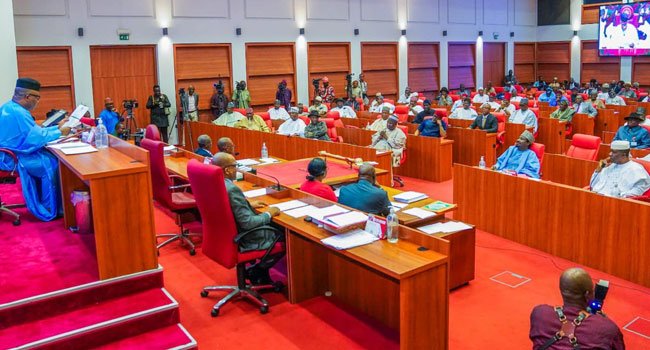
THE Senate on Thursday confronted the President’s economic management team over what it described as poor implementation of the 2025 budget and unrealistic assumptions underpinning the proposed ₦58.7 trillion 2026 budget, raising the possibility of trimming the ambitious spending plan.
News Point Nigeria reports that the sharp exchanges occurred during a tense budget defence session before the Senate Committee on Appropriations, where key members of the economic team appeared to defend the Federal Government’s fiscal projections.
Several lawmakers expressed frustration over widespread complaints from Ministries, Departments and Agencies (MDAs) regarding non-funding of the 2025 budget. Senators cited reports of unpaid contractors, inadequate capital releases, and mounting liabilities as evidence of serious implementation gaps.


Some members of the committee described the exercise as one of the most troubling budget defence sessions in recent times. They pointed to concerns surrounding a controversial centralised payment system, delays in fund disbursement, and Nigeria’s rising debt profile as issues requiring urgent clarity.
Dissatisfied with explanations offered by the Minister of Finance and Coordinating Minister of the Economy, Wale Edun, the committee sought further clarification from the Chairman of the National Revenue Service, Zacch Adedeji.
Adedeji acknowledged that past budgets were often constructed on faulty or overly optimistic assumptions, which ultimately undermined implementation.
“When assumptions are not real, there will be a problem. That is what we intend to correct this year. It must be based on realistic budgeting. Efficiency lies in what you can actually execute,” he said, urging lawmakers to embrace projections anchored on credible revenue expectations.
Chairman of the Committee, Senator Adeola Olamilekan, pressed the economic team on whether they were fully confident in delivering the ₦58.7 trillion proposal.
“The indication is that you do not have full confidence in the ₦58.7 trillion budget. Do we reduce this budget or leave it as it is? If it is faulty and we are not reducing it, then you are saying you will meet it?” he asked.

His remarks underscored growing scepticism within the legislature about the government’s ability to meet its revenue and expenditure targets in light of persistent fiscal pressures.
Responding to questions on the 2025 budget’s performance, the Minister of State for Finance assured lawmakers that steps were being taken to address funding gaps.
She disclosed that MDAs had been directed to upload their cash plans for all pending obligations with immediate effect. According to her, the Federal Government was prepared to begin settling outstanding payments, with disbursements expected to commence immediately or, at the latest, by Monday.


The assurance was aimed at calming concerns over delayed payments to contractors and service providers, which lawmakers warned could hamper economic activity and public confidence.
Following the heated exchanges, the committee went into a closed-door session to deliberate further on the 2026 budget framework and the implementation record of the current fiscal year.
As deliberations continue, the Senate’s insistence on realism signals heightened legislative scrutiny over fiscal policy, amid growing public pressure for improved transparency, accountability, and effective budget execution.