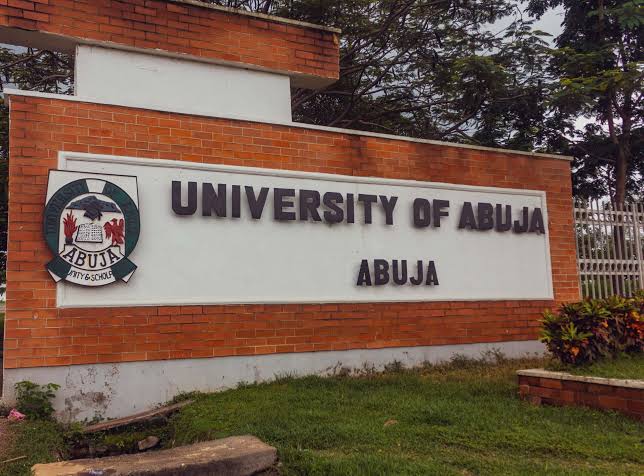
A GLIMMER of light may finally be appearing at the end of the tunnel for the leadership crisis that has cast a long shadow over the University of Abuja. Recent pronouncements by the Federal Government regarding the status of medical fellowships vis-à-vis the PhD in the Nigerian university system have inadvertently reopened the urgent question of leadership legitimacy at the institution.
What initially appeared to be a desperate attempt by the Minister of Education, Tunji Alausa, to create a legal cover for the controversial leadership situation at the University of Abuja has now dramatically backfired. Rather than resolving the matter, the Minister’s own clarification has reignited scrutiny of the legality and propriety of the current arrangement.

Read also: Federal Government Confirms Ebola Case In Abuja, Begins Contact Tracing For 44 People
With the government’s categorical reaffirmation that medical fellowships cannot be regarded as equivalent to a PhD, the controversial appointment of the current Vice-Chancellor of the University of Abuja, Pastor Hakeem Babatunde Fawehinmi, who does not hold a PhD, is once again thrust into the spotlight.

Following the meeting of the Federal Executive Council on Wednesday, 4 March 2026, the media was awash with reports suggesting that the Federal Government had approved a move to allow medical fellowships to be treated as equivalent to PhDs for purposes of academic progression.
According to reports, including those by Premium Times, the Minister initially announced that the government had approved an amendment that would enable medical professionals to treat their fellowships as equivalent to a PhD for academic advancement within Nigerian universities.


The reports further suggested that the proposed reform would involve amendments to the Act establishing the National Postgraduate Medical College of Nigeria and would be transmitted to the National Assembly of Nigeria for legislative consideration.
However, the announcement immediately generated intense controversy within academic circles. In a familiar pattern of policy reversals that has increasingly characterised the management of Nigeria’s education sector, the Federal Ministry of Education was soon compelled to issue a clarification. In that clarification, the government explained that the proposal was not intended to equate medical fellowships with PhDs.
Rather, it would simply allow the National Postgraduate Medical College to award doctoral degrees in addition to its traditional fellowships. In making this clarification, the Minister himself reaffirmed a long-established principle within the Nigerian university system: a PhD remains the highest academic qualification and a fundamental requirement for progression to the top ranks of academia. Indeed, he acknowledged that positions such as professor and vice-chancellor require possession of a PhD.

With this clarification, the government may well have avoided opening a dangerous Pandora’s box. Recognising medical fellowships as equivalent to PhDs would inevitably have triggered a scramble by other professional bodies seeking similar recognition for their own fellowships. Such a development would have introduced confusion into a university system that depends on clearly defined academic standards.
Yet the clarification also has unavoidable implications. If the PhD remains the highest academic qualification within the university system, and if possession of that qualification is an established requirement for academic leadership, then the current leadership situation at the University of Abuja raises fundamental questions of institutional consistency and legal propriety.
Universities are built on hierarchy of knowledge and clearly defined academic standards. It would therefore be institutionally incongruous for an individual who does not possess the highest academic qualification within that system to preside over it. A Vice-Chancellor who supervises doctoral programmes and presides over the award of PhD degrees must logically possess that qualification.


The irony, however, is that the current predicament did not arise in a vacuum. The Minister of Education himself played a central role in the chain of events that culminated in the controversial leadership arrangement now confronting the University of Abuja.
Read also: Ebola: ‘We Are On Top Of It’, FG Assures Nigerians Of Capacity To Contain Virus
The dissolution of established governing structures and the subsequent decisions that followed have left the institution grappling with a legitimacy question that refuses to disappear.
The consequential optic is clear and repugnant: a willingness to remove a validly appointed vice-chancellor is now matched or surpassed by a stubborn unwillingness to redress the appointment of a “pretender”. What is to be done?
Perhaps the most unsettling irony of this episode is that the very official who set this chain of events in motion has spent considerable time in institutional environments where such conduct would be legally impossible.
In those jurisdictions, dismantling university governance structures or bending established academic requirements would trigger immediate judicial and institutional consequences.Yet what would be swiftly checked elsewhere has been attempted in Nigeria with a confidence that suggests our institutional rules are merely ornamental. Universities, however, are not personal estates of political office holders, and the laws that govern them cannot be suspended at convenience.
Indeed, the true tragedy of this episode lies not merely in the embarrassment visited upon the University of Abuja, but in the disturbing message it sends about how fragile institutional safeguards become when executive authority is exercised without restraint.
Yet institutions possess a quiet but stubborn resilience. The law has an enduring way of reasserting itself, and universities, perhaps more than most institutions, have long institutional memories.
In that sense, the irony of this entire affair now rests squarely on the shoulders of the Minister of Education. The joke, ultimately, is on a minister who appeared to believe that the deployment of raw executive power and the machinery of government to override the governing laws of a university would carry no consequences.
The joke is on a minister who assumed that the unlawful removal of duly constituted governing authorities of a legally autonomous institution, and their replacement with handpicked loyalists, would simply pass as business as usual.
The joke is also on the overconfident public official whose intervention plunged the University of Abuja into an avoidable leadership crisis that has culminated in the deeply embarrassing spectacle of installing an ineligible medical professional as the university’s helmsman.
And the irony deepens further for Dr Tunji Alausa, who is widely believed to harbour gubernatorial ambitions in Lagos State, yet now finds himself unable to extricate himself from a predicament of his own making, compounded by other widely criticised policy missteps that could easily mature into political baggage.
Read also: FG Releases Additional ₦4.04bn To Pay 600 Former Nigeria Airways Workers
The uncomfortable truth remains that no ministerial pronouncement can conjure into existence a qualification that the law itself clearly requires. Now that the Federal Government, through the Minister of Education, Dr Tunji Alausa, has publicly reaffirmed that a PhD has no equivalent within the Nigerian university system, the question before policymakers is no longer theoretical. It is legal, institutional and immediate.
If indeed a PhD has no equivalent, then the unavoidable question Nigerians are now asking is a simple one: Whither the University of Abuja?
- Jamiu is of Ahmadu Bello University, Zaria