

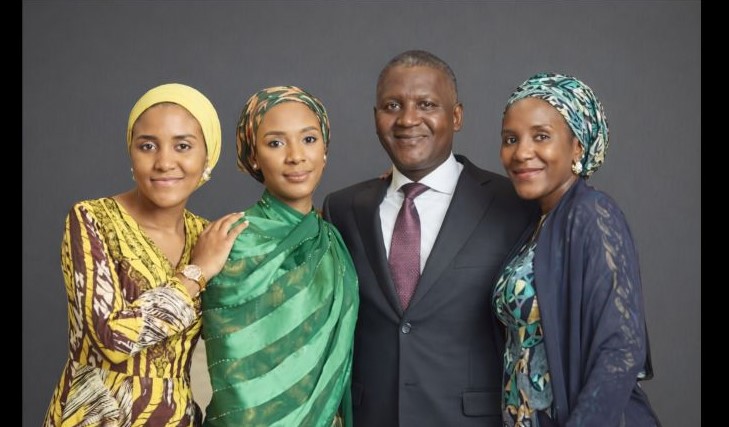
UNKNOWN to millions of Nigerians, on February 16, 2026, Dangote Industries Limited made a series of high-profile appointments that could ultimately shape the future of Africa’s largest business empire. Framed within its ambitious Vision 2030 goal of becoming a $100 billion enterprise, News Point Nigeria Sunday examines how the move goes far beyond routine corporate restructuring.
At its core, it signaled something deeper: a deliberate and carefully calibrated succession strategy by Africa’s richest man, Aliko Dangote.
For a conglomerate so deeply woven into Nigeria’s economic fabric, the elevation of Dangote’s three daughters into strategic executive roles has triggered conversations that go far beyond boardroom politics, touching on legacy, sustainability, culture, and the future of indigenous enterprise.


The restructuring placed each of Dangote’s daughters at the heart of the Group’s most critical operations.
Mariya Dangote, the eldest, now serves as Group Executive Director overseeing Commercial Operations across the cement and food businesses, two pillars of the conglomerate’s domestic and regional dominance.
Halima Dangote was appointed Group Executive Director in charge of the Dangote Family Office and international operations in Dubai and London, positioning her at the intersection of global strategy and financial stewardship.
Fatima Dangote, meanwhile, assumes responsibility as Group Executive Director for Commercial Operations in Oil and Gas, a portfolio that includes the $20 billion refinery, petrochemicals, fertilizers, and upstream exploration through WAEP.
Taken together, these roles are not ceremonial. They represent operational command over the very engines that power the Dangote empire.
For many Nigerians, Dangote’s businesses are often viewed through the narrow lens of private ownership. But in reality, the scale and reach of the conglomerate tell a different story.

Dangote’s operations intersect daily with the lives of millions. From sugar, salt, and flour that sustain households, to cement that shapes infrastructure, to fertilizer that drives agriculture, and petroleum products that fuel transportation and industry, its footprint is almost inescapable.
In this sense, Dangote has evolved into more than a businessman. His enterprise has become a national economic institution, a brand tied to Nigeria’s identity, productivity, and aspirations.
Its listed companies on the Nigerian Exchange have also created wealth for countless investors, with consistent dividend payouts transforming long-term holdings into life-changing assets.


This broad-based impact explains why questions about succession are not merely internal concerns, they are matters of national interest.
At 68, Dangote remains active and influential. Yet, in corporate governance, timing is everything.
The challenge for any founder-led enterprise especially one of such magnitude is ensuring continuity beyond the individual. History, particularly in Nigeria, offers cautionary tales of once-thriving businesses that collapsed after the passing of their founders.
This reality makes the recent appointments both strategic and urgent. By bringing his daughters into executive leadership while he is still actively involved, Dangote appears to be opting for a transition model built on mentorship rather than abrupt succession.
It is a model that allows institutional knowledge, corporate culture, and strategic vision to be transmitted deliberately.
Perhaps the most profound implication of these appointments lies in their cultural significance.
In many parts of Nigeria, succession especially in business and inheritance has historically favored male heirs. Women are often sidelined or assigned secondary roles.
Dangote’s decision disrupts that norm.
By placing his daughters at the forefront of a multibillion-dollar enterprise, he is not only redefining leadership within his company but also challenging entrenched societal expectations.
It is a move that reflects broader global trends, where women are increasingly occupying leadership positions across industries, breaking long-standing barriers.
The Dangote succession plan also throws into sharp relief a persistent weakness in Nigeria’s business ecosystem: the lack of continuity.
Many indigenous enterprises have struggled to survive beyond their founders. The reasons vary absence of structured succession plans, internal family disputes, weak corporate governance, and an overreliance on the founder’s personal authority.
The result is a pattern of decline.
Once prominent names in Nigeria’s industrial history have faded, serving as reminders of what happens when sustainability is not institutionalized.
Against this backdrop, Dangote’s move appears less like a personal decision and more like a systemic intervention, an attempt to set a new standard for long-term business survival.
Globally, family-controlled enterprises remain powerful drivers of economic stability and growth.
Major corporations such as Walmart, Samsung, BMW, Volkswagen, and LVMH operate within frameworks where family influence coexists with professional management.
These businesses demonstrate that succession, when properly structured, can strengthen rather than weaken corporate institutions.
In this context, Dangote’s approach aligns Nigeria more closely with global best practices, where continuity is seen as a strategic asset rather than a vulnerability.
For Mariya, Halima, and Fatima Dangote, the new roles come with immense expectations.
They are not merely inheriting positions, they are stepping into responsibilities that carry significant economic implications for millions of Nigerians.
Their performance will shape not only the future of the Dangote Group but also perceptions about leadership, gender roles, and the viability of family run enterprises in Africa.
The challenge before them is clear: to transition from being beneficiaries of a legacy to becoming its custodians and innovators.
Dangote’s move also sends a message to Nigeria’s broader business community. Prominent entrepreneurs such as Abdulsamad Rabiu, Tony Elumelu, Mike Adenuga, Jim Ovia, Femi Otedola, and Innocent Chukwuma, even the growing AA Rano and Mangal of Kano and Katsina face similar questions about sustainability and succession.
The lesson is increasingly clear: building a successful business is only half the task; ensuring its continuity is equally critical.
At a deeper level, the Dangote succession story touches on the philosophy of wealth itself. In many societies, wealth creation is often followed by consumption and eventual dissipation. But sustainable wealth particularly at scale requires stewardship.
It demands systems, discipline, and a long-term vision that transcends individual lifetimes.
As global investor Warren Buffett once suggested in his reference to the “Lucky Sperm Club,” those born into wealth have a responsibility not just to preserve it, but to use it productively.
In Dangote’s case, that responsibility extends beyond family, it touches the broader economy.
The elevation of Dangote’s daughters is more than a corporate reshuffle, it is a defining moment in Nigeria’s business history. It reflects a conscious effort to institutionalize continuity, challenge cultural norms, and align with global standards.
Whether this strategy ultimately succeeds will depend on execution, adaptability, and the ability of the girls to navigate an increasingly complex business environment.
But for now, one thing is clear: the Dangote Group is no longer just the story of one man. It is becoming a dynasty in the making and perhaps, a blueprint for the future of an all female Nigerian enterprise.