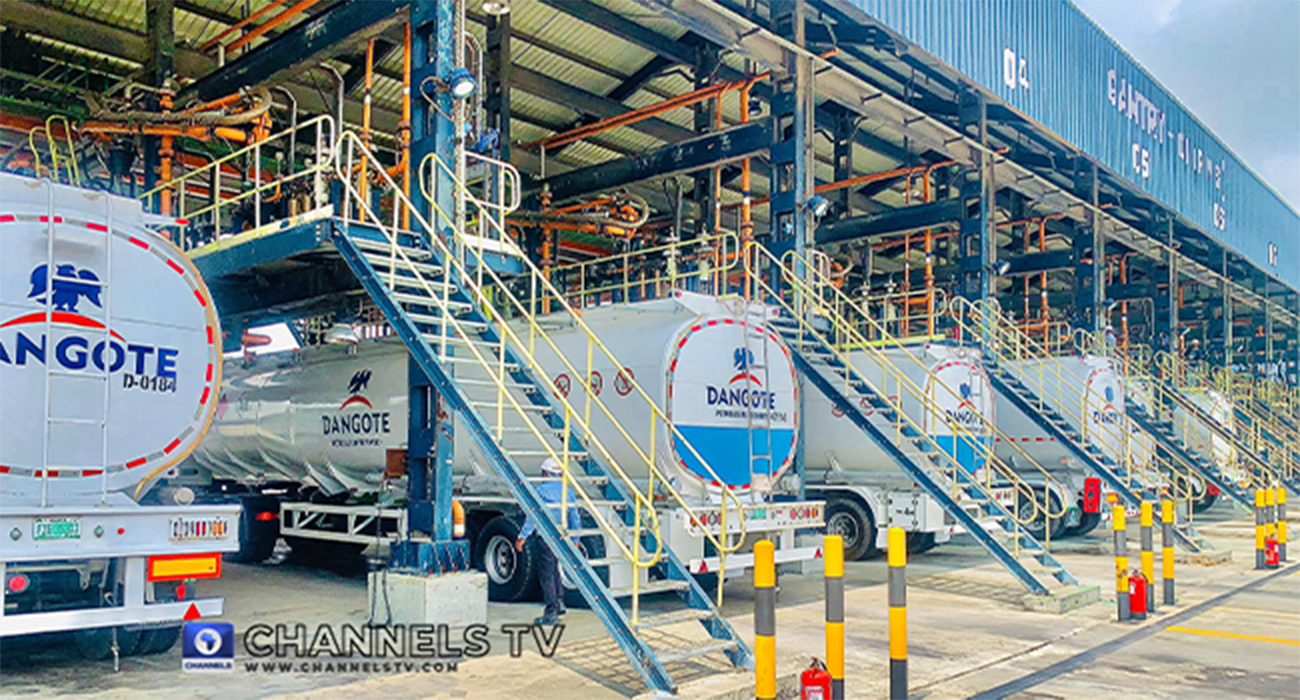

NIGERIA’s fuel market is bracing for another round of price shocks following a fresh increase in the gantry prices of petrol and diesel by the Dangote Petroleum Refinery.

News Point Nigeria reports that the refinery has again adjusted its pricing template, a move that is expected to tighten pressure on consumers and businesses already grappling with high energy costs.

Read also: ‘No Room For Inefficiency, Corruption’, Gombe Governor Warns New Commissioners, Advisers
A top official at the facility, who confirmed the development to our News Point Nigeria on Tuesday night, said the decision was driven by prevailing international crude oil benchmarks and broader market realities.

Under the new pricing structure, petrol has risen by N75 per litre to N1,275, representing an increase of about 5.02 per cent. Diesel recorded a sharper jump of N200 per litre, climbing to N1,950.
This marks a significant increase from last month’s prices of N1,200 per litre for petrol and N1,750 for diesel, with diesel now edging closer to the N2,000 per litre threshold at the pump, a development likely to intensify cost pressures across multiple sectors of the economy.


Explaining the rationale behind the adjustment, the refinery official pointed to external global factors, particularly geopolitical tensions affecting crude oil supply.
“The adjustment is in line with global market trends. You are aware of the ongoing tensions in the Middle East and how they have impacted crude oil prices. These are external factors that directly influence refined product pricing,” the official said.
Read also: Court Warns IPOB Suspects’ Lawyers Against Delaying DSS Officer’s Murder Trial

He added, “Petrol has been reviewed upward by N75 to N1,275 per litre, which is about a five per cent increase, while diesel has increased more significantly by N200 to N1,950 per litre. These changes reflect the realities of the international market.”
Market data from Petroleumprice.ng corroborated the development, confirming that the latest petrol price reflects a 5.02 per cent increase at the gantry level.
The development comes at a time when many stakeholders had hoped that increased local refining capacity would help stabilise domestic fuel prices. However, Nigeria continues to remain exposed to global oil price volatility due to its reliance on international crude benchmarks for pricing.


Global oil markets have remained volatile in recent weeks, largely due to escalating tensions in the Middle East—a region responsible for a significant share of the world’s crude oil supply. Any disruption, or even perceived risk to supply routes, typically results in price spikes that ripple through the global energy market.
Despite being an oil-producing nation, Nigeria operates a deregulated downstream sector where fuel prices are largely determined by market forces. This means that local pricing is influenced not only by international crude prices but also by exchange rates, logistics costs, and refinery operations.
The Dangote Petroleum Refinery, Africa’s largest, was widely expected to reduce the country’s dependence on imported fuel and help stabilise prices in the long term.
The latest increase also comes amid growing concerns over affordability, with many Nigerians already struggling under the weight of high transportation and energy costs.