

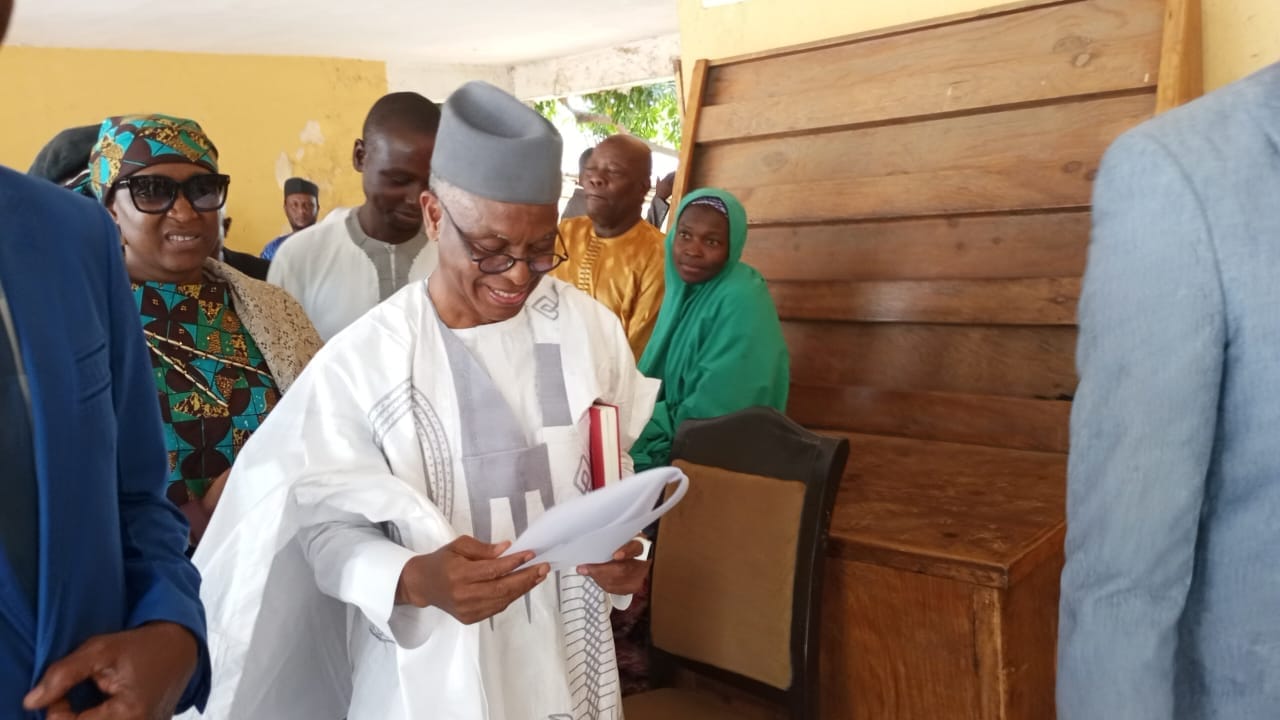
A KADUNA State High Court has provided detailed reasons for denying the bail application of former governor Nasir el-Rufai, following the release of the Certified True Copy (CTC) of its ruling delivered on April 21.
News Point Nigeria reports that the presiding judge, Darius Khobo, held that it was in the interest of justice for el-Rufai to remain in custody to ensure his availability for trial.

El-Rufai had been arraigned by the Independent Corrupt Practices and Other Related Offences Commission (ICPC) on a nine-count charge bordering on alleged conferment of benefit under false pretences and dishonest disposal of loan funds.

The former governor pleaded not guilty to the charges.


Proceedings were held behind closed doors, with journalists barred from the courtroom and relying on information from counsel to report developments. However, details of the ruling later emerged through the Certified True Copy obtained by TheCable.
During the proceedings, the court noted that el-Rufai’s bail application was supported by a 24-paragraph affidavit deposed to by Muhammed Bala Aliyu.
According to the judge, the defendant argued that the offences were non-capital and emphasised his status as a former governor with strong community ties.
Khobo further stated that el-Rufai informed the court that he had voluntarily returned from Egypt, described the charges as fundamentally defective, and claimed to have health conditions requiring specialist monitoring.
The court, however, noted that the ICPC opposed the application and filed a nine-paragraph counter-affidavit dated April 13, deposed to by Idris Abubakar.

The anti-corruption agency argued that the alleged offences were “economically sabotaging” and raised concerns about a genuine risk of interference with witnesses as well as ongoing investigations involving other suspects still at large.
The ICPC also alleged that el-Rufai obstructed law enforcement officers at Abuja airport in February and described him as a flight risk with the means to evade trial due to his high standing in society.
In addition, the commission contended that no medical evidence was provided to substantiate his claims of ill health.


Counsel to el-Rufai, Ubong Akpan, maintained that the application for bail was anchored on constitutional and statutory presumptions in favour of liberty.
On the other hand, counsel to the ICPC, Osuobeni Akponimisingha, urged the court to reject the application, stressing the gravity of the alleged economic crimes and the risk of interference.
In his ruling, Justice Khobo observed that the bail application relied heavily on el-Rufai’s status as a former governor and minister, describing such status as a “double-edged sword.”
He held that the concerns raised by the ICPC regarding possible interference with ongoing investigations were weighty and deserving of serious consideration.
The judge further ruled that the prosecution had presented substantial arguments in its counter-affidavit, which were not effectively challenged by the defence.
“It is, however, noteworthy here that inspite these weighty depositions in the Prosecution/Respondent’s counter affidavit which sought to controvert the depositions in the Applicant’s supporting affidavit, the Applicant never deemed it fit to file a further and better affidavit to further controvert the said weighty depositions,” the judge said.
He added that the failure to file a further affidavit meant that the prosecution’s claims stood unchallenged and were deemed admitted.
“The law is trite: if in an application for bail pending trial there is good reason to believe or strongly suspect that the accused will jump bail, or interfere with witnesses, the court will be acting within its discretion to refuse bail,” he ruled.
On the issue of health, the court held that although the defendant claimed to have medical conditions requiring specialist attention, no credible medical evidence was presented to support the claim.
“The law is settled that where an application for bail seeks to lay claim to ill-health, credible evidence in that branch of medicine ought to be made available before the court,” the judge stated.
Consequently, the court refused the bail application and ordered that el-Rufai remain in the custody of the ICPC pending the commencement of trial.
The court also directed that the trial be conducted expeditiously, with accelerated hearing on a day-to-day basis where practicable.
Following the ruling, both the prosecution and defence agreed that the trial should commence in the first week of June.
The case was subsequently adjourned to June 1, 2, 3, and 4, 2026, for hearing.