

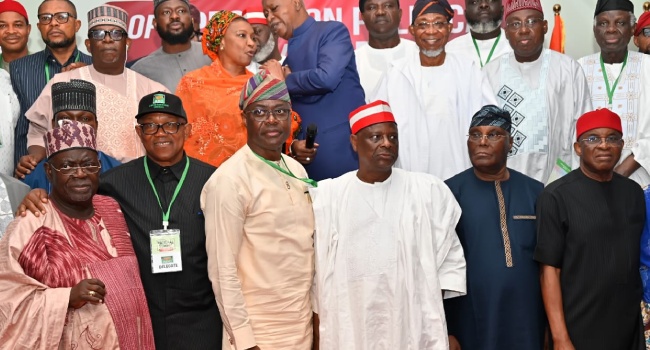
NIGERIA’s political landscape has entered a defining moment as the far-reaching implications of the “Ibadan Declaration” continue to reverberate across the country, following a bold resolution by opposition leaders to unite behind a single presidential candidate ahead of the 2027 general elections, an unprecedented move that has triggered both optimism and scepticism nationwide.

In this Sunday Political Feature, News Point Nigeria online newspaper takes a deep dive into the significance of the development, its political undercurrents, and what it could mean for Nigeria’s democratic future as the race toward 2027 gradually gathers momentum.
Leaders of opposition parties converged on Ibadan, the Oyo State capital, on Saturday for the National Summit of Opposition Political Leaders, where they resolved to present a consensus presidential candidate for the election. The decision formed part of nine key resolutions contained in a communiqué issued at the end of the high-stakes gathering.


In the communiqué, titled the “Ibadan Declaration,” the opposition described the move as necessary to “rescue the nation and suffering masses,” while warning against what it termed efforts by the ruling All Progressives Congress (APC) to entrench a one-party state.
The event drew an array of influential political figures, including former Vice President Atiku Abubakar; the Labour Party’s 2023 presidential candidate, Peter Obi; former Minister of Transportation, Rotimi Amaechi; and former Kwara State governor, Abdulfatah Ahmed.
Also present were the New Nigeria Peoples Party’s 2023 presidential candidate, Rabiu Kwankwaso; former Niger State governor, Babangida Aliyu; former minister Rauf Aregbesola; former Cross River State governor, Liyel Imoke; and political economist Prof. Pat Utomi.
The summit further featured former Secretary to the Government of the Federation, Babachir Lawal; co-convener Professor Jerry Gana; former APC Chairman, Chief John Oyegun; former Sokoto State governor, Aminu Tambuwal; former minister Bolaji Abdullahi; and former Osun State governor, Olagunsoye Oyinlola, among others.
Dominated largely by factions within the Peoples Democratic Party (PDP) and the African Democratic Congress (ADC), the opposition leaders stressed the urgency of setting aside internal differences to build a unified political platform capable of challenging the APC in 2027.
Reading the communiqué on behalf of the participating parties, PDP factional National Chairman, Taminu Turaki (SAN), reaffirmed their determination to participate fully in the 2027 elections despite what they described as sustained “onslaught” and political pressure from the ruling party aimed at shrinking opposition space.

On electoral issues, the summit passed a vote of no confidence in the leadership of the Independent National Electoral Commission (INEC), urging the National Assembly to review provisions of the Electoral Act 2026 that they believe could undermine electoral credibility.
They also demanded an extension of the timeline for party primaries, arguing that current guidelines posed significant challenges to opposition parties.
The communiqué further called for the release of politicians allegedly being harassed or detained on bailable conditions, insisting that democratic participation must remain open and inclusive.


Commending Nigerians for their resilience, the opposition leaders declared that the Ibadan meeting marked the beginning of sustained coalition-building efforts ahead of the 2027 elections.
Among the resolutions, they stated: “That we shall resist all attempts by the APC to foist a one-party state on Nigeria.
“That despite the onslaught and afflictions of the ruling party… we shall field candidates and partake in the 2027 election.
“That we shall work towards fielding one presidential candidate… to rescue our nation and our suffering masses.”
They also insisted that INEC Chairman, Prof. Josh Amupitan, should not conduct the 2027 elections, alleging bias and loss of public confidence.
In his welcome address, Oyo State Governor Seyi Makinde warned that the concentration of political power and internal crises within opposition parties were shrinking democratic space.
“Democracy without opposition is not democracy,” Makinde said, cautioning that weakening opposition structures could erode meaningful political choice.
He referenced the historical “Operation Wetie” crisis, warning against complacency in the face of democratic decline and urging political actors to rise above divisions.
Turaki, in his remarks, called for a unified opposition framework—described as the Ibadan Accord or Declaration—to defend democracy and rebuild public trust.
“To succeed, it is inevitable that we must come together… guided by equity, fairness, justice, transparency, and fear of God,” he said.
Similarly, ADC National Chairman, Senator David Mark, framed the coalition as a “national rescue mission,” warning that democratic institutions were under pressure and citizens’ rights increasingly undermined.
“What is at stake is greater than every single one of us,” Mark said, urging opposition leaders to prioritise national interest over personal ambition.
However, the APC dismissed the initiative as unrealistic. Speaking with News Point Nigeria, the party’s National Secretary, Ajibola Basiru, described the coalition as impractical and driven by conflicting ambitions.
“They are just engaging in delusion… all of them want to be president,” Basiru said, questioning how consensus would be achieved among figures like Atiku, Obi, and Kwankwaso.
He maintained that the ruling party remained focused on strengthening its structures and preparing for the elections, dismissing the opposition’s efforts as “political theatrics.”
Basiru also criticised Makinde’s reference to “Operation Wetie,” describing the remark as irresponsible and reflective of political frustration.
Amid the political exchanges, two prominent scholars have offered sharply contrasting perspectives on the opposition’s bold move.
A United States-based Professor of Political Science, Professor Peter Kehinde, described the Ibadan consensus as historic and necessary, particularly in light of Nigeria’s deepening socio-economic challenges.
Professor Kehinde said the development represents a significant turning point in Nigeria’s democratic journey, noting that it is the first time in the country’s political history that opposition forces are deliberately setting aside differences to present a common front against an incumbent government.
According to him, the timing of the alliance is critical, given the widespread economic challenges confronting Nigerians, including rising inflation, unemployment, declining purchasing power, and growing public frustration over the cost of living.
“Nigeria is going through a difficult phase economically and socially. Across the country, citizens are grappling with hardship that has eroded livelihoods and deepened inequality. In such a moment, political actors must rise above narrow interests and act in the broader national interest,” he said.
Professor Kehinde argued that the Ibadan consensus signals a recognition by opposition leaders that fragmented politics can no longer effectively respond to the scale of Nigeria’s current challenges. He described the move as a commendable demonstration of political maturity and strategic thinking.
“This is a commendable step. It shows that, perhaps for the first time, opposition leaders are placing Nigeria and Nigerians above personal ambition and partisan calculations. That is the kind of leadership required in times of national strain,” he noted.
While acknowledging that the success of the coalition would depend on execution, the political scholar expressed confidence that with the right framework, credible processes, and the emergence of a broadly acceptable candidate, the opposition stands a strong chance of success.
“With the right framework in place, transparency in the selection process, and the choice of a competent and unifying candidate, this single approach can reshape the electoral landscape. It is not just about defeating an incumbent; it is about offering Nigerians a viable alternative anchored on trust and performance,” he added.
Professor Kehinde further observed that Nigerians, burdened by economic realities, are increasingly eager for credible political alternatives and would likely rally behind a unified opposition platform that demonstrates seriousness and cohesion.
“Nigerians are watching closely. If this unity is sustained and translates into a credible programme of action, I am convinced that citizens will come out in large numbers to support this push. People want solutions, not divisions,” he said.
He commended the opposition leaders for what he described as a bold and necessary political recalibration, urging them to remain consistent, disciplined, and focused on delivering a message of hope, reform, and national renewal.
“As long as they sustain this unity and avoid internal contradictions, this could mark the beginning of a new chapter in Nigeria’s political development,” Professor Kehinde concluded.
In contrast, Kebbi-based political scientist, Professor Dalhatu Magaji, expressed strong reservations, arguing that the coalition lacks sincerity and cohesion.
Professor Magaji contended that the move has not generated genuine public enthusiasm, insisting that many Nigerians are instead focused on ongoing reforms and visible progress under the administration of Bola Ahmed Tinubu.
According to him, despite the economic difficulties being experienced across the country, the Tinubu administration has initiated far-reaching structural reforms aimed at stabilising the economy and laying a foundation for long-term growth. He pointed to policy shifts such as fuel subsidy removal, exchange rate unification, and fiscal adjustments as difficult but necessary steps toward economic recovery.
“Transitions of this magnitude are never painless, but what we are witnessing are foundational reforms designed to correct years of structural imbalances. Nigerians understand this, even if the immediate impact is challenging,” he said.
Professor Magaji also highlighted progress in critical sectors, particularly power, noting that the government has made significant investments in energy infrastructure, including dedicated power solutions for universities and teaching hospitals. He said billions of naira have been channelled into power projects aimed at ensuring more reliable electricity supply to key institutions.
“In the power sector, there are targeted interventions to provide stable electricity to universities and hospitals through embedded and captive power plants. These are capital-intensive projects running into billions of naira, and they are already improving service delivery in those sectors,” he stated.
On healthcare, the scholar noted ongoing efforts to strengthen infrastructure, expand access, and improve service delivery, while in education, he cited investments aimed at revitalising institutions and enhancing learning conditions.
“These are not cosmetic changes. They are deliberate efforts to rebuild core sectors, health, education, and power that directly affect the quality of life of Nigerians,” he added.
Turning to the opposition’s unity plan, Prof. Magaji expressed scepticism about its sustainability, arguing that underlying personal ambitions among key figures could undermine the coalition.
“Many of the individuals involved have longstanding presidential ambitions. From former Vice-President Atiku Abubakar to Rotimi Amaechi and Peter Obi, among others, each has publicly indicated interest in the presidency. The question is: what happens when only one ticket is available?” he queried.
He further argued that the absence of widespread public excitement following the Ibadan declaration suggests that Nigerians are unconvinced by the initiative.
“If Nigerians truly believed in this arrangement, you would see spontaneous excitement and mobilisation. That is not happening. People are watching, but they are not celebrating,” he said.
Professor Magaji warned that internal disagreements could quickly surface once the process of selecting a consensus candidate begins, especially if stakeholders feel sidelined.
“Once the ticket is decided, especially if it is perceived to favour certain interests, you may begin to see fractures. Political coalitions built primarily around power calculations often struggle to survive the test of selection,” he noted.
He also raised concerns about the role of money in the process, suggesting that financial influence could ultimately determine the outcome.
“In our political reality, there is always the risk that the highest bidder dictates the direction. If that perception takes hold, it could further erode confidence in the opposition’s sincerity,” he said.
While acknowledging the right of opposition parties to organise and challenge the government, Professor Magaji maintained that Nigerians are more likely to judge political actors based on performance and tangible outcomes rather than alliances formed ahead of elections.
“In the end, Nigerians will decide based on what they see and feel in their daily lives. Alliances alone do not win elections credibility, performance, and trust do,” he concluded.
As Nigeria moves steadily toward the 2027 elections, the Ibadan Declaration has undeniably reshaped political discourse, raising critical questions about unity, credibility, and the future of democratic competition.
With hearings, alignments, and negotiations expected to intensify in the coming months, the nation now watches closely caught between the promise of a united opposition and the realities of political ambition in one of Africa’s most complex democracies.