

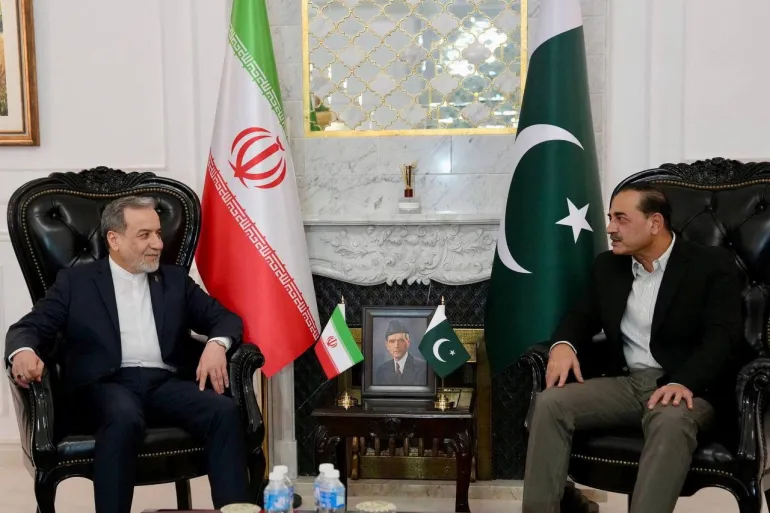
IRANIAN Foreign Minister Abbas Araghchi has discussed with regional interlocutors a proposal aimed at reopening the Strait of Hormuz but deferring talks with the US on Tehran’s nuclear programme for later, during a 72-hour diplomatic sprint across three countries seemingly aimed at securing a broader buy-in for the plan.
Araghchi on Monday met with Russian President Vladimir Putin in St Petersburg, after visiting Islamabad twice in two days – the two trips sandwiching a meeting in Muscat, Oman. Sources close to these diplomatic efforts told Al Jazeera that senior intelligence officials from several countries were present at the Muscat talks.
Discussions in Muscat focused on the Strait of Hormuz, regional security guarantees, and the framework for a potential settlement, with nuclear-related issues set aside for a later stage.


Iran submitted its latest proposal to end the war with the US to Pakistan, which is transmitting messages between Tehran and Washington after direct talks on April 11 in Islamabad failed to deliver a breakthrough.
The White House has not confirmed the contents of the Iranian proposal, also reported by the Associated Press. Spokeswoman Olivia Wales said the US “will not negotiate through the press” and would “only make a deal that puts the American people first, never allowing Iran to have a nuclear weapon”.
But it is unclear whether US President Donald Trump will accept the Iranian proposal to push back nuclear negotiations. Speaking to Fox News on Sunday, Trump said Iran already knew what was required.
“They cannot have a nuclear weapon. Otherwise, there’s no reason to meet,” he said, adding that Tehran was welcome to reach out. “You know there is a telephone. We have nice, secure lines.”
The latest diplomatic efforts are unfolding against a ticking clock.
Under the 1973 War Powers Resolution, Trump faces a May 1 deadline to obtain congressional authorisation to continue military operations against Iran, now in their ninth week. A fourth bipartisan Senate bid to invoke the resolution was defeated 52-47 on April 15. Republican lawmakers have largely backed Trump so far, but several have said that support will not extend beyond the 60-day window without formal congressional approval.

During the first of his two visits to Islamabad, Araghchi on Monday met Pakistan’s Prime Minister Shehbaz Sharif, Deputy Prime Minister and Foreign Minister Ishaq Dar, and Army Chief Field Marshal Asim Munir.
He then travelled to Muscat, and returned to Pakistan on Sunday, meeting Munir again before departing for Moscow.
Araghchi said in a message on social media after his departure that Pakistan had “played an important role in mediating negotiations between Iran and the United States recently”, adding that “incorrect approaches and excessive demands of the United States” had prevented the previous round of talks from achieving its objectives despite “some progress”.


Senior Pakistani officials familiar with the discussions said Islamabad would continue its efforts as an honest facilitator.
Iranian state media, however, struck a firmer tone.
The Fars News Agency, close to Iran’s Islamic Revolutionary Guard Corps (IRGC), said Araghchi had relayed messages through Pakistan outlining Tehran’s red lines on nuclear issues and the Strait of Hormuz. These, it said, were “an initiative by Iran to clarify the regional situation”.
Aizaz Chaudhry, a former Pakistani foreign secretary, said the conduct of the talks had been notable in itself.
“I have seen a commendable display of confidentiality. This is a disciplined and professional method to conduct these talks,” he told Al Jazeera.
Beyond visits to Pakistan, Oman and Russia, Araghchi held telephone calls with the foreign ministers of Qatar, Saudi Arabia, Egypt and France over the past three days.
Qatar’s Prime Minister Sheikh Mohammed bin Abdulrahman bin Jassim Al Thani spoke directly with Araghchi, warning that sea lanes must not become “a bargaining chip or pressure tactic”.