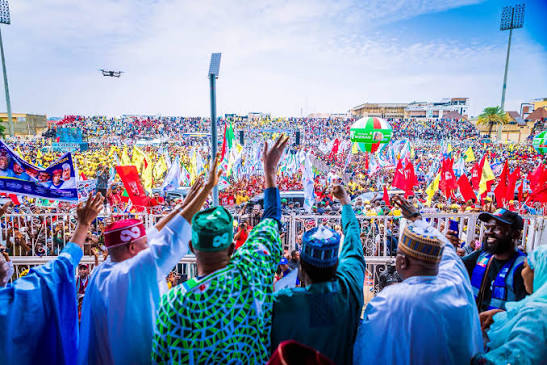
KANO metropolis was practically on lockdown on Saturday as thousands of All Progressives Congress (APC) supporters poured into the streets to receive a fresh wave of political heavyweights and their supporters into the ruling party ahead of the 2027 general elections. What began as a party rally quickly assumed the character of a major political demonstration, with the APC using the occasion to showcase its expanding structure and its determination to consolidate its hold on Kano.
In this Sunday Political features, News Point Nigeria dissects and analyses the situation, the symbolism of the mammoth gathering, the political significance of the defections, the role of Governor Abba Kabir Yusuf in the emerging APC equation, and the broader battle for Kano ahead of the 2027 presidential, governorship and National Assembly elections.

Read also: Police Arrest Two Teenagers In Kano, Recover Pistol, Live Ammunition
From the Sani Abacha Stadium to the surrounding streets of Kofar Mata, Kanti Kwari, Kurmi markets and IBB Way, Kano was transformed into a sea of party colours, flags and placards. Supporters sang, danced and chanted as they waited for the arrival of the party’s leading figures and the formal reception of the new entrants. The scale of the crowd was such that the excitement spilled beyond the stadium into adjoining commercial areas, creating an atmosphere that was as much political theatre as it was party mobilisation. Reports from the event confirmed that the crowd extended to major roads around the venue.

For traders and petty vendors, however, the political carnival also became a business opportunity. Sellers of snacks, water, soft drinks and souvenirs made brisk business as thousands of people converged on the area. The rally therefore provided a familiar Nigerian political spectacle in which mobilisation, commerce, entertainment and partisan politics merged into one large public event.
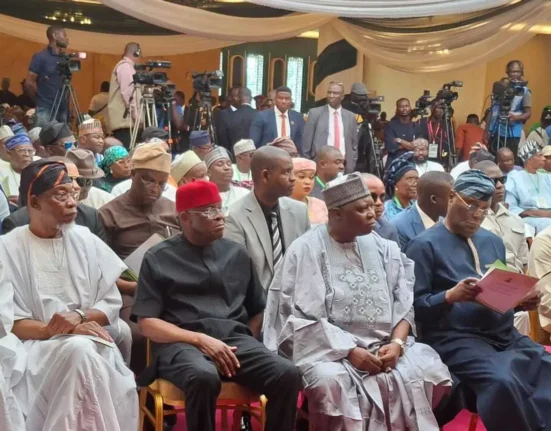
The atmosphere became even more electric when a long convoy carrying Governor Abba Kabir Yusuf, APC National Chairman Professor Nentawe Yilwatda, his predecessor Dr Abdullahi Umar Ganduje, Deputy Senate President Senator Barau Jibrin and other party stalwarts manoeuvred its way into the arena. They had gathered not merely for another party event, but to formally receive some of the most recognisable political figures to have recently abandoned opposition platforms for the APC.


At the centre of the reception were Senators Rufa’i Sani Hanga, Kabiru Ibrahim Gaya and Mas’ud El-Jibrin Doguwa. Hanga, who represents Kano Central and had been the state’s only opposition senator, was particularly significant. His movement into the APC, alongside Gaya and Doguwa, provided the rally with a powerful political message at a time when the ruling party is aggressively rebuilding its structure in the state.
But the movement was not limited to the three senators. The new entrants included former PDP deputy governorship candidate Yusuf Bello Danbatta; former Speaker of the Kano State House of Assembly Isyaku Ali Danja; Ali Datti Yako, identified with the NNPP and NDC political structures; Badaru Umar; former NNPP figures Abdullahi Zubairu Abiya and Abdulmajid Dauda Dandawaki; former Special Adviser to the President Senator Baraka Sani; and several other former party leaders and political actors.
Other names on the list included former NDC Kano State Woman Leader Amina Sirajo, former Assistant Woman Leader Hauwa’u Turaki, former NDC Chairman in Gezawa Gambo Hamza, former NDC Chairman in Kura Handanu Umar, former NDC Director-General Saminu Shehu Kura, former NDC Youth Leader Danladi Musa Garko, former NDC Auditor Sahabi Garba, former Gwale Local Government Chairman Sani Jibrin Dan Zara, former Makoda Local Government Chairman Hassan Abba Makoda and other prominent political figures.

The defectors did not arrive alone. They came with supporters and political structures from across the state, making the occasion less about individual politicians crossing party lines and more about the movement of established political networks. Recent reporting put the wider number of new APC members at more than 136,000, although the political significance of the exercise arguably lies less in the headline figure than in the calibre and reach of the personalities involved.
For Governor Yusuf, the development represents a significant moment in the continuing political realignment of Kano. He described the mass defection as a strong indication of the growing acceptance of the APC in the state and said the influx would further strengthen the party ahead of 2027.
Yusuf commended the new members for their decision and urged them to remain committed to the development, peace and progress of Kano State and Nigeria. He presented the APC as a broad political platform where all members could contribute meaningfully to the development of the state and the country, while calling on the new entrants to join hands with existing stakeholders to strengthen unity, peace and stability within the party.


The governor also assured the defectors that his administration would continue to work with all stakeholders to promote unity, stability and sustainable development across Kano. He appealed to APC members and supporters to remain united, peaceful and focused as the party prepares for the 2027 elections.
The message from Yusuf is important because his own movement into the APC earlier this year dramatically altered Kano’s political landscape. His defection, which was accompanied by a large number of state and federal lawmakers, was already reshaping the balance of power between the APC and the opposition in a state traditionally regarded as one of Nigeria’s most fiercely contested political territories.
Speaking on behalf of the defectors, Senator Rufa’i Sani Hanga expressed commitment to the APC and pledged to mobilise support for President Bola Ahmed Tinubu and Governor Yusuf to ensure victory in the 2027 general elections. The defectors said their decision was driven by confidence in the leadership of Tinubu and Yusuf and by their belief that the APC offered a platform through which they could support the development of Kano State.
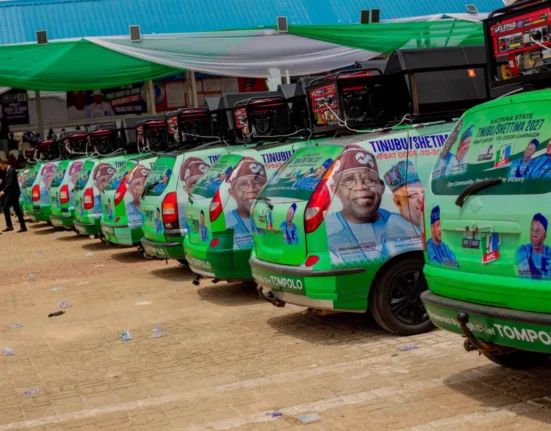
But the Kano rally was not only about defections. It was also used to formally unveil the Tinubu Support Campaign Council, giving the gathering a second and arguably bigger political dimension: the commencement of a more organised effort to build the structures that will carry President Tinubu’s re-election campaign into the 2027 elections.
Former Kano Governor Abdullahi Umar Ganduje, speaking at the occasion, interpreted the size and energy of the crowd as evidence that President Tinubu’s Renewed Hope Agenda was gaining wider acceptance in Kano and across Nigeria. He described Tinubu as a progressive leader with a clear vision for the sustainable development of the country.
The symbolism of Ganduje standing alongside Yusuf at the rally was itself noteworthy. Kano politics has historically been defined by powerful personalities, competing political camps and shifting alliances. The presence of Yusuf, Ganduje, Yilwatda, Barau and other APC leaders on the same platform offered a visual representation of a party attempting to put its internal differences behind it and project a common front ahead of 2027.
APC sources described the Kano rally as a test run for the party’s presidential campaign machinery. Campaigning for the presidential and National Assembly elections is scheduled to begin on August 19, while the ruling party has already constituted a Presidential Campaign Council to coordinate its national campaign.
The campaign council itself reflects the breadth of the political operation the APC is assembling. President Bola Ahmed Tinubu is chairman, with Vice President Kashim Shettima and APC National Chairman Nentawe Yilwatda as vice chairmen. Former Zamfara Governor Senator Abdulaziz Yari is Director-General, while Imo State Governor Hope Uzodimma is secretary. Senator Ajibola Bashiru and Hadiza Bala-Usman serve as deputy and assistant secretaries respectively.
The council also brings together a formidable collection of political veterans and serving office holders. Its advisory body includes Chief Bisi Akande, Chief Segun Osoba, Senator Rochas Okorocha, Senator Abdullahi Adamu and Senator Florence Ita-Giwa. Senate President Godswill Akpabio, Speaker Tajudeen Abbas and Yobe Governor Mai Mala Buni are among those assigned senior deputy director-general responsibilities, alongside Senator Bamidele Opeyemi and Senator Barau Jibrin.
Read also: Hunters Kill Two Suspected Bandits, Recover ₦10m Ransom In Kano Forest
Senator Adams Oshiomhole is responsible for mobilisation, while the President’s Chief of Staff, Femi Gbajabiamila, is assigned the administration portfolio. James Abiodun Faleke, who played a pivotal role in the 2022/2023 campaign, has returned as deputy director-general for election planning, coordination and monitoring.
Faleke will work with zonal directors including Senator Olushola Adeyeye in the South-West, Dr Ngozi Olejeme in the South-South, Senator Uche Ekwunife in the South-East, Muntaqha Rabe in the North-West, Ahmed Muhammed Ketso in the North-Central and Senator Sani Danladi in the North-East. Stella Okotete, Engineer Abdullahi Garba Ramat and Audu Maikori will serve as secretaries of the election planning directorate.
The legal directorate will be led by Muiz Adeyemi Banire, with Dr Liman Hassan and Babatunde Ogala as deputies. Other members include Prince Lateef Fagbemi, former Governor Ibrahim Shema, Worgu Boms and Dr Kingsley Tochukwu Udeh.
The media and strategic communication machinery is equally extensive. Minister of Information and National Orientation Mohammed Idris Malagi is among the coordinating directors, alongside Dele Alake, Bayo Onanuga and Lanre Issa-Onilu, while Tunde Rahman, Sunday Dare, Daniel Bwala and Felix Morka are coordinating deputy directors. The structure underscores the importance the APC places on communication as the campaign moves towards the election season.
Against that national backdrop, Kano assumes a special place. It is not simply another state in the APC’s electoral calculations. Kano has historically been one of the major political engines of northern Nigeria, capable of shaping national narratives and producing voting blocs that can influence presidential contests.
Governor Yusuf has therefore been increasingly direct in asking Kano people, particularly APC supporters and members of various support groups, to mobilise massively for Tinubu’s re-election and for other APC candidates in 2027.
That appeal was contained in a statement issued by his spokesman, Sunusi Bature Dawakin Tofa, on Saturday, following the visit of members of the Tinubu Support Group led by Chief James Faleke as part of efforts to strengthen grassroots mobilisation ahead of the election.
Yusuf expressed appreciation to Faleke, parliamentarians and members of the organising committee for their commitment to strengthening the APC and mobilising support for Tinubu across the country. He assured them that Kano would continue to play a leading role in the President’s re-election effort, as well as in supporting APC candidates contesting National Assembly and other elective positions.
The governor also appealed to young men and women, political support groups and citizens interested in the future of Kano and Nigeria to remain committed to democratic participation and come out en masse during the 2027 elections.
He said the people of Kano would continue to support policies and programmes aimed at strengthening democracy and delivering tangible benefits to Nigerians. He also urged APC supporters to remain united, organised and focused, stressing that victory in 2027 would require sustained grassroots mobilisation and collective commitment.
Yusuf thanked senators, members of the House of Representatives and other political stakeholders who participated in the event, describing their presence as evidence of growing support for the APC ahead of the elections.
The governor’s position is significant because the APC is no longer approaching Kano from the position of an outsider. With Yusuf now in the party, a large number of lawmakers and political actors having followed him, and another wave of opposition figures now crossing over, the APC is seeking to transform its growing numerical presence into an organised electoral advantage.
Yet the real test lies beyond the crowd.
Political rallies in Kano have historically produced spectacular images, but elections are ultimately won through organisation, voter mobilisation, credible candidates, local structures and the ability to translate political excitement into votes. The APC’s challenge is therefore to maintain the momentum created by these defections while managing the competing interests that naturally accompany the arrival of influential politicians from different political families.
The party leadership has already acknowledged this challenge by calling on existing members to accommodate the new entrants and remain united. The influx of politicians from the NNPP, PDP, NDC and other political formations means that the APC is becoming a larger political tent, but also one containing personalities with different histories, ambitions and loyalties.
For the defectors, the calculation is equally clear. Their decision gives them a place within the ruling party’s growing structure and access to the machinery being assembled for 2027. Their pledge to support Tinubu and Yusuf is therefore not merely a declaration of party membership; it is also an indication that they intend to remain politically relevant in the new Kano equation.
For Tinubu, the Kano development provides an opportunity to strengthen a state that remains crucial to any serious presidential campaign in the North. For Yusuf, it provides the opportunity to consolidate his position as the dominant political figure within the APC structure in Kano. For Ganduje and other longstanding APC figures, it presents an opportunity to demonstrate that the party can accommodate its old and new blocs under one umbrella.
But perhaps the biggest political message from Saturday’s gathering is that the battle for Kano has entered a new phase.
The streets around Sani Abacha Stadium, Kofar Mata, Kanti Kwari, Kurmi markets and IBB Way offered a vivid picture of the political energy being generated by the APC. The defections, the support groups, the campaign machinery and the assurances from the governor all point in one direction: the ruling party intends to fight hard to make Kano one of the strongest pillars of Tinubu’s 2027 re-election bid.
Read also: Tinubu To Campaign In Kano, Lagos, Rivers, Nine Other States As APC Releases Timetable
Whether that momentum survives the long road to the ballot box, however, will depend on much more than the size of Saturday’s crowd. It will depend on whether the APC can turn political realignment into lasting grassroots loyalty, whether the new entrants can work with existing party structures, and whether the opposition can find a strategy capable of countering the ruling party’s expanding coalition.
For now, Kano’s political map is clearly being redrawn. The APC has demonstrated that it can attract major names from rival camps, while Governor Yusuf has publicly placed the weight of the state’s political machinery behind Tinubu’s re-election effort. With the 2027 contest approaching, the question is no longer whether Kano will be a major battleground, but how the latest realignment will shape the battle when the campaigns move from rallies and defections to the voters themselves.