
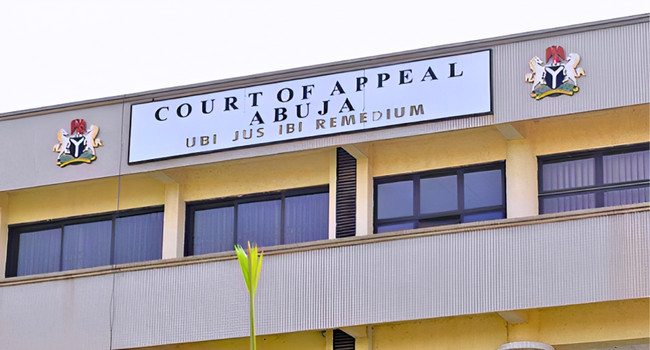
THE Court of Appeal in Abuja on Tuesday nullified the judgment of the Federal High Court that ordered the Independent National Electoral Commission (INEC) to deregister the African Democratic Congress (ADC) and four other political parties.
News Point Nigeria reports that the appellate court held that the judgment delivered by the Federal High Court on June 15 was a nullity, ruling that it was made without jurisdiction and therefore could not stand.

Read also: After Losing Bail Appeal, El-Rufai Appears In Court With ADC Governorship Candidate

In a unanimous judgment delivered by a three-member panel of justices led by Justice Abba Mohammed, the Court of Appeal held that the trial court wrongly assumed jurisdiction by entertaining an incompetent suit filed by a non-juristic entity.


The appellate court ruled that there was no valid suit before the lower court that could have warranted the consequential order directing INEC to deregister the affected political parties.
It further held that the trial court failed to properly evaluate the evidence placed before it, noting that documentary proof showing that the affected parties had won various elective positions in previous elections was ignored.
The appellate court also found that the Federal High Court acted in defiance of an order directing it to stay proceedings pending the determination of an interlocutory appeal.

Consequently, the appellate court held that the Federal High Court ought to have dismissed the substantive suit for lack of jurisdiction and merit.
The court subsequently allowed the separate appeals filed by the affected political parties, restored their registrations and awarded costs against the National Forum of Former Legislators, which instituted the suit.

The affected political parties are the African Democratic Congress (ADC), Action Peoples Party (APP), Action Alliance (AA), Accord Party and Zenith Labour Party (ZLP).
The appellate court declared that all five political parties remain duly registered and legally recognised.
The Court of Appeal had earlier, on June 16, stayed the execution of the Federal High Court judgment pending the determination of the appeals.


Read also: Atiku, ADC Demand Answers From INEC Over Ballot Printing Contracts, Fresh Staff Transfers
In its judgment, the appellate court also faulted the conduct of Justice Peter Lifu for proceeding with the case despite an earlier order issued on May 22 directing him to stay proceedings pending the outcome of the interlocutory appeal.
The panel observed that although Justice Lifu’s attention had been drawn to the subsisting stay order, he still proceeded to deliver judgment.
Describing the action as “a form of judicial impertinence,” the appellate court added that the Supreme Court had previously held that a judge who acts in such a manner “is unfit for the bench, as the conduct amounts to judicial rascality.”
News Point Nigeria recalls that Justice Lifu had ordered INEC to deregister the five political parties after holding that they failed to satisfy the constitutional requirements for their continued existence.
He also restrained INEC from recognising the parties, accepting candidates sponsored by them or giving effect to their activities ahead of the 2027 general elections.
The judgment followed a suit marked FHC/ABJ/CS/2637/2026, instituted by the National Forum of Former Legislators.
The plaintiff had asked the Federal High Court to determine whether INEC was constitutionally bound under Section 225A of the 1999 Constitution (as amended), the Electoral Act 2022 and its regulations to deregister political parties that failed to meet the prescribed electoral performance thresholds.
The forum argued that the affected parties failed to secure at least 25 per cent of the votes in a state during a presidential election or win at least one elective seat at the national, state or local government levels as required by law.
It further contended that the parties’ poor performance in the 2023 general election and subsequent by-elections rendered their continued registration unconstitutional and detrimental to the integrity of Nigeria’s electoral process.
The Attorney General of the Federation and Minister of Justice, Lateef Fagbemi (SAN), who was joined as a defendant in the suit, supported the plaintiffs’ case, arguing that retaining the affected political parties was inconsistent with the provisions of the Constitution and undermined the country’s electoral integrity.
Read also: Appeal Court Dismisses Kwara Government’s Defamation Case Against Ex-Senate President Saraki
Dissatisfied with the Federal High Court judgment, the affected political parties and INEC filed separate appeals, urging the Court of Appeal to set aside the decision.
The appellate court upheld the appeals and vacated the Federal High Court judgment in its entirety.