

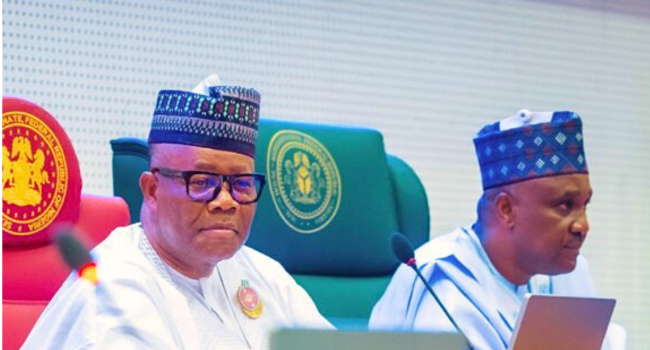
THE Federal High Court sitting in Lagos has declared unlawful the National Assembly’s controversial N110 billion expenditure on vehicles and allowances for lawmakers, ruling that the spending violated procurement laws, constitutional provisions and the principles of public accountability.
News Point Nigeria reports that the court specifically held that the allocation of N40 billion for the procurement of 465 vehicles for members of the National Assembly, alongside N70 billion in support allowances for newly elected lawmakers, breached statutory procurement standards and undermined public trust.

The court also directed the President of the Senate, Godswill Akpabio, and the Speaker of the House of Representatives, Tajudeen Abbas, to ensure that all future procurements and expenditures of public funds by the National Assembly strictly comply with due process requirements and are guided by transparency, accountability and value for money.

The judgment was delivered by Justice Yellim Bogoro on May 6, 2026, in Suit No. FHC/L/CS/1606/2023 filed by the Socio-Economic Rights and Accountability Project against the National Assembly.


A certified true copy of the judgment was sighted on Sunday.
According to a statement issued by SERAP’s Deputy Director, Kolawole Oluwadare, the organisation instituted the suit in August 2023 against Akpabio and Abbas following plans by the National Assembly to spend N40 billion on 465 vehicles and N70 billion in support allowances for newly elected lawmakers despite worsening economic hardship in the country.
In her judgment, Justice Bogoro held that the scale of the expenditure and the absence of evidence showing compliance with due process rendered the procurement arbitrary and inconsistent with established procurement standards.
“Looking at the magnitude of the expenditure, coupled with the absence of demonstrable due process, leads me to conclude that the procurement is arbitrary, disproportionate and inconsistent with statutory procurement standards,” the judge held.
She further ruled that the expenditure presented a clear case of self-dealing and conflict of interest because those who approved the spending were also direct beneficiaries of it.

“The beneficiaries of the expenditure are the very officials approving it, and the expenditure confers direct pecuniary and material benefits. This to my mind constitutes a case of self-dealing and conflict of interest,” she stated.
Justice Bogoro said the court could not ignore the prevailing economic realities facing Nigerians and the widespread hardship experienced across the country.
“I have taken judicial notice of the economic realities in Nigeria and the widespread financial hardship affecting Nigerian citizens. In this context, the allocation of N110 billion for the benefit of lawmakers demonstrates a failure to prioritise national interest,” she held.


The judge stressed that public office should never be used as a platform for personal enrichment and that public officials must remain bound by constitutional obligations and their oath of office.
“The allocation of N110 billion for the benefit of lawmakers also undermines the fiduciary duty owed to the Nigerian people. Public office must not be used for personal enrichment. Public officers must act within constitutional boundaries and in good faith. I hold that the conduct complained of is inconsistent with the oath of office,” she ruled.
The court also dismissed arguments by the defendants that the doctrine of separation of powers and legislative autonomy prevented judicial scrutiny of the expenditure.
According to Justice Bogoro, legislative independence does not place lawmakers above the law.
“The Defendants have urged the Court to decline jurisdiction on grounds of legislative autonomy. It should be noted that the doctrine of separation of powers does not operate as a shield for illegality,” she said.
“It is noteworthy to state that the Court is concerned with the legality and constitutionality of legislative spending.”
The judge recalled that SERAP had approached the court seeking judicial interpretation of constitutional and statutory provisions in relation to the proposed expenditure.
According to the organisation, the planned use of N40 billion for vehicle procurement and N70 billion in support allowances under the Supplementary Appropriation Act 2022, signed in 2023, violated Section 57(4) of the Public Procurement Act 2007, provisions of the Code of Conduct for Public Officers, and the oath of office contained in the 1999 Constitution as amended.
The court noted that SERAP alleged that lawmakers approved the purchase of 465 bulletproof vehicles at approximately N305 million per vehicle, bringing the overall expenditure to N110 billion.
The organisation argued that the spending was excessive and inconsistent with constitutional requirements, procurement laws and the remuneration framework established by the Revenue Mobilisation Allocation and Fiscal Commission.
SERAP also informed the court that it had written to both Akpabio and Abbas requesting a reversal of the decision but received no response.
The defendants, however, denied the allegations and argued that the claims were based on media reports and speculation.
They maintained that the expenditure was lawful, properly appropriated and had already been executed, rendering the suit academic. They also argued that no valid pre-action notice had been served before the commencement of the suit.
SERAP countered that the matter involved live constitutional questions and that declaratory reliefs remained available even where the disputed action had already been completed.
The organisation further argued that the urgency and public interest nature of the case exempted it from the requirement of a pre-action notice.
Justice Bogoro resolved several jurisdictional objections raised by the defendants, including arguments relating to locus standi, pre-action notice, abuse of court process and whether the matter had been overtaken by events.
On the issue of standing, the court held that public interest litigation has become a recognised feature of Nigerian jurisprudence and that non-governmental organisations can legitimately institute actions aimed at protecting public interest.
“From the facts deposed and given the nature of the suit, SERAP being a public interest organisation committed to transparency and accountability has demonstrated sufficient interest,” the judge ruled.
“I therefore hold that SERAP has locus standi to sue, as the matters are of undeniable public concern.”
On the issue of pre-action notice, the court acknowledged that the Legislative Houses (Powers and Privileges) Act ordinarily requires a three-month notice before legal action can be instituted against a legislative house.
However, Justice Bogoro held that recognised exceptions apply in matters involving urgency, public interest and fundamental rights.
The court noted that SERAP had attached documents showing that it had written to the National Assembly requesting a reversal of the decision before proceeding to court.
The judge referred to exhibits attached to SERAP’s originating summons titled: “Re: Request to Rescind the Scandalous National Assembly Budget of ₦110 Billion to Buy 465 Bulletproof SUVs and Support New Lawmakers.”
Reacting to the judgment, SERAP Deputy Director Kolawole Oluwadare described the ruling as a significant victory for transparency, accountability and the responsible management of public resources.
According to him, the judgment reinforces the principle that public office is a public trust that must be exercised in the interest of citizens.
The statement also quoted prominent human rights lawyer Femi Falana, who commended SERAP for pursuing the case.
Falana reportedly said lawmakers’ lifestyle choices in the midst of widespread economic hardship could not be justified and urged the Revenue Mobilisation Allocation and Fiscal Commission to fully exercise its constitutional responsibilities regarding the remuneration of public officials.
In the final outcome of the case, the court declared that the National Assembly’s vehicle procurement programme and support allowances violated the Public Procurement Act, the Code of Conduct for Public Officers and constitutional oath provisions.
Justice Bogoro consequently ordered the leadership of the National Assembly to ensure strict adherence to due process, transparency, accountability and value-for-money principles in all future procurement and expenditure decisions involving public funds.