

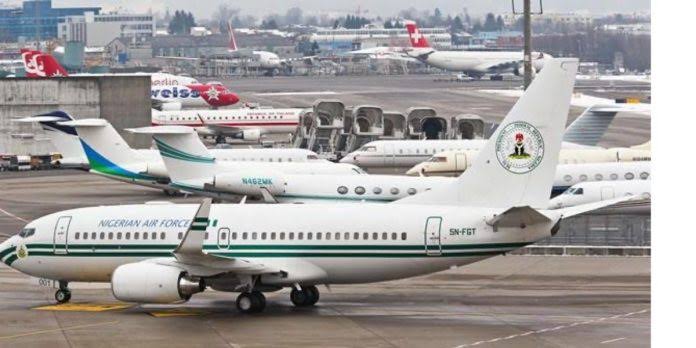
NIGERIA’s spending on the Presidential Air Fleet has risen sharply due to overseas maintenance arrangements, the Office of the National Security Adviser (ONSA) told the Senate during its 2026 budget defence session.

News Point Nigeria reports that the disclosure was made by Mohammed Sanusi, Permanent Secretary at the Office of the National Security Adviser, when he appeared before the Senate Committee on National Security and Intelligence to present the agency’s proposed estimates for the 2026 fiscal year.
Sanusi explained that the continued servicing of aircraft in the Presidential Air Fleet outside Nigeria has significantly increased maintenance expenditure, placing additional strain on the security budget.


While acknowledging the spike in costs, he did not provide detailed figures for total spending on the fleet in 2025 or the cumulative amount expended since the current administration assumed office.
The 2026 budget proposal presented by ONSA covers not only the central office but also its specialised units. These include the National Counterterrorism Centre, the National Cybersecurity Coordination Centre, the National Centre for the Control of Small Arms and Light Weapons, and the Presidential Amnesty Programme.
Sanusi noted that beyond aircraft maintenance, the intelligence community faces several operational challenges that could hamper effectiveness if not urgently addressed.
Among the constraints listed were a shortage of operational vehicles for covert assignments, irregular disbursement of overhead allocations, non-implementation of the 2025 capital budget, funding shortfalls for personnel posted abroad, and exchange rate volatility affecting service-level agreements with international partners.
He indicated that currency fluctuations have made it increasingly difficult to predict and manage contractual obligations tied to foreign-based services.
Chairman of the Senate Committee on National Security and Intelligence, Yahaya Abdullahi, said the National Assembly leadership would carefully review the submissions and determine appropriate interventions.

“After receiving reports from the various committees, the National Assembly leadership will sit down to review the issues and work out appropriate solutions, particularly those that have arisen in the current financial year,” Abdullahi said.
He also referenced the recent declaration of a national emergency on security by Bola Tinubu, stressing that such a declaration must be matched with sufficient financial backing.
“If such an emergency has been declared, there must be adequate funding to support it,” he stated.


Abdullahi revealed that lawmakers may seek direct engagement with President Tinubu to communicate the concerns of security and intelligence agencies.
“We will develop a strategy to ensure that the president’s declaration does not become merely symbolic. If necessary, we will engage the leadership of the National Assembly to seek a meeting with the president,” he said.
According to him, the objective would be to present the operational and financial challenges directly to the president to facilitate decisive action.
The committee chairman described 2026 as a crucial year for Nigeria’s democratic stability, warning that inadequate funding could undermine preparations ahead of another election cycle.
“We emphasised that 2026 is a very critical year for the survival of the nation’s democracy. Given the current security situation, failure to adequately fund these agencies could create serious challenges as we approach next year’s elections,” Abdullahi cautioned.
He confirmed that the committee has concluded its budget defence exercise and is currently compiling its report for submission to the Appropriations Committee and the National Assembly leadership.