

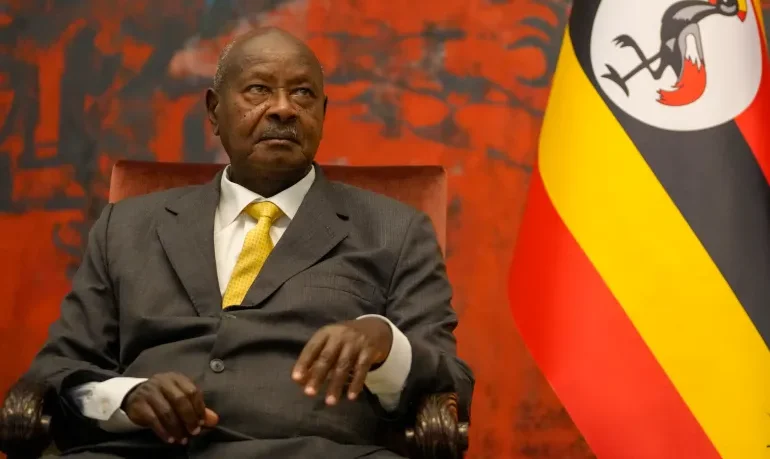
UGANDANS under the age of 40 – and that is more than three-quarters of the population – have only known one president.
Yoweri Museveni seized the top job in 1986 following an armed uprising and at the age of 81, he shows no signs of budging.
His time at the helm has been accompanied by a long period of peace and significant development, for which many are grateful. But his critics say he has maintained his grip on power through a mixture of sidelining opponents and compromising independent institutions.


“We don’t believe in [presidential] term limits,” he once told the BBC, secure in his role after winning a fifth election.
A year later, the age limit for a presidential candidate was removed – paving the way, many believe, for Museveni to become president for life.
Museveni’s journey began in 1944, when he was born into a family of cattle keepers in Ankole, western Uganda.
He came of age during Uganda’s struggle for independence from the UK, which was followed by a period of brutality and turbulence under Milton Obote and Idi Amin.
For many years, Museveni did not know his birth date, writing in his memoir: “We had real life-threatening challenges such as extra-judicial killings and looting… we had no time to worry about details such as dates of birth.”
In 1967, Museveni left Uganda to attend the University of Dar es Salaam in neighbouring Tanzania. There, he studied economics and political science and forged alliances with politically active students from around the region.

Museveni’s name gained currency in the 1970s, after a coup by the notorious Amin.
Museveni helped form the Front for National Salvation – one of the rebel groups that, with Tanzania’s help, ousted Amin. Amin was infamous for crushing dissent and expelling the country’s Asian community. Under his eight-year rule an estimated 400,000 people were killed.
“He was part of the colonial system,” Museveni told the Global Indian Network in a recent interview. “Idi Amin was ignorant… a bit chauvinistic”.


Following Amin’s fall, former President Milton Obote returned to power via a general election. However, Museveni refused to accept Obote’s leadership, claiming the vote had been rigged.
He launched a guerrilla struggle in 1981 and five years later, his rebel group, the National Resistance Movement (NRM), seized power and Museveni became leader.
Uganda’s economy began to grow steadily and over 10 years, the country saw an average annual growth of more than 6%. Primary school enrolment doubled and HIV levels dropped because of an anti-Aids campaign spearheaded by the president.
Museveni became a darling of the West, but his reputation took a hit in 1998, when Uganda and Rwanda invaded neighbouring Democratic Republic of Congo in support of rebels fighting to overthrow the government.
Around this time, critics also complained that the president was growing less tolerant of opposing views. It also became clear he had no plans to cede power.
Museveni had said, in a 1986 collection of writing: “The problem of Africa in general, and Uganda in particular, is not the people but leaders who want to overstay in power.”
But by 2005 his views had seemingly changed and Uganda’s constitution was amended, removing the cap on how many terms a president could serve.
In 2017, the age limit for presidential candidates was also eliminated – a move which led to MPs throwing chairs in a chaotic parliamentary brawl.