

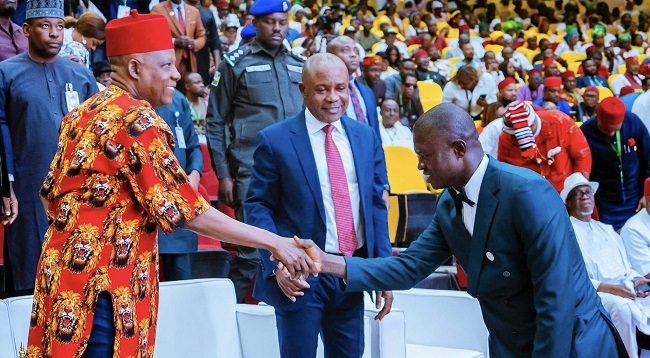
VICE President Kashim Shettima on Wednesday unveiled a 25-year development blueprint for Nigeria’s South-East region, describing the zone as a central pillar of the country’s long-term economic future and a critical driver of national growth.

News Point Nigeria reports that Shettima unveiled the blueprint at the South-East Vision 2050 Regional Stakeholders’ Forum held in Enugu, where he announced that President Bola Ahmed Tinubu has approved the establishment of the South East Investment Company Limited to mobilise funding for the region’s development.
According to the Vice President, the new investment vehicle will pool resources from the diaspora, capital markets, and development finance institutions to support long-term infrastructure and economic projects across the South-East.


He described the forum as a decisive departure from short-term governance cycles, stressing that Vision 2050 represents a structured, multi-decade framework deliberately designed to secure the region’s future.
“This forum reflects foresight, responsibility, and a shared understanding that the future is not something we wait for, but something we must deliberately design,” Shettima said.
“In recognition of the distinctive character of the South-East—its entrepreneurial spirit, its global diaspora, and its long-standing relationship with international capital—President Bola Ahmed Tinubu approved the establishment of the South East Investment Company Limited.”
Shettima explained that the company would work in synergy with the South-East Development Commission (SEDC) to close post-civil war infrastructure gaps, enhance productivity, and drive the region’s long-term competitiveness.
Reaffirming the federal government’s commitment to regional development, the Vice President said the SEDC was conceived to deliver structural transformation rather than function as a routine administrative body.
“Let me be clear: this is not another layer of bureaucracy. It is a delivery institution focused on tangible outcomes—jobs, productivity, and growth,” he said, adding that Nigeria is strongest when its regions thrive.

He also acknowledged the historical burden borne by the South-East, stressing that deliberate and coordinated regional planning was both urgent and necessary.
Shettima further recognised the role of the diaspora, particularly Umu Igbo Unite, a United States-based network of over 10,000 young professionals, noting that the region’s future would be jointly built by stakeholders at home and abroad.
“The future of the South-East will be built both at home and abroad, together,” he said.


Earlier, Governor Peter Mbah of Enugu State, speaking on behalf of his counterparts in the region, formally endorsed the South-East Vision 2050, describing it as an opportunity to align regional development with Nigeria’s long-term national agenda, Vision 2060.
Mbah said the South-East could no longer afford to operate as five isolated states, commending President Tinubu for the establishment of the SEDC.
“I am here to invite you to a bold re-imagining of the South-East as a single economic bloc,” he said.
“For too long, we have looked at our five states as individual islands. I propose the birth of the South-East Common Market, a bold, borderless unification of our commerce, our talent, and our industrial grit.”
According to him, the integration of the region’s economies would transform the South-East into a seamless theatre of enterprise, where shared heritage fuels collective prosperity.
Speaking on the theme, “Charting a Shared Path to Sustainable Prosperity for South-East Nigeria,” Mbah warned that global prosperity is increasingly defined by the ability of regions to organise, integrate markets, and build scalable systems.
Also speaking, Governor Francis Nwifuru of Ebonyi State pledged his administration’s full support for the implementation of the development blueprint, noting that it would help close unemployment and poverty gaps while unlocking economic potential across sectors.
Nwifuru said Ebonyi State is building on investments in agriculture, agribusiness, education, solid minerals, and rural development to position itself as a growth hub in the South-East.
Similarly, Governor Alex Otti of Abia State expressed satisfaction over the unanimous adoption of Vision 2050 by key public and private sector stakeholders, describing the summit as a turning point for the region’s economic transformation.
For his part, Governor Charles Soludo of Anambra State thanked President Tinubu for establishing the SEDC, describing it as a long-awaited gift to the South-East.
In a keynote address, the UNDP Resident Representative, Mrs Elsie Attafuah, shared global lessons on long-term regional planning, emphasising institutional capacity and sustainable implementation.
She stressed that genuine industrialisation requires infrastructure that supports domestic production and urged stakeholders to ensure disciplined execution of Vision 2050.
The Minister of Trade and Investment, Dr Jumoke Oduwole, underscored the importance of aligning resources and policies under the Vision 2050 framework, pledging her ministry’s support.
She announced the launch of a nationwide trade facilitation tour aimed at boosting exports, describing the South-East as the springboard for Nigeria’s industrial transformation.
On his part, Chairman of the South-East Development Commission, Sir Emeka Wogu, said Vision 2050 was designed to ensure continuity, coordination, and synergy among South-East states in the execution of the region’s development agenda.