

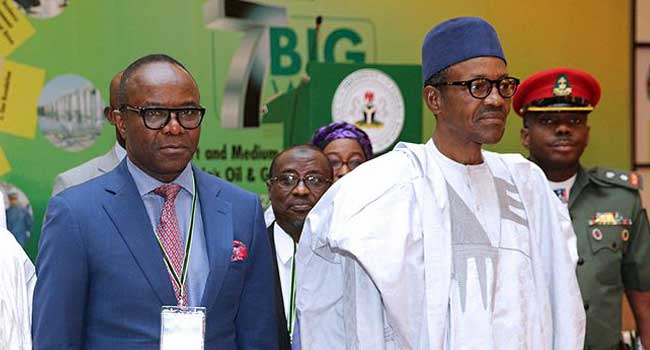
FORMER Minister of State for Petroleum Resources, Dr. Ibe Kachikwu, has revealed that late former President Muhammadu Buhari once threatened to sack him if his push to remove petrol subsidy failed.

News Point Nigeria reports that Kachikwu, who also served as Group Managing Director of the Nigerian National Petroleum Company Limited (NNPC), made the disclosure on Monday during a virtual business mentorship lecture series organised by the Nigerian Content Development and Monitoring Board (NCDMB).
Reflecting on his turbulent tenure between 2016 and 2019, the former minister said one of his biggest challenges was tackling recurring nationwide fuel queues, which had paralysed economic activities and created public outrage.


“The greatest challenge that I had when I resumed as GMD was the issue of long queues at petrol stations. Very few Nigerians realise how traumatic it is for a minister or a GMD, who’s committed, to wake up in the morning and find out the whole country is grounded,” Kachikwu recounted.
He explained that investigations revealed a large portion of petrol imported into Nigeria under the subsidy regime was being smuggled across the borders, frustrating efforts to stabilise supply.
Despite his repeated appeals to Buhari to review pump prices, the President strongly resisted, insisting on keeping petrol at a subsidised rate because of his populist stance.
Eventually, Kachikwu said Buhari reluctantly gave him the green light but with a stern warning.
“I went to the President very many times and said, ‘Look, I need to move up on price.’ He resisted that very much because of his populist-type position.
“Eventually, he said, ‘Okay, you know what? I’ll leave you to take the risk. If you take the risk and it works, fine. If it doesn’t work, I fire you.’ That’s all well and good for me. And I did,” Kachikwu revealed.

To navigate the crisis, Kachikwu introduced what he described as “price modulation,” a policy that allowed petrol prices to reflect global oil market realities. According to him, the measure ended fuel scarcity almost overnight.
“That singular price adjustment removed the subsidy. There was no more subsidy. And within 48 hours, magically, every queue in the country stopped.
“It never happened again until I left. So, that was how I could, at least, sleep better, and the government was willing to make more money,” he said.


The former minister further disclosed that he refused to settle billions of naira in subsidy arrears inherited from previous administrations because many of the claims could not be verified.
“We didn’t pay the arrears of subsidy because my position was that I could not audit the transparency of the subsidy claims. So, I preferred not to deal with those issues,” he maintained.
On the recent decision by President Bola Tinubu to end fuel subsidies, Kachikwu argued that while the move was unavoidable, it should have been implemented with a more comprehensive plan.
He stressed the need for simultaneous reforms in refining capacity, infrastructure development, transportation, and support for oil-producing communities to cushion the impact on ordinary Nigerians.
Kachikwu’s revelations add fresh perspective to Nigeria’s long-running fuel subsidy debate, which has remained one of the most contentious policy issues in the country’s political and economic landscape.