A YOUTH-LED agricultural initiative, Sustainable Harvest Kano, led by Khadija Shehu Jebu and her project team, has empowered 30 smallholder farmers with practical knowledge and skills in sustainable agriculture, climate resilience, food preservation and agribusiness.

News Point Nigeria reports that the project was implemented in Doka Local Government Area of Kano State and supported through the Youth Empowerment Fund, funded by the European Union in partnership with Global Youth Mobilization. The initiative, which ran from April to August 2026, brought together farmers and community stakeholders to address challenges affecting agricultural productivity, food security, livelihoods and environmental sustainability.

Read also: Kano Shuts Down 35 Private Health Facilities Over Regulatory Violations
Sustainable Harvest Kano was developed in response to challenges confronting smallholder farmers, including limited access to modern agricultural knowledge, declining soil health, inefficient use of fertilisers and water, climate-related pressures and significant post-harvest losses.

At the heart of the project was the recognition that agricultural resilience goes beyond simply producing more food. Farmers need the knowledge and tools to protect their soil, manage water efficiently, adapt to changing climatic conditions, preserve their harvests, add value to their produce and access better markets.
The project commenced with a needs assessment and community engagement, enabling the team to interact directly with farmers and community stakeholders and gain a better understanding of the realities of agricultural production within the community. These engagements subsequently informed the project’s training and practical activities.


As part of the pre-harvest training, 30 farmers were trained on sustainable and climate-smart agricultural practices, including soil health and testing, appropriate fertiliser application, row spacing, organic fertilisation, pest management, water conservation and improved agronomic practices.
Particular attention was given to climate resilience and sustainable resource management, with farmers introduced to practices that could help them respond to changing rainfall patterns, improve soil moisture retention, use water more efficiently and maintain the long-term productivity of their farmland.
The project also established a demonstration farm, providing farmers with an opportunity to move beyond theoretical learning and observe sustainable practices being applied under real farming conditions.

One of the practical approaches adopted on the demonstration farm was a comparative plot system. Two sections of the plot were cultivated using improved farming practices, while the middle section was managed using conventional practices. This enabled farmers to observe the differences between the approaches throughout the production cycle and understand the potential benefits of improved agronomic practices.
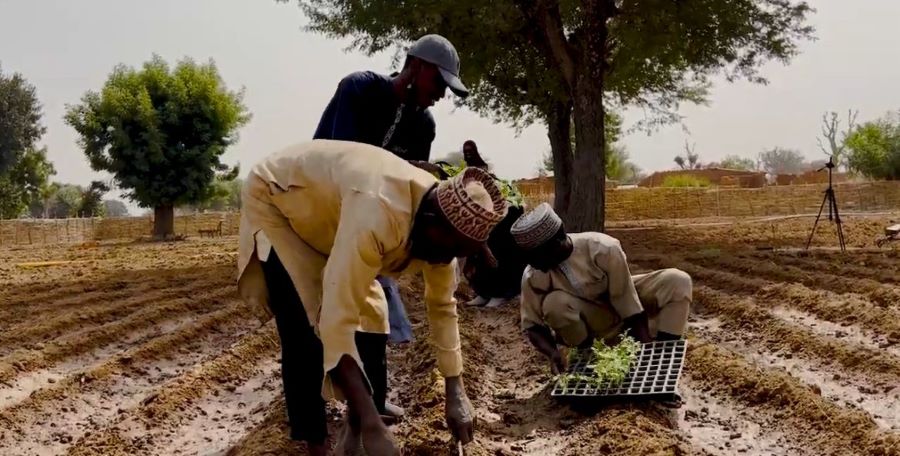
Farmers participated in activities including nursery establishment, planting, transplanting, crop management, monitoring and harvesting. The hands-on approach was designed to give participants the confidence and practical experience needed to replicate the practices on their own farms.
The initiative subsequently addressed another critical point in the agricultural value chain through post-harvest management and food preservation training. Farmers were taught improved methods of harvesting, handling, drying, storage, processing and preservation to reduce spoilage and extend the availability of agricultural produce beyond its immediate harvest season.


Read also: ‘I Was Not Consulted’, Popular Musician Rejects Appointment To Kano Governor’s Campaign Council
The project also emphasised value addition and agribusiness development, with participants learning how processing and packaging can increase the value of their produce, alongside basic concepts in pricing, marketing, financial management and connecting agricultural products to potential markets.
According to the project team, reducing post-harvest losses is not only an agricultural issue but also a food-security and economic issue. When farmers are able to preserve surplus produce rather than lose it after harvest, more food can remain available for consumption or sale, while farmers have greater opportunities to generate income from their production.
The project also hosted a Sustainable Agriculture Seminar, bringing together farmers, young agripreneurs, agricultural experts and other stakeholders to discuss sustainable agriculture, food security, climate resilience, soil management, water resource management and food preservation.
The seminar provided a broader platform for knowledge exchange while highlighting the importance of involving young people in developing solutions to agricultural and environmental challenges.
Speaking about the motivation behind the initiative, project lead Khadija Shehu Jebu, an Agriculture student, said her academic background and exposure to farming communities had enabled her to observe the gap between farmers’ resourcefulness and their access to practical agricultural knowledge and support.
The project team believes farmers should not only be viewed as beneficiaries but as partners in developing solutions that respond to their realities. The activities were therefore designed around practical learning, community engagement, demonstration and knowledge-sharing rather than relying solely on classroom-based training.
With the completion of the core project activities, Sustainable Harvest Kano is now moving towards its sustainability phase through the development of youth-led farming cooperatives and step-down training.
The cooperatives are intended to strengthen peer learning, resource sharing, market opportunities and continued collaboration among participating farmers, while the step-down training will allow participants to share the knowledge gained with additional farmers in their communities.
The project represents a youth-led effort to connect agriculture, climate action, food security, environmental sustainability and economic empowerment at the community level.
By equipping farmers with practical skills across the agricultural value chain—from soil preparation and climate-smart production to harvesting, preservation, processing and marketing—Sustainable Harvest Kano aims to contribute to stronger farming communities capable of adapting to climate pressures while producing, preserving and generating greater value from their agricultural resources.
Read also: Kano Doctors Threaten Two-Week Warning Strike Over Unmet Demands
The team hopes that lessons from the project can inform similar initiatives in other farming communities across Kano State and Nigeria, demonstrating how locally driven, youth-led interventions can contribute to building more sustainable and resilient food systems.