I AM currently researching and writing an independent biography of Muhammadu Buhari – a project I commenced in April 2024 and I recognise that this places me in a position of potential professional interest: the public perception of Buhari, and the reception of competing works about him, may indirectly affect my own work.
It is also important to disclose that, before his passing, Buhari himself was personally involved in my project and granted interviews on his life and public service. In that limited sense, the work was personally authorised by him. However, it is not a commissioned biography, and he did not fund or pay me to produce his presidential biography.
Read also: Atiku’s Demagoguery In The Face Of Tinubu’s Logical Policies – By Sunday Dare

For these reasons, I am stating my position upfront, and I have confined my critique to questions of method, evidence, and representational fairness – what is asserted, what is demonstrated, what is omitted, and whether Charles Omole’s claims in his book meet the documentary standards that a serious political biography owes the public record.


There are two kinds of political biography that matter in a nation’s memory.
One is the disciplined kind – the kind that tells a leader’s story with documentary patience, that distinguishes what is known from what is alleged, that admits ambiguity where the record is contested, and that measures “legacy” by institutions, policies, outcomes, and the long tail of consequences.
The other is the theatre kind – vivid, intimate, confidence-laden, morally certain – built around insider scenes, whispered drama, and sweeping conclusions that sound decisive precisely because they are not burdened by the hard work of proof.
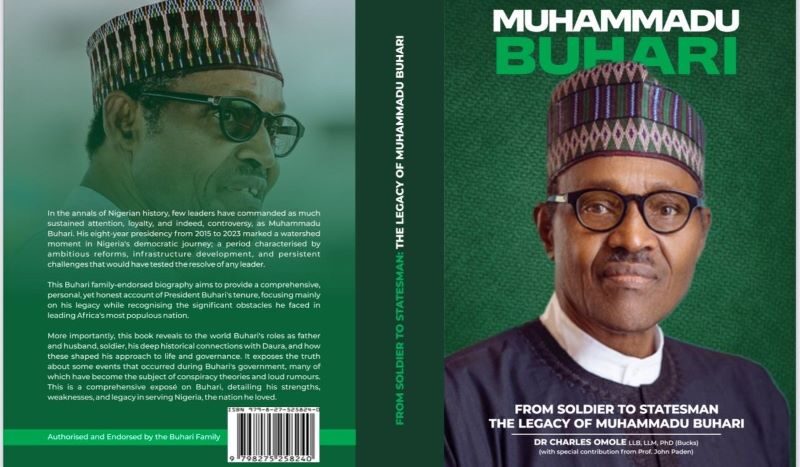
Charles Omole’s book, Muhammadu Buhari – From Soldier to Statesman: The Legacy of Muhammadu Buhari (published in 2025 by IPSPR Publications), presents itself as the first kind while operating, in critical respects, like the second. That is the central problem. It is not that the book is “sympathetic” or “unsympathetic.” It is that it asserts, insinuates, and concludes at a frequency and confidence level that the disclosed body of evidence does not appear to justify; and then he places the word “legacy” on the cover as though palace intrigue is a substitute for record.
This critique is therefore not a quarrel with feelings. It is a quarrel with method.

The book’s contract with readers is advocacy-heavy, not historiography-heavy
A serious political biography signals its method early – scope, documentary base, interview rules, independence, and how it resolves contested facts. Omole’s public framing, including the language used to sell the book, leans toward an “exposé” – a truth-revealing intervention designed to settle rumours, validate insider narratives, and close debates.
That posture is not automatically illegitimate. But it raises the bar. When a book says, in effect, “I am exposing the truth,” it must then behave like a work that can carry that burden – careful sourcing, corroboration, clear separation between first-hand testimony and inference, and visible effort to seek counter-witnesses where the stakes are high.


Instead, the text is punctuated by statements that read as conclusions without demonstration. Consider the tone of a line such as p. 22: “moments that reveal how Buhari himself sometimes became a captive in the very office he held.” This is a strong narrative sentence. It is also a sentence that, by its nature, requires evidence – not atmosphere. Who “captured” him? By what mechanism? With what proof? In what documented sequence? Without those answers, the line functions as a fictional verdict.
“From Soldier to Statesman” – yet “legacy” is thinly treated, and sometimes rhetorically diminished
A subtitle that promises “The Legacy of Muhammadu Buhari” establishes a clear obligation. Legacy is not gossip. Legacy is the measurable footprint of power.
Legacy requires engagement with plans and policies, the execution pathway of those plans, the institutional reforms attempted, the projects delivered or abandoned, the macroeconomic record, the security doctrine, the foreign policy posture, the anti-corruption architecture, and the governance trade-offs that defined the era. It requires, at minimum, a serious register of what the administration said it would do, what it did, what it failed to do, and why.
Yet the book’s framing contains a conspicuous absence of that policy-and-outcome spine. The author distinguishes his work from Professor John Paden’s by implying Paden dealt with “plans and ambition,” while Omole will present “what actually happened.” But “what actually happened” cannot be reduced to who whispered in corridors. It is budgets, reforms, decisions, implementation, and results.
This gap is not merely academic. It becomes a betrayal of the title. If a book wants to be about Buhari “the man,” it should say so plainly, and drop the claim of “legacy” from its cover. If it wants to own “legacy,” it must do the hard work of legacy.
A fair reader comparing Omole’s approach with sectoral, record-driven assessments of the Buhari era – including multi-author volumes that draw heavily on publicly available data, policy documents, and measurable outcomes – will immediately see the difference between biography-as-institutional history and biography-as-palace narrative. The first can be debated. The second is often unprovable and inexplicable.
The Paden cover claim is a credibility hazard, not a minor marketing flourish
The book cover carries the line “With special contribution from Prof. John Paden.” In the body, however, Omole states that he wrote “the entire book,” and Paden appears principally as a cited source – not a contributing author with a clearly delineated, substantive section.
This is an epistemic issue; not a personal one. A book that trades on a scholar’s name implies a form of intellectual sponsorship. If the “special contribution” is not defined and visible, it reads as an attempt to borrow legitimacy without paying the reader the honesty of specification.
In biography, credibility is cumulative. You do not begin by blurring an attribution question and then ask the reader to trust you on more consequential matters.
A pattern of assertion without demonstrated support
There are several claims in the work that illustrate the same methodological weakness. Categorical statements are made with no disclosed proofs:
p. 88 – The 1985 currency-change foreknowledge claim:
The author asserts that the only cabinet member who knew about the decision to change Nigeria’s currency before the public announcement was General Tunde Idiagbon. How would such a huge national project have been executed in a very short time without adequate preparations by key government agencies? That is an extraordinarily specific claim about cabinet process. It is also practically difficult to sustain without documentation – minutes, memos, correspondence, or multiple named witnesses. Thus, it reads not as history but as narrative convenience.
p. 89 – “Some cabinet members felt the administration was not as honest as it claimed”: This is a sweeping allegation about the moral reputation of the 1983–1985 administration, projected from unnamed sentiment. It would require, at minimum, attribution – or a clear explanation of why attribution cannot be provided – and corroboration. The first Buhari regime has been criticised for many things across four decades. But “dishonesty” is not an allegation that can be casually inserted without record.
p. 264 – “Common wisdom” that Buhari was unelectable:
Even if some commentators once believed this, “common wisdom” is not evidence. It is rhetoric. A claim about national electoral psychology should be anchored in time-bound references – elite statements, polling, internal party memos, media content analysis, or clearly defined regional sentiments. To present it as a national truism is to launder opinion as fact.
*p. 266 – Integrity as “potential weakness”:*
Buhari’s perceived personal integrity was, across long stretches of Nigeria’s political history, his primary political brand – the reason supporters rallied and adversaries feared his ascendance. To recast that as a “weakness,” without careful context, reads like a forced deployment of a viewpoint that contradicts a widely common knowledge.
Read also: Rule Of Law, Nigeria’s Only Hope Of Survival (1) – By Dr Hassan Gimba
p. 282 – Northern domination in appointments:
This is a claim that can be tested. A serious biographer would show the dataset, define “domination,” separate perception from measurable distribution, and engage counter-arguments. To assert it as a settled fallacy-free conclusion, without illustration, is to outsource analysis to cliché.
Further examples: high-stakes claims presented without visible body of evidence
Several additional assertions – each consequential for Buhari’s historical record – are framed in ways that read as settled conclusions, yet (as presented) do not supply the minimum documentary trail required for claims of this gravity.
p. 285 – The cabal decided Emefiele’s reappointment as CBN Governor.* This is a claim about who exercised presidential power in a constitutionally weighty appointment. If a biographer asserts that the decision was made by a “cabal,” rather than by Buhari through formal processes, the book must do more than narrate suspicion. It should identify the mechanism of control: Who initiated the reappointment memo? Who cleared it? Who briefed the President? What meeting produced the decision? What contemporaneous documents – submission notes, approval chains, dated correspondence, minutes, or testimonies from named officials – demonstrate “cabal decision” rather than (i) Buhari’s judgment, (ii) institutional lobbying, (iii) political bargaining, or (iv) bureaucratic momentum? Without such evidential anchors, “the cabal decided” becomes a rhetorical verdict masquerading as a documented fact.
p. 285 – “Buhari did not know most of his ministers;” the cabal imposed them on him; they were loyal to the cabal.
Here the book compresses multiple propositions into one sweeping narrative: (1) Buhari did not know most ministers, (2) a cabal imposed them, (3) their loyalty was primarily to that cabal. Each proposition is testable, and therefore demands specificity. Which ministers, precisely? During which cabinet formation cycle – 2015, or 2019? What does “did not know” mean: never met, never worked with, no prior familiarity, no political contact?
What is the evidential basis – interviews, records, diaries, aides’ notes? And “imposed” is not a neutral word; it implies coercion or bypass of presidential agency. A biographer must show the imposition pathway: who submitted names, who blocked alternatives, and where Buhari’s preferences were overruled. Finally, “loyal to the cabal” is essentially an allegation of dual allegiance. It requires demonstrable indicators – documented instructions, meeting attendance, discernible voting/decision patterns, or named ministerial testimony – not merely a post hoc explanation for administrative outcomes the author dislikes.
pp. 306 & 436 – “Nigeria became less secure under President Buhari than it was before him.”
This is presented as a broad comparative judgment, but it is not meaningful unless the book defines its metric. “Less secure” can refer to territorial control, casualty trends, kidnapping frequency, banditry incidents, insurgency intensity, communal conflict patterns, urban crime, or public perception. A serious biography must specify: Which security indicators? Which baseline years? Which data sources? If the claim is made without comparable metrics – acknowledging that reporting standards, media coverage, and conflict geography change over time – it collapses into a blunt political slogan. A responsible approach would either (i) use credible datasets and trend lines, (ii) disaggregate by threat type and region, and (iii) explain attribution limits, or it would candidly describe the claim as contested rather than conclusively settled.
p. 522 – “The cabal changed his speeches several times.”
Speech editing happens in every modern presidency; that is not scandal. The scandal, if intended, lies in the implication that Buhari’s public words were altered in ways that distorted his intent or signaled governance by proxy. That requires a forensic approach: Which speeches? What dates? What were the draft versions versus final versions? Who authored edits? Who approved them? Are there marked-up drafts, email trails, or testimony from speechwriters and communications officials? Without identifying specific speeches and documentary comparisons, “they changed his speeches” remains a cinematic insinuation – powerful as fiction, weak as history.
p. 549 – “Tunde Sabiu had a hold on most of the ministers.”
This is an expansive claim of informal dominance. But “had a hold” is analytically empty unless translated into observable mechanisms: control of access to Buhari, control of briefing schedules, gatekeeping of memos, ability to hire or fire, power to block projects, or influence over disciplinary actions. Which ministers? Over what period? Through what documented incidents? If the book cannot name the channels and provide concrete examples with corroboration, the phrase functions as a trope – an all-purpose explanation that cannot be falsified and therefore cannot be responsibly deposited as historical conclusion.
p. 588 – “Buhari protected individuals who should have been scrutinized … pleaded with the new administration on behalf of his kinsmen … seeking to shield them from inquiry because he still depended on them for many personal matters.”
This is among the most serious claims in the list because it alleges: (1) Buhari actively sought to obstruct scrutiny and justice, (2) did so on behalf of “kinsmen,” and (3) was motivated by continuing personal dependency. These are motive-and-conduct allegations, not casual commentary.
They demand the highest standard of proof: who are the “individuals,” what inquiries were pending, what precisely did Buhari do or say, to whom, when, through what channel, and what records exist – letters, emissaries’ accounts, meeting notes, corroborating witnesses? The phrase “because he still depended on them for many personal matters” introduces psychological inference. The book could not document this motive with credible testimony and corroboration; so, it crosses from biography into mind-reading – and mind-reading is not evidence.
Each of the foregoing claims is historically consequential. They collectively imply a presidency where formal authority was routinely displaced by unelected actors, where ministerial loyalty was diverted away from constitutional accountability, and where post-tenure conduct blurred the line between statesmanship and private protection. If a book is going to ask Nigerians to accept conclusions that heavy, it must show its work – clearly, specifically, and with verifiable trails.
“Cabal” as an elastic explanation becomes a substitute for governance analysis
“Cabal” language is politically powerful because it is emotionally satisfying. It provides a villain without requiring a mechanism.
Used carefully, “cabal” can describe informal influence networks that arise around power.
Used loosely, it becomes a narrative solvent that dissolves accountability.
It can do four convenient things at once: excuse the principal from agency; condemn unnamed actors without evidential exposure; turn complex bureaucratic failures into melodrama; and transform contested interpretations into moral certainty.
Omole’s book leans heavily on “cabal” as an explanatory engine, yet it does not convert the label into a demonstrable structure. He references Mallam Mamman Daura and Mallam Ismaila Isa Funtua (who died in July 2020). Beyond these two men and apart from mention, in other contexts, of Buhari’s Chief of Staff, Mallam Abba Kyari, and his Personal Assistant, Mr. Tunde Sabiu the argument remains largely impressionistic.
Basic questions that a serious political biography must answer are left unresolved: Who, precisely, constituted this “cabal”? What were their specific and general roles?
Through which access routes did they allegedly exert control appointments, memos, schedules, security protocols, briefing chains, or gatekeeping of presidential audience? Which concrete decisions did they override, delay, or redirect, and on what occasions? Where is the documentary trail minutes, directives, correspondence, logs, or corroborated testimony – showing a consistent pattern rather than episodic suspicion? And when Buhari allegedly opposed them, what did he do in response: reverse decisions, discipline actors, reassign portfolios, clarify publicly, or accept the outcome? Finally, which counter-witnesses were sought – officials, aides, security personnel, ministers, or institutional records capable of confirming or disputing the claim?
Without clear answers to these questions, “cabal” ceases to be analysis and becomes myth – a convenient, elastic story that can explain everything while proving nothing, not unlike the enduring and often untestable legend of the “Kaduna Mafia” in Nigeria’s political folklore.
The “sympathy” posture is structurally inconsistent with the book’s evidential gaps
Omole frames sections of the book as “sympathetic” – “a sympathetic retelling,” an “Epilogue: A Sympathetic Assessment.” Sympathy is not disqualifying. But sympathy without evidential discipline produces a peculiar distortion: it can preserve the subject’s moral aura while relocating responsibility onto faceless courtiers, unnamed forces, and unverifiable intrigues.
That is a convenient architecture for legacy management. It is not an adequate architecture for history.
A biographer must choose the rules of the genre: If this is an intimate exposé, it must carry the full weight of proof for extraordinary claims; if this is a legacy biography, it must anchor itself in policy, institutions, and outcomes, with contested claims handled transparently and fairly.
The hybrid – “authorized exposé” without visible proof – tends to produce the worst of both worlds: scandal without documentation, and legacy without substance.
The practical “hatchet-job” test – and why Omole’s public footprint fails
If a biography were fair, serious, and built for national memory, it would ordinarily do the following:
Separate Buhari-the-man from Buhari-the-state.
Treat allegations with documentary rigour, not insinuation.
Provide counter-witnesses – critics, opposition figures, civil society, affected communities, bureaucrats who disagreed, external partners.
Use measurable indicators where possible.
Disclose conflicts and constraints – endorsements, access conditions, corroboration rules.
What the book’s most visible claims emphasise, by contrast, is the most unverifiable domain of political storytelling – private-room allegations, dramatic reconstructed scenes, and elastic labels.
That is not how a national record is responsibly written.
Conclusion: what this book is, and what it is not
As presented through its framing, its rhetoric, and the types of claims it advances, Omole’s work sits closer to an insider-driven narrative intervention than to a documentary political biography. It elevates palace-intrigue claims into legacy-defining “truth” while appearing to underweight the measurable record of governance that the title promises.
A book may be critical. A book may be sympathetic. A book may be intimate. But a book that claims to “expose truth” must show its proof. A book that claims “legacy” must do legacy work.
Read also: Why We Omitted Pantami, Adebutu, Gwarzo From 2027 Governorship List – INEC
If Omole wishes to defend the book on professional grounds, the path is simple: publish a transparent evidential annex – document identifiers, dates, repositories, corroborations, and counter-witness engagements – for the most serious allegations and the most consequential conclusions. Anything less asks Nigerians to accept atmosphere as historical archive.
Nigeria’s historical memory deserves better than that.
- Dr Yakubu is Africa’s most published professional biographer, and Editor of “Muhammadu Buhari: The Nigerian Legacy (2015-2023)” (Five Volumes) and he can be reached via email at: udu.yakubu@gmail.com.