

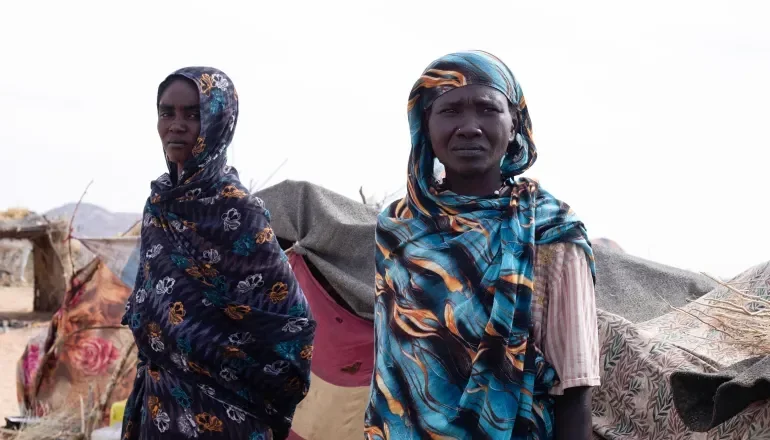
WHEN Sudan’s paramilitary Rapid Support Forces (RSF) stormed the besieged city of el-Fasher on October 26, Mabrooka’s husband and brother ran for their lives.
The plan was for them to head to Tawila about 60 kilometres (37 miles) away – where Mabrooka would be waiting for them with her three small children. By sundown, they had still not arrived.
News spread that the RSF, which has been fighting a bitter war against the Sudanese Armed Forces (SAF) since April 2023, was carrying out summary executions against the population of el-Fasher, which it accused of siding with its enemy. Mabrooka began fearing the worst.


Then, her phone rang.
A voice told Mabrooka to wire 14,000 Sudanese pounds ($23) – a hefty sum for displaced and destitute Sudanese families – to a bank account, which she suspected belonged to an RSF fighter.
“When I got the call, I was terrified and crying the whole time,” Mabrooka, 27, told Al Jazeera. “I knew they would for sure torture and kill them if I didn’t muster up the money.”
Since the RSF captured the army’s last stronghold in the sprawling western region of Darfur, the group has carried out a series of atrocities, including execution, rape and mass looting, according to survivors and local monitors. The Sudan Doctors Network put the death toll from the RSF attack at 1,500 in the first few days after the city’s fall, but the true number could be far higher.
While acknowledging that some crimes have been committed by its forces, the RSF has largely denied some of the worst accusations against it, and insists that it is “liberating” territory.
But in el-Fasher, most of the victims have been from the mainly sedentary “non-Arab” population, who have lived in fear of the nomadic “Arab” fighters who comprise most of the RSF.

The targeted ethnic violence has forced tens of thousands of people to flee to neighbouring villages, but many people have been abducted for ransom by RSF fighters along the way.
According to local monitors, international non-government organisations, and victims’ families, it’s likely that thousands of people have desperately wired money straight to RSF fighters to national banks via banking applications.
Monitors told Al Jazeera that ransoms range from anywhere between $20 to $20,000.


“There is a large number among the displaced people who have been detained, and the RSF is asking for a really big amount from their families,” said Mohamed*, a local relief worker in Tawila with the Emergency Response Room (ERR), a grassroots initiative spearheading the aid response across Sudan.
Mathilde Vu, the Sudan advocacy manager for the Norwegian Refugee Council, told Al Jazeera that many civilians are reportedly being detained as they flee and asked to pay a “transportation fee” to reach Tawila.
Many children have been separated from their parents, as well as women and children from their husbands, she said.
In addition, the United Nations estimates that more than 70,000 people have been uprooted from el-Fasher since October 26 and that over 40,000 of them headed towards Tawila.
Of this number, Vu noted that only about 6,000 people have arrived in Tawila so far.
“This is a clear indicator that people are disappearing or are being held back,” she told Al Jazeera.
Some families who lost touch with loved ones in el-Fasher received ransom videos from unidentified kidnappers.
Local monitors and global relief agencies, who asked to remain anonymous to protect their teams on the ground, said that RSF fighters appear to be the kidnappers in most cases.
However, criminal gangs and other “Arab” militias aligned with the RSF may also be implicated.