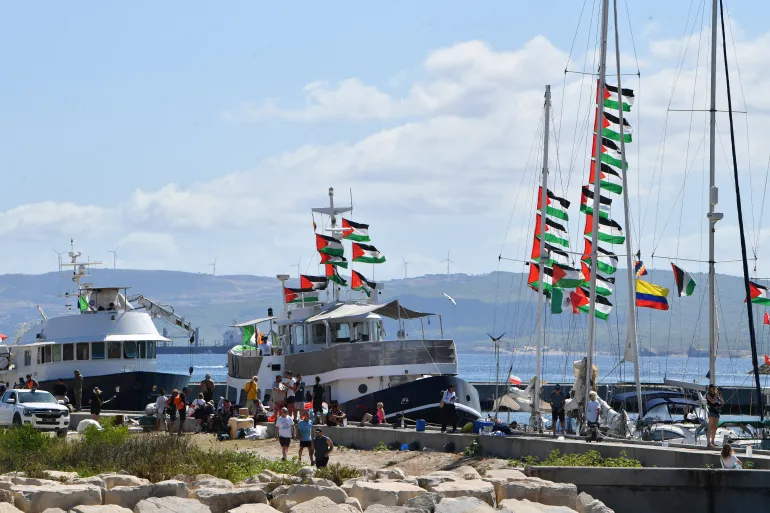
SIX months after Tunisian authorities began arresting organisers of a pro-Palestinian flotilla, four activists remain in pre-trial detention, with growing concern over the health of one of them, who has been on hunger strike for more than three weeks.
Wael Naouar, a Tunisian activist and member of the steering committee of the Global Sumud Flotilla, began his hunger strike on August 16 to protest his continued detention.

Read also: Tunisia Military Court Sentences Politician To Four Years In Prison
His lawyer, Bassem Trifi, who is also president of the Tunisian League for Human Rights (LTDH), said on Tuesday that Naouar was entering his 24th day without food and described his condition as “very serious”.

Trifi, who visited Naouar in prison last week, said the activist had lost 18kg (40lb) and was suffering from low blood pressure and low blood sugar, as well as difficulty breathing, walking and speaking. He was also experiencing pain throughout his body, particularly in his stomach, Trifi said.
Anis Harrathi, an activist and member of the committee supporting the detainees, said Naouar was aware of the physical risks of a prolonged hunger strike, but had chosen to continue because he believed remaining silent was more perilous than continuing his strike.


“Wael knows very well the risks of a hunger strike,” Harrathi told Al Jazeera. “Yet he chose to put his body in confrontation with an entire system, because there comes a moment when silence becomes more dangerous than hunger.”
Harrathi said Naouar’s protest was not about personal heroism but what he sees as a broader injustice affecting him and the other detainees.
Read also: Foreign National Beaten To Death By A Mob In South Africa

“Wael is not protesting only against his imprisonment,” Harrathi said. “He is protesting against a logic that wants to turn prison into a tool used to silence opposing voices, turn solidarity with Palestine into a charge, and turn civil and political activism into a security case.”
Seven activists were initially detained in connection with the investigation in March. Three have since been released, leaving Naouar and three others, Nabil Channoufi, Ghassan Henchiri and Ghassan Boughdiri, in pre-trial detention.
The case remains under judicial investigation, and none of the four has been convicted of an offence.


The investigation was ordered by Tunisia’s Economic and Financial Judicial Pole, a specialised body that handles major economic and financial cases, over what state news agency TAP described, citing a judicial source, as “suspicious financial flows” received by organisers of the Global Sumud Flotilla.
Investigators have been examining the origin and use of the funds and whether they were diverted for purposes unrelated to the flotilla.
Trifi said the investigation concerns allegations including money laundering, aggravated breach of trust, and forgery. He argued that the fundraising activities at the centre of the case were part of a solidarity campaign and should not be treated in the same way as ordinary financial transactions subject to public procurement and accounting rules.
Read also: Kenya Cult Leader Who Told Parents To Starve Children Guilty Of 191 Murders
He also said the fundraising took place at a known location “under the protection of the security services and under the eyes of the state”.
Tunisian authorities have not publicly detailed the allegations against the four or responded to requests for comment on their detention and Naouar’s health.