

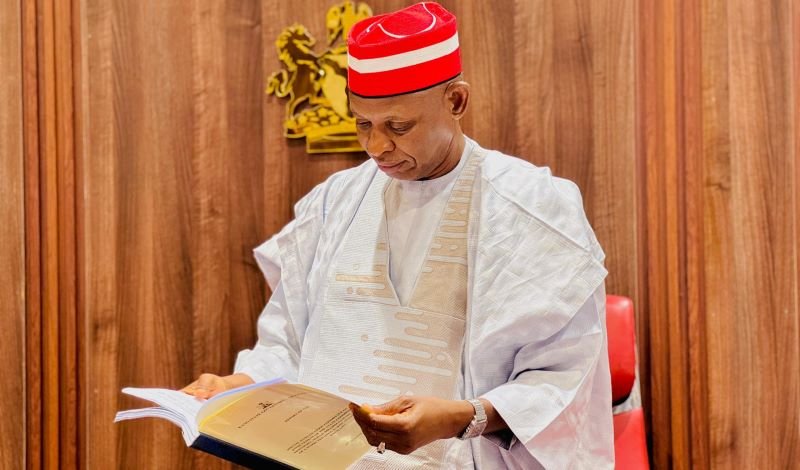
TWO years after Kano State Governor Abba Kabir Yusuf declared a state of emergency on education to rescue the sector from years of neglect, overcrowded classrooms, and an alarming out-of-school children crisis, the state’s latest Annual School Census has revealed that public primary schools are still battling a severe shortage of teachers, with one teacher handling as many as 105 pupils.
News Point Nigeria reports that the 2024/2025 Annual School Census (ASC), the latest official assessment of Kano’s education sector, showed that the pupil-teacher ratio in public pre-primary and primary schools stands at 105:1 far above both national and international standards, despite the government’s declaration of an education emergency, massive budgetary allocations, and thousands of teacher recruitments.

According to the report, junior secondary schools recorded a teacher-student ratio of 50:1, while senior secondary schools recorded 37 students per teacher.

The figures fall significantly short of recommended standards. According to the United Nations Educational, Scientific and Cultural Organisation (UNESCO), the ideal pupil-to-teacher ratio at the primary school level is 25 pupils to one teacher.


Nigeria’s National Policy on Education also prescribes a ratio of 1:25 for pre-primary education, 1:35 for primary schools, and 1:40 for secondary schools.
However, many public primary schools, particularly in densely populated urban centres, continue to operate far above these approved standards because of overcrowding and inadequate teaching personnel.
Although the school census report was released in December 2025, the Kano State Ministry of Education confirmed that it remains the latest official assessment of the state’s education sector.
The findings come amid an unprecedented enrolment of more than 5.6 million learners in public schools across Kano State.
According to the report, a total of 5,690,634 pupils and students were enrolled during the period under review.

The figure comprises 683,773 pupils in pre-primary schools, 4,034,744 in primary schools, 509,314 students in junior secondary schools, 412,518 in senior secondary schools, 31,236 learners in science and technical schools, and 19,049 participants in adult and non-formal education centres.
The report noted that the massive enrolment has placed enormous pressure on available teachers, classrooms, and other educational facilities, raising concerns about the quality of teaching and learning across public schools.
Classroom congestion remains another major concern.


According to the census, an average of 145 pupils share a classroom in public pre-primary and primary schools, while classroom ratios stand at 78:1 in junior secondary schools and 69:1 in senior secondary schools.
Sanitation facilities are equally overstretched.
The report showed that one toilet serves an average of 343 pupils in public pre-primary and primary schools, while the ratios stand at 122:1 in junior secondary schools and 73:1 in senior secondary schools.
The census covered all 7,331 public pre-primary and primary schools, 1,451 junior secondary schools, 800 senior secondary schools, 49 science and technical schools, and 63 adult and non-formal learning centres across Kano State.
Despite the infrastructure challenges, the report highlighted encouraging progress in school participation, especially among girls.
Girls accounted for 52 per cent of enrolment in both pre-primary and primary schools, 56 per cent in junior secondary schools, and 54 per cent in senior secondary schools.
At the primary level alone, total enrolment reached 4,034,744 pupils, including 2,095,761 girls, while junior secondary schools recorded 509,314 students, of whom 284,708 were female.
The report further revealed that Kano’s public education system is supported by 45,007 teachers across various levels, with the majority serving in pre-primary and primary schools.
The Annual School Census serves as a key education planning tool used by governments and development partners to assess enrolment trends, infrastructure needs, and resource gaps across the education sector.
The latest findings come almost two years after Governor Yusuf declared a state of emergency on education, citing the deplorable condition of schools and the growing number of out-of-school children.
Speaking during a ceremony at the Government House in Kano at the time, the governor said the extraordinary measure became necessary to tackle the decay in education quality and infrastructure.
“A state of emergency, as declared today, is an extraordinary legal measure that allows us to take some bold steps to address these critical challenges swiftly and effectively. It is a call to action for all stakeholders—government, educators, parents, the private sector and the community at large—to unite and prioritize the revitalization of our education system,” Yusuf had said.
He lamented that Kano had 989,234 out-of-school children, warning that the situation threatened to rob an entire generation of its right to education and a brighter future.
“Our beloved state is witnessing an alarming proliferation of out-of-school children, with the current figure standing at 989,234 children of both genders, a situation that threatens to rob an entire generation of their right to education and a brighter future,” the governor said.
“The statistics are grim, and the faces of these children, devoid of the promise of learning, haunt us as a collective failure.”
Governor Yusuf also painted a bleak picture of the condition of public schools.
“Our schools, which should be sanctuaries of knowledge, discipline and growth, are in a deplorable state. Dilapidated infrastructure is a common sight—roofs caving in, walls crumbling, and classrooms that can no longer provide a safe and conducive learning environment.”
“The lack of instructional materials further compounds the problem, leaving our teachers and students to struggle with outdated and insufficient resources.”
He further disclosed that more than 4.7 million pupils sat on bare floors to receive lessons, while about 400 schools had only one teacher handling all classes, subjects, and pupils.
“Despite the decay of the sector, our administration, since assuming office, has commenced the rehabilitation of schools and the provision of instructional materials to ensure effective service delivery,” he said.
As part of the emergency measures announced then, the governor approved the recruitment of an additional 10,000 teachers and pledged regular training and retraining programmes to achieve his vision of making “every teacher a caring educator.”
He also approved the employment of at least 1,000 academic and non-academic staff into tertiary institutions.
The governor further disclosed that his administration had paid the registration fees of all Kano indigenes studying in higher institutions across the country.
“We’ve set aside over N300 million to be disbursed to teachers as soft loans, geared towards boosting their morale for effective service delivery,” Yusuf said.
The Commissioner for Education at the time, Alhaji Umar Doguwa, also announced that the governor had approved the payment of NECO and NBAIS examination fees for more than 118,000 Kano indigene secondary school students sitting for their examinations.
Meanwhile, the current Commissioner for Education, Ali Haruna Makoda, acknowledged that significant challenges remain but insisted that the government has continued implementing major interventions to reverse years of neglect.
Speaking recently during the visit of the Minister of State for Education, Professor Suwaiba Sa’id Ahmad, to inspect AGILE projects in Kano, Makoda said contracts worth over N24 billion had been awarded for the construction of 49 new schools, while plans were underway to renovate 300 schools across all 484 wards in the state.
He recalled that the administration declared a state of emergency on education in 2023 because of years of neglect and dilapidated infrastructure.
According to him, education has consistently received the largest share of the state’s budget, 29.75 per cent in 2024, 31.5 per cent in 2025, and 30 per cent in 2026.
“Wherever you step in, you will definitely see our project,” Makoda said.
He disclosed that more than 2,500 classrooms have been renovated, while over 18,000 teachers have been recruited to close manpower gaps and correct staffing imbalances across schools.
Makoda added that under the state’s new teacher deployment policy, newly recruited teachers are expected to serve in their native communities to ensure that rural areas are not left behind.
Despite these interventions, the latest Annual School Census indicates that overcrowded classrooms, inadequate teaching personnel, and overstretched infrastructure remain major challenges confronting Kano’s public education system, underscoring the enormity of the task facing the government in its quest to transform the sector.