

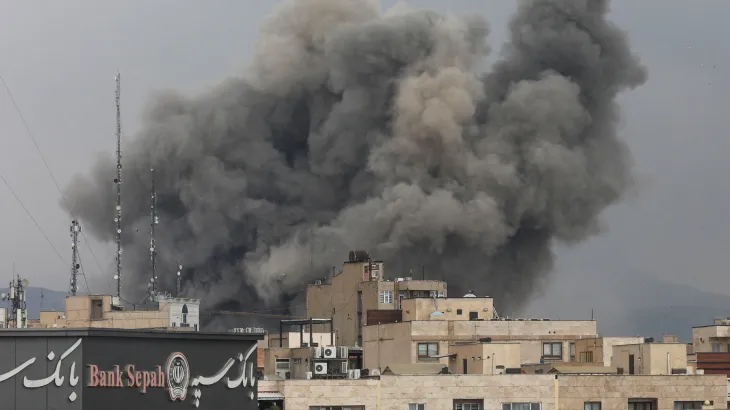
THE United States has carried out its 10th consecutive night of airstrikes against Iran, with explosions reported in Sirik, Bandar Abbas, Qeshm Island, Shiraz, Isfahan, Chabahar and Konarak, as tensions across the Middle East continue to escalate.

The renewed bombardment came amid retaliatory attacks by Iran, fresh threats from US President Donald Trump and a maritime blockade declaration by Yemen’s Iran-backed Houthi rebels against Saudi Arabia, raising fears of a wider regional conflict and further disruptions to global energy supplies.

The US Central Command (CENTCOM) announced on Monday evening that the latest operation was aimed at further weakening Iranian military capabilities allegedly being used to attack commercial shipping in the Strait of Hormuz.


According to CENTCOM, the strikes concluded at about 9 p.m. Eastern Time (0100 GMT) after American forces targeted Iranian military command centres, maritime assets, missile and drone launch facilities, as well as air defence systems.
Iranian media reported multiple explosions across strategic locations, including Sirik, Bandar Abbas, Qeshm Island, Shiraz and Isfahan, marking the 10th straight night of military action by Washington against Tehran.
In response, the Islamic Revolutionary Guard Corps (IRGC) claimed responsibility for attacks on American military assets in Kuwait, saying it struck US HIMARS missile systems, radar installations, satellite receivers, a telecommunications centre and hangars housing MQ-9 drones at various locations.
The IRGC also announced that it had destroyed a radar installation and American air defence systems in Bahrain as part of its retaliatory operations against the United States and its allies in the Gulf region.
The conflict has increasingly threatened maritime activities in one of the world’s most critical oil routes. Earlier on Monday, two Greek-owned oil tankers were reportedly hit in the Strait of Hormuz, while the United Kingdom Maritime Trade Operations disclosed that another tanker was struck near Oman’s port city of Limah, forcing crew members to abandon the vessel.
Early on Tuesday, the IRGC claimed that two additional oil tankers attempting to navigate what it described as the “unsafe southern route” through the Strait of Hormuz suffered explosions and “massive fires.”

Shortly before the latest bombing campaign commenced, President Donald Trump issued a stern warning to Iran on social media, declaring that Tehran would pay “many times over” for attacks that resulted in the deaths of American soldiers.
Trump’s remarks followed a week in which at least three US military personnel were killed. Two soldiers lost their lives and another was reported missing after an Iranian missile struck a military installation in Jordan on Friday, while another service member was killed in northern Iraq.
The US president also repeated earlier warnings that any continued Iranian attacks on commercial vessels in the Strait of Hormuz would provoke an even stronger American response.


Meanwhile, opposition to the military campaign has begun to emerge within the United States. Senate Minority Leader Chuck Schumer called for an end to hostilities, vowing that Democratic lawmakers would compel Republicans to vote on measures aimed at halting military operations.
In a post on X, Schumer said, “Every second Trump prolongs his war in Iran is another second our service members remain in danger.”
He added that Senate Democrats would “force Senate Republicans to take another vote to end this war and bring our troops home.”
Despite the continued hostilities, the White House disclosed in a statement that diplomatic contacts between Washington and Tehran remain ongoing. However, it stressed that military operations against Iran would continue until President Trump decides otherwise.
The regional crisis widened further after Yemen’s pro-Iranian Houthi movement announced a maritime blockade against Saudi Arabia, threatening to disrupt shipping routes in the Red Sea and potentially reignite the Yemeni conflict, which had remained relatively subdued for the past four years.
The Houthis’ declaration has heightened concerns among global energy markets, with analysts warning that prolonged instability in the Gulf and Red Sea corridors could significantly impact international oil supplies and maritime trade.