

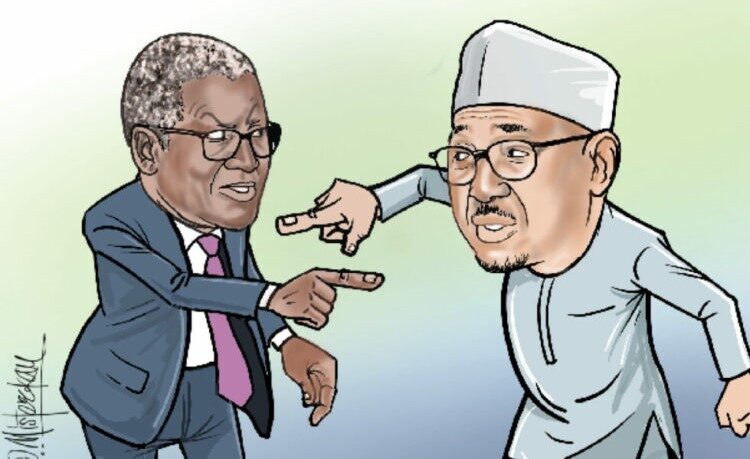
THIS week, Nigeria witnessed a moment that crystallised public frustration, elite rivalry and institutional anxiety into a single, explosive narrative. As chronicled by News Point Nigeria, the confrontation between Aliko Dangote and a senior oil regulator, Engr Farouk Ahmed was less about two individuals and more about the soul of governance in a high-stakes sector.
For years, Nigerians have complained about opaque regulation, unaccountable officials and a system that appears to reward privilege while demanding sacrifice from ordinary citizens. Those grievances found an unexpected outlet when Africa’s richest man publicly accused the Chief Executive Officer of the Nigerian Midstream and Downstream Petroleum Regulatory Authority (NMDPRA), Engr. Farouk of corruption.
The allegation was delivered not in a courtroom or through anonymous leaks, but in broad daylight at a refinery briefing in Lekki, Lagos. Dangote claimed that Ahmed spent millions of dollars on the secondary education of his children in Switzerland, a charge that immediately resonated with a public already primed to question how public servants live far beyond visible means.


What followed was a cascade of reactions: petitions to anti-graft agencies, counter-narratives, regulatory scrutiny and, eventually, a resignation that underscored the volatility of power when public perception turns hostile.
Standing before journalists, Dangote questioned how a career public servant could afford such an expensive lifestyle without raising red flags and further framed the allegation not merely as a personal grievance but as a matter of public trust, accountability, and institutional integrity.
“I’ve had people actually complaining about a regulator who put his children in secondary school, and that secondary school education, which is six years, four of them cost Nigeria five million dollars,” Dangote said. He contrasted this with his own choices, noting that his children attended secondary school in Nigeria.
For Dangote, the issue went beyond schooling. It touched on the social contract between the state and taxpayers. He spoke as a businessman who pays substantial taxes and expects that public funds are used responsibly, not siphoned away through what he suggested were unexplained personal expenditures.
Within days, the comments ignited fierce public debate. But Dangote was only getting started.
A few days later, in a paid advertorial published in national newspapers, the billionaire industrialist doubled down, releasing more detailed claims to support his allegations. This time, names were mentioned, schools were listed, and a clearer picture was painted of what Dangote alleged was a lifestyle far removed from the earnings of a public official.

He named four children; Faisal Farouk, Farouk Jr., Ashraf Farouk, and Farhana Farouk and claimed they attended some of Switzerland’s most elite boarding schools, including Montreux School, Aiglon College, Institut Le Rosey, and La Garenne International School. Dangote outlined what he described as estimated costs covering tuition, accommodation, upkeep, and travel over several years.
The advertorial did not just accuse; it sought to persuade. Dangote argued that the figures raised fundamental questions about income declaration, conflicts of interest, and the credibility of regulatory oversight in a sector already fraught with suspicion and opacity.
Soon after, the confrontation moved from the pages of newspapers to the desks of investigators.


On December 16, Dangote formally petitioned the Independent Corrupt Practices and Other Related Offences Commission (ICPC), demanding the arrest, investigation, and prosecution of Ahmed. In the petition, obtained by News Point Nigeria, Dangote alleged that the NMDPRA chief had lived far beyond his lawful means, spending millions of dollars on his children’s education without evidence of legitimate income to support such expenditure.
The petition went further, accusing Ahmed of using the instrumentality of the NMDPRA to divert public funds for private gain claims Dangote said had already triggered public anger and protests by various groups. He argued that throughout Ahmed’s adult life, his work had been confined to the public sector, making the alleged spending even more difficult to justify.
Dangote invoked provisions of the ICPC Act, insisting that the allegations amounted to abuse of office, corrupt enrichment, and embezzlement offences punishable under Nigerian law.
He urged the commission to act decisively, not only to ensure justice but also to protect the image of President Bola Tinubu’s administration.
Notably, Dangote pledged to personally provide evidence to back up his claims.
The ICPC responded swiftly. Within hours of receiving the petition, the anti-graft agency acknowledged it publicly, confirming that it would investigate the allegations against the NMDPRA chief. For many observers, the speed of the response underscored the gravity of the claims and the prominence of the petitioner.
As the investigation loomed, confusion briefly reigned online. A statement purportedly signed by Ahmed circulated on social media, attempting to rebut Dangote’s allegations. But late on Wednesday, Ahmed distanced himself from the document in a terse message made available to News Point Nigeria, denying that he had authorised or issued any public response.
That denial only deepened the intrigue.
Then came another twist. The Dangote Group released a fresh statement alleging that Ahmed was also under scrutiny for plans to approve the payment of massive outstanding “bridging claims” to oil marketers claims dating back several years. Bridging claims, meant to reimburse marketers for transporting fuel across regions, have long been controversial, with critics arguing they are riddled with inconsistencies and poor verification.
By midweek, the drama reached its climax.
Farouk Ahmed resigned as Chief Executive Officer of the NMDPRA. Presidential spokesman Bayo Onanuga confirmed the development in a statement sent to News Point Nigeria, adding that President Tinubu had forwarded new nominees to the Senate to replace both Ahmed and the head of the upstream regulator.
Hours before his resignation, Ahmed had paid a quiet visit to the Presidential Villa. He stayed briefly, declined to speak to journalists, and left without explanation. By nightfall, his exit from office was official.
Behind the scenes, the stakes were enormous. Dangote’s refinery represents one of the largest private investments in Africa, and sources close to the billionaire told News Point Nigeria that he believed regulatory actions were being used to undermine that investment. Initially, Dangote chose restraint, stepping back to gather information rather than escalate publicly.
When he returned to the fight, it was with precision.
According to another source close to the billionaire, Dangote engaged international investigators from US to trace the backgrounds and dealings of those he believed were obstructing his business.
‘Had the President not compelled Farouk to resign, the damaging information Dangote was prepared to release could have ruined Farouk and seriously damagd his family beyond repair, particularly on a personal level”, the source told this newspaper.
The implication was clear: the confrontation could have gone much further, with devastating personal consequences, had it not ended when it did.
Veteran journalist, Editor-In-Chief of LEADERSHIP and author of the new book A Midlifer’s Guide to Content Creation and Profit, Azubuike Ishiekwene captured the moment in his weekly column, describing the clash as one of the most spectacular battles Africa’s wealthiest man has fought in recent years. He suggested that Ahmed’s resignation might be a pause rather than a conclusion, given the depth of the issues raised.
For Ishiekwene, the episode marked a rare instance of Dangote shaking the table publicly challenging a regulator and framing the fight as one not just for his business, but for the country.
As the dust settles, Nigeria is left with lingering questions: about regulation, accountability, power, and the uneasy relationship between big capital and public institutions. Whether the ICPC probe will bring clarity or merely deepen the controversy remains to be seen.
What is certain is that the events of the past week have redrawn the lines of engagement and reminded the nation that even in systems accustomed to silence, some battles eventually spill into the open.